





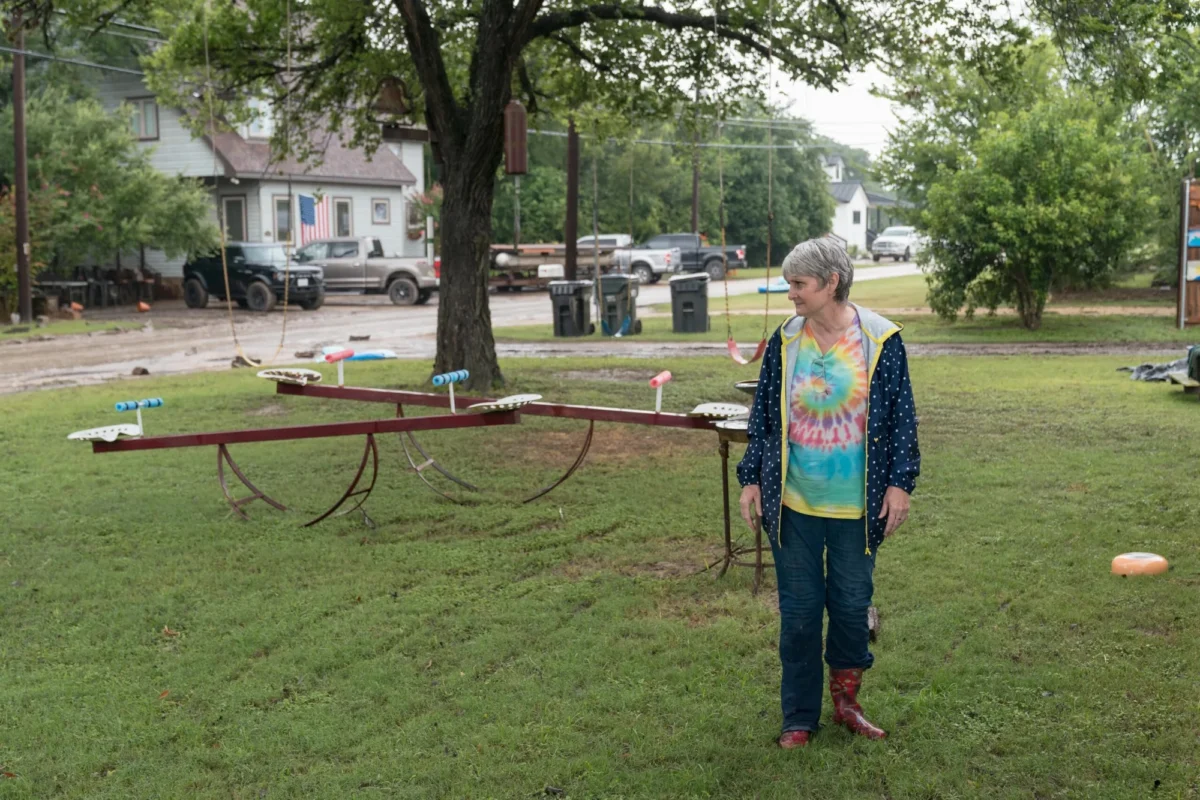
KERRVILLE, Texas — The silence that followed the retreat of the floodwaters on Thursday was perhaps more haunting than the roar of the rivers that preceded it. For the residents of the Texas Hill Country, the events of the early morning hours felt like a cruel, cinematic re-run of a tragedy they had only just begun to process.
Standing on the patio of the Calvary Temple Church in Kerrville, Soyla Reyna took a ragged breath. For hours, she had served as a primary point of contact for the displaced, coordinating supplies and offering sanctuary to those who had once again lost everything. As the relentless rain finally tapered off, she looked toward the horizon with a weary expression.
“A lot of it was unbelievable,” Reyna said. “People are devastated by the reoccurrence. It is a psychological weight that many are simply not prepared to carry again.”
By midday Thursday, nearly 50 people had sought refuge at Calvary Temple, carrying little more than the clothes on their backs. They were survivors of a nightmare that has become an unwelcome hallmark of life in this region—a recurring, violent deluge that has shattered the illusion of the "once-in-a-century" storm.
The Night of Terror: A Chronology of the Deluge
The tragedy of the 2026 floods is inextricably linked to the trauma of July 2025, a disaster that claimed 119 lives in Kerr County and left an indelible scar on the landscape. For many, the panic began at 5:15 a.m. on Thursday, when the dark stillness of the morning was punctured by the realization that the rivers were rising—not just with rain, but with a terrifying, familiar momentum.
Sherri Steadham, a resident of Center Point, was awoken by a neighbor who lives closer to the riverbank. That neighbor’s home had already taken on four inches of water. "When it happened last year, we thought, ‘Oh my God, it’s never happened before, so maybe it won’t happen again in our lifetime,’" Steadham said. "And here we are, a year and a few days later."
While the 2025 flood was marked by a sudden, violent "wall of water" that caught residents in their sleep, Thursday’s event unfolded as a "slow creep." However, the lack of immediate velocity did not mitigate the sheer scale of the destruction. As the morning progressed, the Guadalupe River in Comfort reached a staggering 37 feet, while the Pedernales River in Fredericksburg surged to 34 feet.
By midday, the scenes of devastation were eerily similar to the previous year: fences draped in tangled debris, vehicles tossed like toys into fields, and dark, oily water lines marking the lower third of residential walls. The community response, however, was also familiar. Neighbors, acting on the instincts forged in the fires of the 2025 crisis, immediately coalesced to begin the cleanup, offering hot meals and warm clothes to those who had been forced from their RVs and homes.
Supporting Data: When Records Become the New Normal
The hydrology of the Hill Country is shifting, and the data suggests that the baseline for "normal" is moving into dangerous territory. Last year, the Guadalupe River in Hunt hit a record-breaking 37.5 feet on July 4. While Thursday’s levels were slightly below that mark in some areas, the cumulative impact of two major floods in 13 months has decimated local infrastructure.
In Center Point, the local Fire Department—which had undergone extensive post-2025 renovations—found its new facilities all but destroyed by the latest surge. In Burmenthal, the destruction was similarly absolute. Russell Studebaker, a local peach farmer with 32 years of history on the land, watched in disbelief as the river backed up into his creek—a phenomenon he had never witnessed in three decades.
"This is the highest I’ve ever seen it in 32 years," Studebaker said, gesturing toward the swamped low-water crossings that had been swallowed by the Pedernales. "It’s backing up into our place across the road. It’s backing up into our creek. I’ve never seen it back up into there."
The persistent nature of these floods has challenged the meteorological models that once dictated regional planning. What were previously categorized as statistical outliers are now occurring with a frequency that suggests a fundamental change in regional weather patterns, leaving long-time residents to question the future viability of their homes along the river corridors.
Official Responses and the Evolution of Readiness
If there is a silver lining to be found in the tragedy, it lies in the region’s emergency response infrastructure. The failures of the local government during the 2025 flood—which saw residents blindsided by a lack of warnings—were met with a rigorous overhaul of emergency protocols.
Maria Flemming, a neighbor of the Steadhams, noted a stark difference in communication this year. Starting as early as 1:30 a.m., she received a steady stream of warnings. Even when the flood was at its peak, first responders were on the ground, actively checking on residents and urging them to evacuate.
Razor Dobbs, a volunteer firefighter with the Center Point Fire Department, represents the frontline of this increased readiness. Having witnessed the harrowing scenes of 2025, Dobbs noted that the psychological toll on responders is just as heavy as it is on the residents. "When that rain’s hitting really hard, and you hear it pounding, you can see the look on their faces," Dobbs said. "You can see the look on their faces, this is it."
However, unlike the previous year, the department was equipped with the tools to handle the crisis. Following the 2025 disaster, the department received significant funding, which allowed for the acquisition of specialized water-rescue boats and intensive training for volunteers.
"Last night, and the night before, we manned everything," Dobbs said with a mix of pride and exhaustion. "After last year, we got a lot of funding. We invested in the boats and the training, and we got rock solid."
The Human Toll and Future Implications
Despite the improved response, the loss of life remains the most sobering metric of the event. As of Thursday evening, at least two deaths had been confirmed. For the families of the deceased and the hundreds of displaced residents, the resilience of the community offers little solace against the reality of a home lost to the river.
The implications for the Hill Country are profound. Insurance premiums in the region are expected to skyrocket, if coverage remains available at all. Local zoning boards will face immense pressure to restrict building in floodplains, a move that will likely pit property rights against the necessity of public safety.
Furthermore, the "once-in-a-century" myth has been thoroughly dismantled. Residents are now forced to confront the reality that the rivers that provide the lifeblood and beauty of the Hill Country can, with little warning, become instruments of total destruction.
As the sun set on Thursday, the waters began to recede, revealing the grim scope of the wreckage. Neighbors continued to help neighbors, pulling silt-covered belongings from the mud. It was an act of communal defiance, a refusal to let the river define the future of their town. But as Soyla Reyna noted earlier in the day, the "reoccurrence" has changed the character of the region. The trauma of the night is not easily washed away, and for those who stood on their porches looking at the high-water marks, the question is no longer if the river will rise again, but when.
The Hill Country has proven its ability to respond, to organize, and to survive. But as the cleanup begins for the second time in two years, the fundamental question remains: can a community thrive when its very foundation is built on such unstable, rising ground? The answer, for now, is being written in the mud and the debris, one bucket and one boat rescue at a time.
