





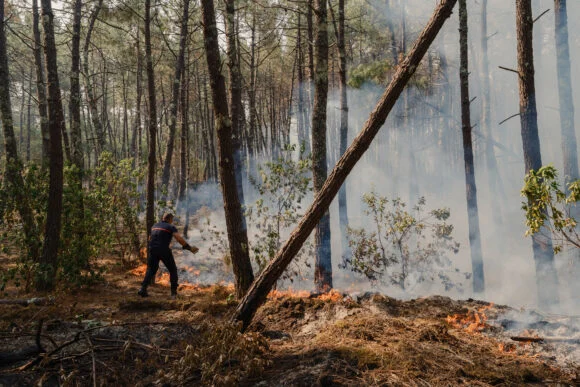
Europe is currently grappling with a landscape transformed by fire. As unprecedented infernos consume vast swathes of land near iconic cities like Bordeaux and Madrid, a new report from the World Weather Attribution (WWA) group has provided a stark, scientific link between these disasters and human-induced climate change. The findings suggest that the extreme weather conditions fueling these blazes are no longer "freak occurrences," but rather a recurring feature of a warming world.
The Scientific Consensus: A New Normal
Scientists at the World Weather Attribution group concluded this Friday that climate change has acted as a powerful force multiplier for Europe’s recent wildfires. By comparing historical summer weather patterns to the conditions observed this year, researchers determined that the climate is now approximately 1.4°C warmer than in the pre-industrial era. This elevation in global temperature has amplified the likelihood of the volatile "triad" of wildfire conditions: extreme heat, low humidity, and high winds.
According to the study, these conditions are now at least twice as likely to occur in France and a staggering 20 times more likely in Spain compared to a world without human-induced warming.
"Climate change means that the right combination of weather conditions that create a tinderbox and turn it into a disaster happens much more often," said Friederike Otto, a professor of climate science at the Centre for Environmental Policy at Imperial College London and a co-author of the study.
Chronology of the Crisis
The current wildfire season did not emerge in a vacuum; it is the culmination of a sequence of environmental factors that began months ago.
The Winter Catalyst
Paradoxically, the foundation for this summer’s devastation was laid during a wet winter. Increased rainfall led to a surge in vegetation growth across southwestern Europe. While this lush greenery initially appeared benign, it acted as a "fuel load." When record-breaking heat waves arrived in June and July, this dense, overgrown vegetation dried out rapidly, turning forests and shrublands into massive stores of combustible material.
July 2026: The Breaking Point
By late July, the situation reached a boiling point. In France, fires broke out near Saumos on July 22, spreading with terrifying speed. By July 29, the fires had consumed approximately 42,000 hectares (104,000 acres) in the Gironde region. The scale of the destruction prompted the evacuation of some 220,000 people across 23 communes.
Similar scenes played out across the border in Spain, where fires near Madrid forced thousands from their homes. As the heat wave persisted, the crisis expanded, with new outbreaks reported in England and Greece, signaling that the threat was not localized to a single region but was a continent-wide emergency.
Supporting Data: Frequency and Probability
The WWA study offers a sobering projection for the future of European landscapes. Based on current atmospheric data, the weather conditions underlying such intense wildfires can now be expected to occur every 20 years in southwestern France and every six years in central Spain.
These intervals represent a significant increase in frequency compared to the pre-industrial baseline. The data underscores a shift from "exceptional" weather events to "frequent" ones, placing immense pressure on regional emergency services and civil protection agencies that are accustomed to fighting fires under less severe conditions.
Expert Perspectives and Nuance
While the link between climate change and fire weather is now robustly established, experts caution that the "cocktail" of disaster includes multiple ingredients.
Imma Oliveras Menor, a senior researcher at the University of Oxford, emphasized that while the WWA study provides vital evidence, it does not account for specific land management practices. Historical policies—such as fire suppression that allows brush to accumulate or the abandonment of rural agricultural land—can exacerbate fire risks. However, Dr. Menor acknowledged the gravity of the findings, noting that "it shows that climate change is here and part of the cocktail that is causing these extreme wildfires."
The consensus among the scientific community is that while land management is a secondary factor, the intensity and frequency of the fires are undeniably driven by the shifting climate.
Economic and Societal Implications
The human cost of these fires is immense, with hundreds of thousands displaced and livelihoods destroyed in the Gironde region and beyond. However, the economic fallout is only beginning to be calculated.
Insurance and Financial Risks
The insurance industry is currently in a state of high alert. As reported by Insurance Journal, insurers are now "actively evaluating" new catastrophe risks. The traditional models used to calculate premiums and risk exposure are being rendered obsolete by the speed of climate change. If wildfires that were once expected every 50 years now occur every six, the insurance sector must fundamentally rethink how it underwrites property in vulnerable regions. This could lead to a massive increase in premiums or, in extreme cases, the withdrawal of coverage from fire-prone areas, leaving homeowners and businesses exposed.
Infrastructure and Urban Planning
The fires have demonstrated that urban centers—even those not located in traditional "wildland-urban interfaces"—are increasingly vulnerable. The need for better urban planning, fire-resistant construction materials, and improved forest management is no longer a matter of policy preference; it is a matter of public safety. Cities like Bordeaux and Madrid must now integrate wildfire defense into their long-term urban development strategies.
The Path Forward: Mitigation and Adaptation
The fires of 2026 serve as a visceral warning. The strategies employed to date—primarily reactive fire suppression—are proving insufficient in the face of climate-driven infernos.
Adaptation Strategies
- Managed Landscapes: Moving away from total fire suppression to "prescribed burning" to reduce fuel loads.
- Early Warning Systems: Utilizing AI-driven satellite imagery to detect fire starts in real-time, allowing for rapid intervention before conditions turn the flame into a firestorm.
- Resilient Architecture: Retrofitting existing structures and mandating fire-proof designs for new construction in at-risk zones.
The Mitigation Imperative
Ultimately, experts agree that adaptation can only go so far. Without a significant reduction in global greenhouse gas emissions, the 1.4°C of warming will continue to climb, pushing the climate toward even more extreme thresholds. The 2026 wildfire season is not an anomaly; it is a preview of a future where Europe’s landscapes may permanently change.
As the smoke begins to clear over the scorched forests of France and Spain, the conversation is shifting from "if" this will happen again to "when." The science is clear: the tinderbox has been set, and without global action, the match will continue to be struck with terrifying regularity.
Photograph: A firefighter inspects a fire which has flared up again in the forest during wildfires at Lège-Cap Ferret, France, on Wednesday, July 29, 2026. Wildfires that began near Saumos on July 22 have burned about 42,000 hectares (104,000 acres) and forced the evacuation of some 220,000 people from 23 communes in the Gironde.
Copyright 2026 Bloomberg.
