





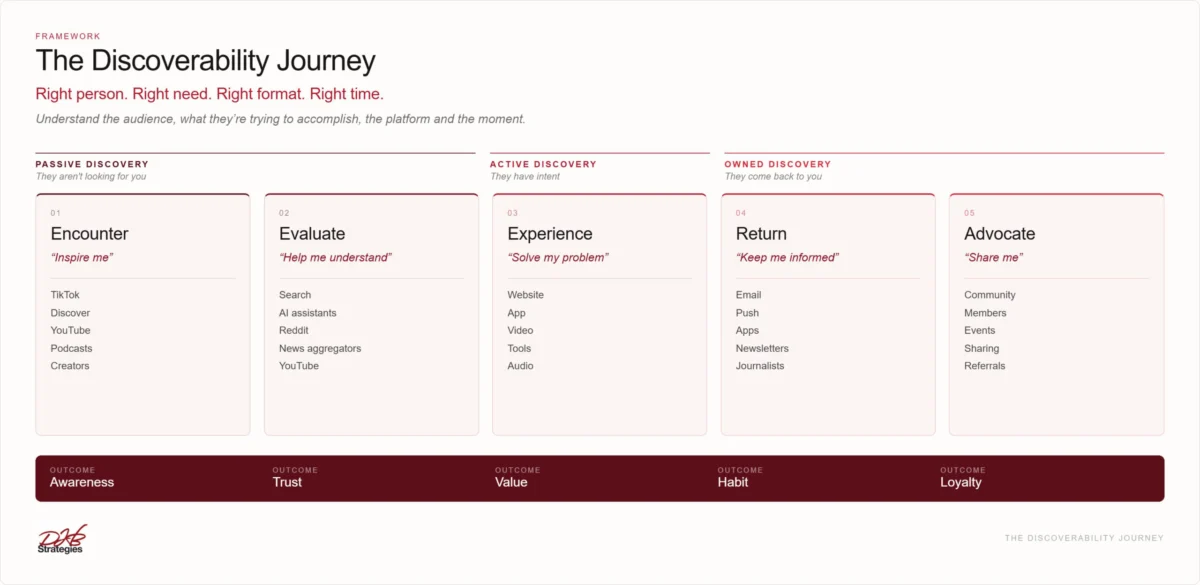
The digital landscape has undergone a seismic shift. For years, the SEO playbook was dominated by the pursuit of rankings on a single, centralized engine. Today, that paradigm is obsolete. Discoverability is now a fragmented, multi-surface journey where passive, off-platform discovery often dictates the user’s initial interest before they ever reach a brand’s "home"—the website.

As SEO transitions into a discipline more akin to feed management—a concept championed by industry leaders like Chris Green—publishers must pivot. While Google still facilitates over a trillion clicks annually, the reality is that up to 86% of user journeys are now discovery-led. Your website remains your most critical asset, but its role has evolved from a simple search destination to a foundational entity that must be crawled, rendered, indexed, and cited across a complex ecosystem of answer engines, social surfaces, and recommendation feeds.

The Governing Questions of Modern Auditing
Despite the complexity of AI-driven search and social discovery, the core tenets of an SEO audit remain surprisingly consistent. The fundamental questions—Can the site be reached? Is it understood? Is it linked? Is it served?—have not changed; rather, the stakes for answering them have.

An audit in 2026 is no longer just about ranking; it is about establishing whether a brand is retrievable, resolvable, and citeable by both human users and the growing legion of AI agents. Success now requires a discoverability-led approach that bridges the gap between Googlebot, large language model (LLM) crawlers, and social discovery algorithms.

Technical SEO: The Bedrock of Reachability
Technical excellence raises the "ceiling" of what a publisher can achieve. Excellent content, no matter how insightful, will be suppressed if a website is slow, inefficient, or structurally incoherent.

The Four Pillars of Technical Audits
- Reached: Can bots access your content? This involves managing crawl budgets and ensuring your site doesn’t waste resources on redundant pages, such as temporary 302 redirects or irrelevant file types.
- Understood: This is where semantic HTML becomes paramount. Tags like
<article>,<nav>, and<section>are not merely decorative; they express intent and hierarchy. Using "div soup" (relying on generic<div>tags for structure) is a critical failure that hampers machine comprehension. - Linked: Internal linking is the nervous system of a publisher site. It is impossible to audit every link on an enterprise-scale site, but you can set processes to ensure news content distributes equity to evergreen and topic-specific pages effectively.
- Served: Speed is the final gatekeeper. Using field data from the Chrome User Experience Report (CrUX) and lab data from Lighthouse, publishers must optimize for the majority of their user base. A site that takes too long to load is a site that bots and users abandon.
Content Strategy: Value Over Volume
The era of creating content solely for search volume is over. In 2026, content must be unique, authoritative, and deeply aligned with audience needs.

Measurement at Scale
Content popularity is measurable through organic traffic, branded search, and engagement metrics. By using tools that facilitate "query counting," publishers can identify patterns in how search engines evaluate their site over time. If a site is losing queries in the top-ranking positions (1–3 or 4–10), it is a clear signal that content decay is occurring or that the site’s authority is shifting.

The "Golden Hour" of News
For publishers, the "Golden Hour"—the window immediately following publication—is critical. To win in Top Stories, amplification is non-negotiable. Content must be pushed through newsletters, social channels, and the homepage immediately to outperform expected engagement metrics. If a news article isn’t indexed or picked up by the time the event it covers is over, the content has failed its purpose.

E-E-A-T: The Qualitative Standard
Experience, Expertise, Authoritativeness, and Trustworthiness (E-E-A-T) are not formal ranking factors, but they are the qualitative benchmarks that define a site’s survival.

According to the Reuters Digital News Report, trust in news is at an all-time low. Therefore, E-E-A-T is not just for SEO—it is a brand survival strategy. A robust E-E-A-T audit must encompass:

- Sitewide Trust: Are help centers and contact pages prominent?
- Desk-Level Authority: Are individual journalists and editors positioned as experts with clear biographies and social presence?
- Off-Site Presence: A brand with a robust review profile (e.g., Trustpilot) sees exponentially higher citation rates by AI than those without. Mentions are the new currency of the web.
Entity Consistency: Resolving the Brand Identity
Entity SEO has evolved from a niche concept to a necessity. Your brand must be recognized as a distinct entity by search engines. This is achieved through:

- On-Site Schema: Using
Organizationschema,sameAsproperties, andalternateNameto tie your various digital footprints (Wikipedia, social channels, etc.) to one canonical identity. - Owned Properties: Creating a master inventory of every platform where your brand exists. NAP (Name, Address, Phone) consistency is as vital here as it is in local SEO.
- Earned Mentions: While you cannot control everything said about you, you can focus on high-impact publications and authoritative citations that influence human decision-making.
Implications: The Road Ahead
The shift toward a "zero-click" and AI-assisted search environment is not a death knell for publishers; it is a call to professionalize. The most successful publishers of 2026 will be those who stop viewing their website as a siloed traffic source and start viewing it as a comprehensive knowledge base.

By focusing on "scale x impact x effort," SEOs can move away from chasing every minor technical bug and instead focus on initiatives that align with business goals—whether that is increasing Average Revenue Per User (ARPU), driving subscriptions, or securing affiliate revenue.

Ultimately, knowing what not to fix is as important as knowing what to fix. The audit of the future is a selective, high-impact exercise that favors architectural stability, entity resolution, and undeniable content quality. In a world where AI can synthesize information, the primary value of a publisher is to be the source of truth that the AI cites, rather than the commodity that the AI replaces.
