





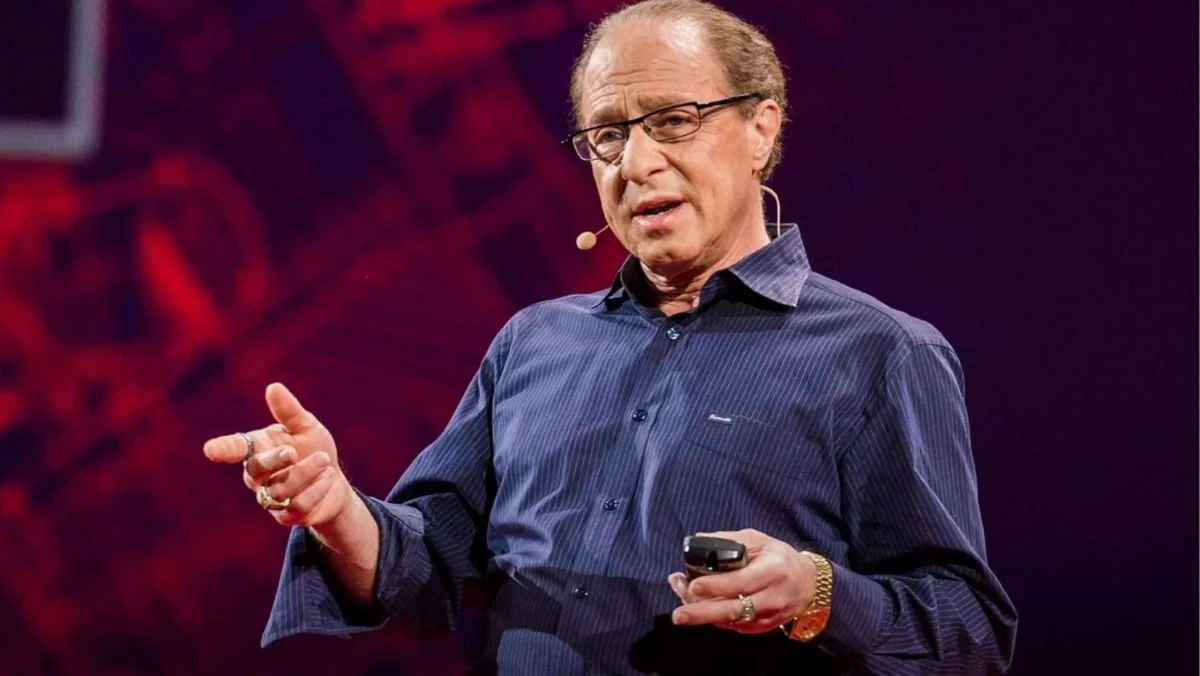
In the high-stakes theater of modern technology, few figures command as much reverence—or controversy—as Ray Kurzweil. As a futurist and principal researcher at Google, Kurzweil has spent decades mapping the trajectory of artificial intelligence, famously predicting that the "singularity"—the point at which machine intelligence surpasses human capability—is not a matter of "if," but "when." For Kurzweil, the math is binary: exponential growth in computing power guarantees a future where biology and machine become indistinguishable.
However, a growing chorus of venture capitalists and industry analysts is beginning to challenge this deterministic view. Among the most vocal is Will Richardson, Managing Partner at Giant Leap, Australia’s premier impact-driven venture firm. Richardson argues that while Kurzweil is a master of tracking silicon-based progress, he consistently underestimates the friction of the human element. In the race to build a super-intelligent future, the "AI curve" is only half the story; the other half is a complex, often messy, landscape of regulation, societal trust, and adoption inertia.
The Chronology of an Exponential Dream
To understand the current discourse, one must look at the timeline Kurzweil has laid out. His career has been defined by his "Law of Accelerating Returns," which posits that technological change is exponential, not linear.
- The Early Years (1990s): Kurzweil accurately predicted the rise of the internet, the ubiquity of mobile devices, and the eventual defeat of chess grandmasters by AI. His track record for predicting hardware-based milestones is arguably unmatched.
- The 2010s: The Deep Learning Boom: As neural networks began to show promise in image recognition and language processing, the mainstream began to catch up to Kurzweil’s timeline.
- The 2020s: The Generative Pivot: With the release of Large Language Models (LLMs) like GPT-4, the "singularity" moved from the realm of science fiction into the boardroom.
- The 2030 Horizon: Current discourse is dominated by the question of whether AGI (Artificial General Intelligence) will emerge by 2030. While tech evangelists point to the current trajectory of compute power, skeptics like Richardson argue that the "adoption curve" is currently hitting a series of speed bumps that silicon metrics cannot account for.
Supporting Data: The Disconnect Between Power and Adoption
The central tension in the current AI debate lies in the divergence between technological capability and economic implementation.
Data from the startup sector reveals a curious paradox. While capital flowing into AI infrastructure—GPUs, data centers, and specialized chips—has reached record highs, the "application layer" is struggling to find mass-market utility. A report by Giant Leap suggests that for every dollar spent on raw computing power, there is a diminishing return on human-centric integration.
"Forecasting often fails because nothing moves on its own," Richardson notes. "We are obsessing over the capacity of the machine while ignoring the capacity of the system—our legal frameworks, our ethical standards, and the basic psychology of human trust—to accommodate that machine."
When we analyze historical technological revolutions, such as the industrial revolution or the dawn of the internet, the lag between invention and societal integration was significant. For AI, that lag is currently being exacerbated by three distinct factors:
- Regulatory Entropy: Unlike the relatively unregulated growth of the early web, AI is being greeted by a global patchwork of legislative efforts—from the EU’s AI Act to various state-level proposals in the US.
- The Trust Deficit: High-profile cases of AI hallucinations, deepfakes, and data privacy breaches have eroded public trust.
- The "Implementation Gap": Most enterprises are currently stuck in the pilot phase, unable to effectively bridge the gap between a chatbot prototype and a mission-critical workflow that actually displaces legacy systems.
Official Responses and the Industry Divide
The industry is currently split into two camps: the "Accelerationists" and the "Pragmatists."
The Accelerationists, often aligned with the ethos of Silicon Valley’s largest incumbents, argue that any pause in development is a surrender to geopolitical rivals. They maintain that the singularity is a natural evolutionary step and that regulatory hurdles are merely "bugs" in the system to be patched.
Conversely, the Pragmatists—including figures like Richardson—argue that the "human variable" is not a bug; it is the operating environment. They contend that if an AI system cannot be understood, trusted, or legally reconciled with human rights, it is effectively non-functional, regardless of how many trillion parameters it possesses.
"We are seeing a bubble in the promise of AI," says a senior analyst at a prominent venture firm. "Investors are pricing in a future where AI handles everything, but they are failing to price in the massive costs of the transition. The cost of labor disputes, the cost of regulatory compliance, and the cost of replacing human-in-the-loop oversight are being treated as externalities when they should be at the center of the valuation model."
The Implications: Why the "Human Variable" Matters
If we accept that Kurzweil is right about the silicon but wrong about the humans, the implications for the next decade are profound.
1. A Shift in Venture Capital Strategy
Investors are beginning to pivot away from "General Intelligence" plays toward "Niche Utility" plays. The startups that will survive are those that solve specific, human-centric problems—such as climate modeling, health diagnostics, or personalized education—rather than those attempting to build a god-like entity that solves everything.
2. The Rise of "Human-Centric AI"
The future of the industry will likely be defined by "Human-in-the-loop" (HITL) designs. This ensures that the machine remains a tool rather than a sovereign agent. Companies that prioritize transparency and "explainability" in their AI models are likely to gain higher market share as institutional trust becomes a premium commodity.
3. The Regulatory Reckoning
We are moving toward a period of "Institutional AI," where the most successful technologies will be those that are "born compliant." The friction caused by regulation will act as a filter, favoring established players with the legal bandwidth to navigate complex environments, potentially stifling the "move fast and break things" startup culture that defined the last decade.
4. The Revaluation of Human Skills
As AI commoditizes cognitive tasks, the economic value of uniquely human skills—empathy, complex ethics, cross-disciplinary judgment, and physical dexterity—is poised for a massive rebound. We may be entering an era where the most valuable "algorithm" is the one that knows when to ignore the computer.
Conclusion: Balancing the Curve
Ray Kurzweil’s projections remain an essential framework for understanding the potential of the hardware that underpins our future. However, Will Richardson’s critique serves as a necessary corrective. The path to the future is not a straight line drawn by Moore’s Law; it is a winding, contested, and fundamentally human path.
To navigate the coming decade, we must stop viewing the human element as a secondary consideration or an "adoption drag." Instead, we must recognize that the most significant technological challenge of our time is not making computers smarter, but making our societies resilient enough to integrate that intelligence. The winners of the next decade will not be those who bet blindly on the AI curve; they will be the ones who successfully price in the complexity of the human experience.
In the final analysis, the singularity may indeed arrive. But until it does, we are still living in a world defined by people, politics, and the slow, necessary work of building trust. Kurzweil may have nailed the silicon, but the human story remains unwritten.
