





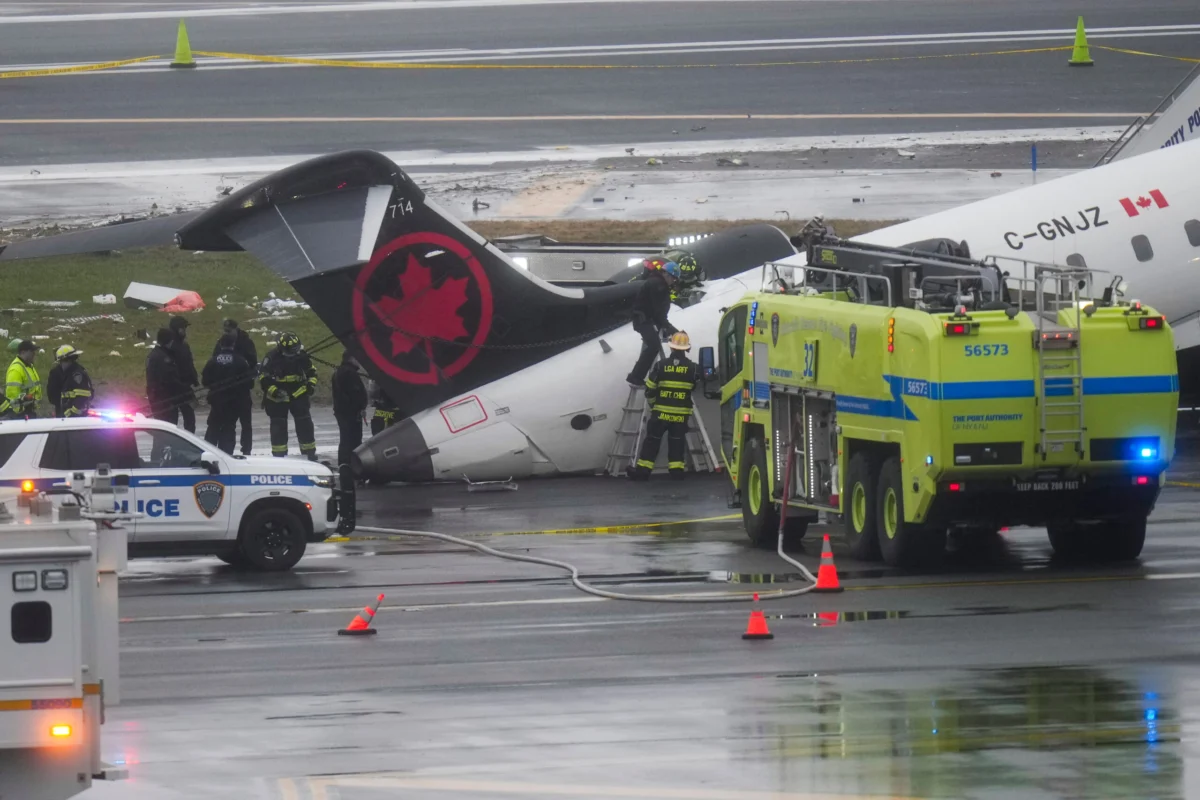
NEW YORK — The National Transportation Safety Board (NTSB) investigation into the tragic March 22 crash at LaGuardia Airport has taken a startling turn, as federal officials confirm that two air traffic controllers abandoned their posts nearly an hour before the disaster occurred. The revelation has ignited a firestorm regarding workplace culture, federal oversight, and the systemic pressures facing the nation’s air traffic control system.
The crash, which claimed the lives of two pilots, occurred at 11:37 p.m. during a period of intense congestion at the airport. According to a government official familiar with the investigation, the two controllers, who were slated to work past the time of the collision, departed the tower prematurely, leaving only two colleagues to manage a chaotic airfield.
The Night of the Crash: A System Under Duress
On the night of March 22, LaGuardia Airport was operating under extreme pressure. Due to earlier weather-related delays, the volume of flights scheduled after 10 p.m. had more than doubled, according to aviation analytics firm Cirium.
As the airport struggled to clear the backlog, a separate emergency unfolded: a United Airlines jet reported a strong, unidentified odor in the cabin, causing flight attendants to fall ill. The resulting emergency response required a convoy of vehicles—including four fire trucks, a police cruiser, and a stair truck—to cross an active runway.
At 11:37 p.m., the Air Canada Express Flight 8646, a CRJ900 regional jet arriving from Montreal with 76 souls on board, touched down on the same runway where the fire truck was crossing. The collision was catastrophic. Pilots Antoine Forest, 30, and Mackenzie Gunther, 24, were killed instantly. It marked the first fatal aviation accident at LaGuardia in 34 years. Thirty-nine others were transported to area hospitals, including six individuals who sustained serious injuries.
The "Early Shove" and Tower Staffing Deficiencies
The revelation that two controllers left their posts early has drawn sharp criticism from safety experts and federal officials. The practice, colloquially known in the industry as an "early shove," involves controllers leaving their shifts before their scheduled departure time—often under the guise of an early break.
While some veteran controllers and industry insiders describe the practice as a long-standing, albeit unofficial, culture, the FAA has signaled that it will no longer tolerate the behavior. A government official speaking on condition of anonymity noted that had the two controllers remained at their posts as required by their shifts, they could have provided essential backup during the high-stress, high-traffic window that culminated in the crash.
The Federal Aviation Administration (FAA) is currently pursuing disciplinary action against the pair, with the potential for termination looming. This move comes as the FAA negotiates a new contract with the National Air Traffic Controllers Association (NATCA), with hopes of implementing a more rigorous and transparent scheduling model.
Official Responses and the "Timecard Fraud" Allegation
Transportation Secretary Sean Duffy has taken a hardline stance against the reported conduct, categorizing the early departures as a form of timecard fraud.
"The vast majority of air-traffic controllers are great patriots—they show up for work, complete their full shift, and come back and do it all again," Secretary Duffy said in a formal statement. "But when a small percentage of individuals take advantage of the American taxpayer, unfairly add additional work to their fellow controllers, and impact the airspace—we have no choice but to act."
Tom Lintner, who spent decades with the FAA and served as a LaGuardia controller before overseeing national air traffic investigations, echoed the Secretary’s frustration. "None of that excuses the issue about when you get paid for eight hours, you’re supposed to be there for eight hours. Seven and a half doesn’t count," Lintner stated.
The National Air Traffic Controllers Association issued a brief, measured response, stating that the union "is actively discussing these allegations with FAA leadership."
The NTSB Investigation: A Complex Web of Causation
While the news of the early departures has dominated headlines, the NTSB’s ongoing investigation, which is expected to extend well into next year, highlights a confluence of failures that led to the tragedy.
A preliminary report released by the NTSB in April revealed that the collision was the result of a breakdown in communication and technology. Seconds before the impact, a controller had cleared the fire truck to cross the runway. However, the truck began its maneuver while warning lights—which act as a mandatory stop sign for crossing traffic—remained illuminated.
Crucially, the fire truck lacked a transponder. Because of this, the tower’s surface monitoring system could not accurately track the vehicle’s position. Consequently, the system failed to predict the potential conflict with the landing Air Canada jet and did not trigger the automated audio or visual alerts that might have prevented the crash.
The report also detailed the final, desperate seconds of the incident. Investigators noted that a controller shouted, "Stop, stop, stop" over the radio. While the turret operator on the fire truck eventually realized the directive was meant for them, it was already too late. The truck was already positioned on the runway as the CRJ900 arrived at high speed.
Implications for Aviation Safety
The crash at LaGuardia has forced a national conversation regarding the state of air traffic control staffing and the reliance on aging or insufficient surface-monitoring technology.
The Staffing Crisis
The overnight shift at LaGuardia typically operates with minimal staffing, which is usually sufficient for quiet hours. However, the surge in traffic due to weather delays created an environment where the "usual" staffing levels were insufficient to manage both routine arrivals and a high-stakes emergency ground response. Critics argue that the FAA has been slow to adapt its staffing models to the increasing volatility of modern commercial aviation.
Technological Gaps
The fact that a major airport’s surface monitoring system was blind to a vehicle because of a missing transponder has raised red flags regarding safety protocols. Aviation experts have long debated the mandatory use of tracking technology for all ground vehicles operating in proximity to active runways. The NTSB’s final report is expected to provide comprehensive recommendations for hardware and software upgrades to ensure that such "blind spots" are eliminated.
Cultural Reform
The "early shove" practice represents a cultural challenge within the FAA. While the union works to protect its members, the broader public and legislative bodies are demanding a culture of absolute accountability. As the FAA navigates its new labor contract negotiations, the pressure to codify strict, non-negotiable attendance requirements has reached an all-time high.
Conclusion
As the investigation continues, the focus remains on the 76 passengers and crew of Air Canada Flight 8646 and the families of the two pilots lost in the line of duty. The tragedy serves as a sobering reminder of how quickly routine operations can descend into chaos when human, procedural, and technological safeguards fail simultaneously.
Whether the termination of the two controllers will serve as a sufficient deterrent or whether more sweeping structural reforms are needed remains to be seen. For now, the aviation industry, the families of the victims, and the traveling public must wait for the NTSB’s final report to understand the full scope of the failures that occurred on that March night.
The FAA, in a final statement, emphasized its commitment to the future of the national airspace: "The agency is committed to holding employees accountable, and we will not compromise the safety or efficiency of the national airspace system."
