





The fundamental contract between search engines and publishers—an exchange of content visibility for traffic—is undergoing its most significant structural shift since the inception of the web. As AI-generated search experiences, such as Google’s AI Overviews and the Gemini app, increasingly synthesize information without directing users to source websites, publishers are facing an existential crisis.
In response, two distinct paths for value extraction are emerging: Google’s proprietary, centralized "AI contribution" program and an decentralized, protocol-based approach centered on the x402 "Payment Required" standard. As these models collide, publishers are forced to evaluate not just how they will be paid, but who will ultimately control the value of their digital assets.
The Google AI Contribution Pilot: A Black Box Economy
On September 14, 2026, the search industry gained clarity on a program that had been rumored for months. Following reporting from Digiday and subsequent analysis by Search Engine Roundtable, Google confirmed the existence of its "AI contribution pilot." This initiative represents Google’s attempt to mitigate publisher backlash regarding AI-driven traffic cannibalization.

Under this program, publishers who opt into the terms are presented with an earnings figure within Google Search Console. However, the mechanism behind these payments remains obscured. Google pays only when it determines that a specific page contributed "significantly" to an answer generated within AI Overviews, AI Mode, or the Gemini app. If a page is merely linked after an answer has been generated, it does not qualify for compensation.
For many publishers, this model is fundamentally flawed due to its lack of transparency. Executives familiar with the program have described it as a "black box," where the platform serves as both the arbiter of value and the payer. Because the calculation method is withheld, publishers have no way to verify if their compensation accurately reflects the utility their content provided to the AI.
The Rise of the x402 Protocol: A Decentralized Alternative
While Google attempts to manage the ecosystem through internal licensing, a segment of the developer community is championing a more radical approach: machine-to-machine micropayments. This model leverages the 402 Payment Required HTTP status code—a feature of the HTTP specification that has remained largely dormant since 1997.

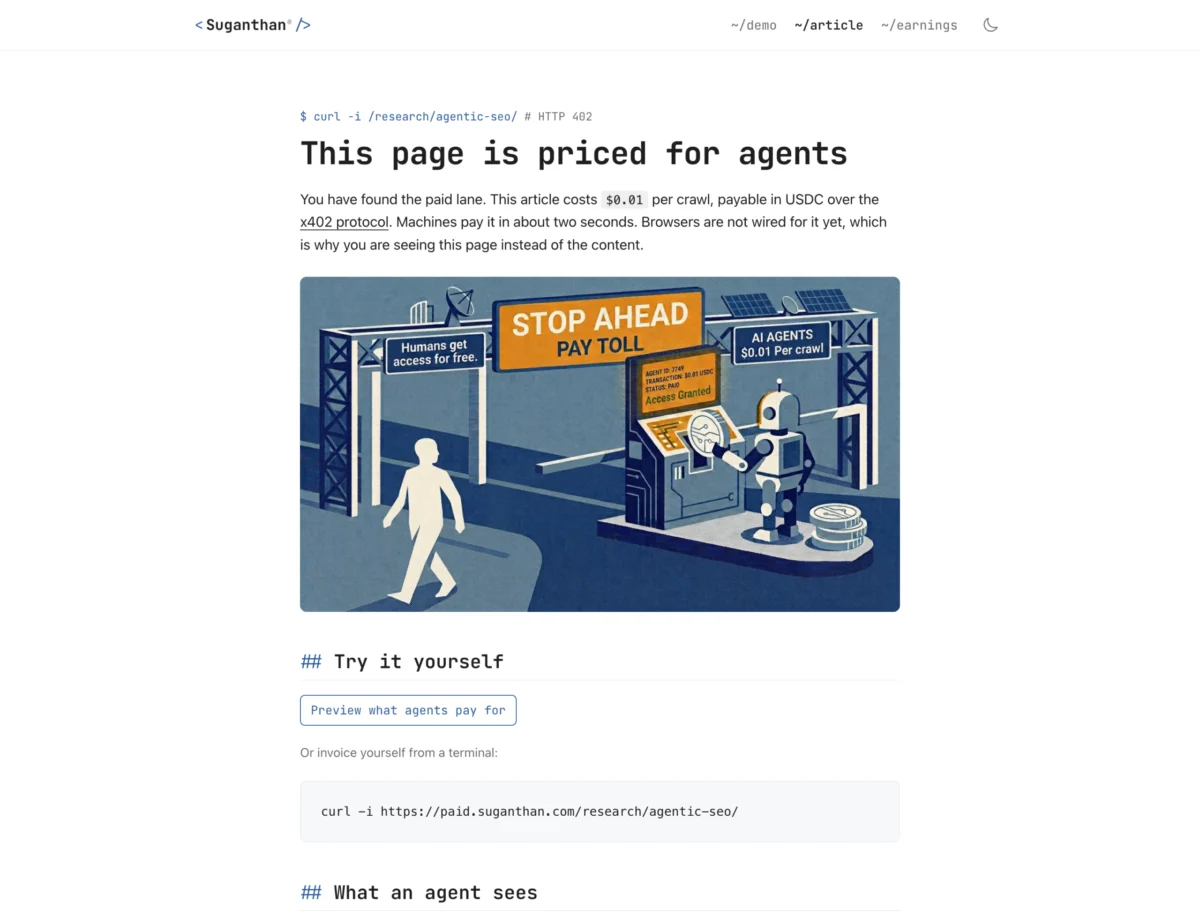
Through the x402 protocol, websites can set a price for access to their content. When an AI agent or crawler attempts to access a protected page, the server returns a 402 status code containing a payment request. The agent, if authorized by its human operator with specific spending guardrails, can instantly settle the transaction on a blockchain, receive the content, and proceed with its task.
This process functions as a "toll booth" for the web. It removes the need for complex, individual licensing negotiations between every small publisher and every AI laboratory. Instead, it creates a standardized, automated marketplace where content has a clear, programmatic price.
Chronology of the Shift
- April 2026: Early signs of Google’s AI contribution pilot appear in Search Console help documentation, though the function remains speculative.
- July 1, 2026: Cloudflare announces its "Monetization Gateway," signaling a shift toward infrastructure that supports pay-per-use for AI agents.
- August 4, 2026: Cloudflare announces "Wallets" for AI agents during "Agents Week," allowing developers to reserve handles for future autonomous transactions.
- August 8, 2026: Independent experiments with x402-based pay-per-crawl implementations begin, demonstrating the feasibility of autonomous, wallet-enabled agent interactions.
- September 14, 2026: Google formally confirms the AI contribution pilot to industry press, marking the official start of its revenue-sharing experiment.
- September 15, 2026: Live demonstrations prove that autonomous agents (such as Claude Code) can successfully navigate 402-gated content, pay with testnet USDC, and record transactions on a public ledger.
Supporting Data: Why "Pay-Per-Crawl" Matters
The debate between "pay-per-crawl" (charging for access) and "pay-per-use" (paying for value contributed) is central to the future of the web. Proponents of pay-per-use, including major cloud infrastructure providers, argue that simply fetching a page does not prove that the content was utilized in a meaningful way.

However, from the perspective of a content owner, pay-per-use is inherently risky. Once a page has been fetched by a proprietary AI system, the publisher has no way to audit whether that content was used to train a model or answer a query.
Conversely, the pay-per-crawl model offers empirical certainty. When an agent pays to access a page, the transaction is verifiable and independent of the platform’s internal reporting. As reported by Press Gazette on September 4, some publishers are already finding that the threat of blocking AI crawlers—via tools like those provided by Cloudflare—is an effective lever for bringing AI companies to the negotiating table for licensing deals. The x402 protocol simply formalizes this power dynamic.
The Mechanics of an Autonomous Transaction
To understand how this functions in practice, one must look at the four-step handshake of the x402 protocol:

- Request: An AI agent attempts to fetch a resource from a website.
- Challenge: The server returns a
402 Payment Requiredstatus, accompanied by a JSON object detailing the price, the asset required (e.g., USDC), and the destination wallet address. - Authorization: The agent’s local controller checks the cost against pre-set "spending guardrails." If the cost is within budget, the agent signs the transaction.
- Settlement: The payment is broadcast to the blockchain, and the server validates the receipt to grant access to the requested content.
In recent tests, this system has functioned with remarkable efficiency. Agents are able to perform tasks, encounter a paywall, assess the cost, pay the cent-level fee, and continue their work without human intervention. This eliminates the "negotiation friction" that prevents small-scale websites from participating in the AI economy.
Implications for the Future of Publishing
The implications of this transition are profound. We are moving toward an era where websites are no longer passive repositories for human readers, but active participants in a machine-driven economy.
1. The Death of the "One-Size-Fits-All" Crawl
For decades, publishers relied on a binary choice: be indexed by search engines for free or block them entirely. The x402 model introduces a spectrum of access. A site might allow human readers to browse for free while charging AI crawlers, or it might offer free access to general summaries while gating deep research datasets.

2. The Power of "Guardrails"
The ability for developers to set spending limits is crucial. Just as human users set budgets for subscription services, AI agents will operate within strict financial parameters defined by their owners. This ensures that the agent cannot "empty the wallet" of its operator, providing a necessary layer of protection against unexpected costs.
3. Institutional Adoption
The underlying infrastructure for this shift is gaining momentum. The x402 Foundation, which became operational under the Linux Foundation on July 14, includes 40 major members, including Google, AWS, Visa, and Mastercard. This suggests that while Google is currently testing a closed, proprietary model, the broader industry is moving toward a standardized, open-protocol future.
4. The Value of Content
Publishers must now audit their content portfolios to determine what actually holds value for an AI agent. General explainers may still be best left as "free" lead magnets, but original datasets, specialized research, and high-quality proprietary tools are prime candidates for monetization via the 402 status.

Conclusion: A Call for Transparency
As Google expands its AI contribution pilot, publishers are advised to approach these arrangements with caution. Accepting early, opaque terms may weaken a publisher’s bargaining position in the long run. If the platform is the sole arbiter of what constitutes "significant contribution," the publisher is essentially accepting a handout rather than building a sustainable revenue stream.
The future of the web likely belongs to systems that are transparent, decentralized, and machine-readable. While we are currently in the experimental phase—with testnet tokens and closed beta programs—the path forward is becoming increasingly clear. Sites that prepare by defining the value of their content and implementing robust, agent-friendly monetization strategies will be the ones that thrive in an AI-dominated information economy.
For now, the advice to publishers is clear: don’t wait for a dashboard to tell you what your content is worth. Start identifying your high-value assets and prepare for a web where every request is a potential transaction. The 402 status code is no longer just a theoretical reservation; it is the foundation of the next web.
