




Introduction: A Humanitarian Catastrophe Fueled by Greed
The Democratic Republic of Congo (DRC) is once again the stage for a harrowing humanitarian crisis that highlights the lethal intersection of regional geopolitical instability and the insatiable global demand for critical minerals. In a scathing new report released this Monday, Amnesty International has formally accused the March 23 Movement (M23)—a powerful rebel faction operating in the eastern DRC—of committing systemic human rights violations, including extrajudicial executions, torture, and forced labor within the mining sector.
As the conflict in the North and South Kivu provinces intensifies, the international community faces growing pressure to address how gold and coltan—minerals essential for the global technology industry—are being transformed into instruments of terror. Amnesty’s documentation suggests that M23’s activities are not merely localized insurgencies but are part of a sophisticated, illicit supply chain that feeds into international markets, thereby implicating corporate entities in the US and the EU.
The Nature of the Abuses: Violations of International Law
The abuses documented by human rights monitors are not isolated incidents but represent a pattern of behavior that directly violates the foundational principles of international humanitarian law (IHL).
Forced Labor and the "Ndake" Pits
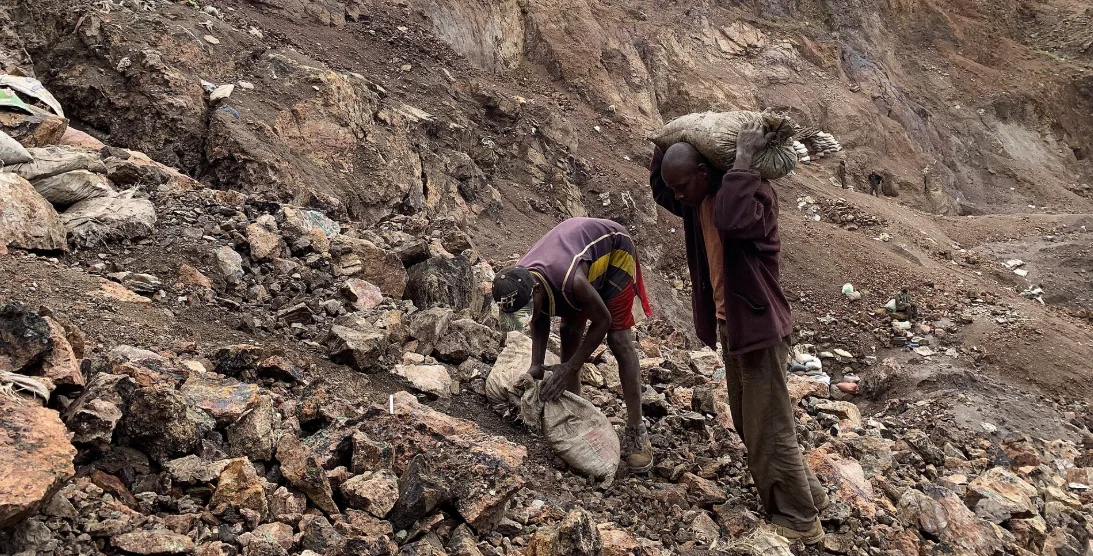
Amnesty International’s investigation reveals that M23 has established a regime of terror within the mines it controls near Rubaya (North Kivu) and Lomera (South Kivu). Miners are subjected to week-long forced labor shifts under threat of violence. The report details the use of repurposed shipping containers as makeshift "torture cells," as well as the excavation of subterranean pits known as ndake. Within these pits, detainees are subjected to routine, brutal beatings, sometimes occurring up to three times per day.
These actions constitute a clear violation of Common Article 3 of the Geneva Conventions, which prohibits "violence to life and person, in particular murder of all kinds, mutilation, cruel treatment and torture" in the context of non-international armed conflicts (NIAC).
Extrajudicial Executions and Disappearances
Beyond the mines, M23 has engaged in a campaign of intimidation against the civilian population. Reports confirm the extrajudicial execution of at least 18 miners. Furthermore, the group has a documented history of enforced disappearances. In March 2025, M23 fighters stormed the CBCA Ndosho hospital in Goma, kidnapping over 130 individuals. Many of these victims remain missing, a direct violation of Rule 98 of Customary International Humanitarian Law, which mandates that parties to a conflict must prevent and address the enforced disappearance of persons.
The Recruitment of Children
Human Rights Watch (HRW) has corroborated these findings, specifically highlighting the "large-scale roundups" of civilians. The group has documented the forced recruitment of children as young as 12, who are abducted from schools, churches, and homes and forcibly conscripted into military training camps. This practice is a flagrant violation of Rule 105 of Customary IHL, which protects the sanctity of family life and prohibits the forced separation of children from their guardians.
Chronology: The Rebirth of the M23 Insurgency
To understand the current crisis, one must look at the historical trajectory of the M23 movement, which has transitioned from a political advocacy group to an armed force accused of war crimes.
- 2006: The Congrès National de Défense du Peuple (CNDP) is formed, ostensibly to protect the interests of the Tutsi population in the eastern DRC.
- 2009: A fragile peace agreement is signed between the CNDP and the DRC government.
- 2012: Disillusioned by the government’s implementation of the peace deal, former CNDP members form the M23 movement.
- 2013: M23 experiences a major military defeat at the hands of the Congolese army and UN forces.
- 2022: The group reemerges, citing the government’s failure to address security deficits and infrastructure decay in the eastern provinces.
- 2025–2026: The conflict escalates into a regional crisis, with accusations of direct Rwandan state involvement, leading to the current ICJ filing by the DRC government.
The Global Supply Chain: From Congolese Pits to International Markets
The core of the M23’s economic engine is the illicit extraction of gold and coltan. These minerals are smuggled across the border into Rwanda before being integrated into global trade routes.
Agnès Callamard, Secretary General of Amnesty International, issued a stark warning regarding this trade: “The African Union and its Member States must take far bolder steps than they have done thus far to put an end to the likely pillage driven by an endless international appetite for African critical minerals.”
The implication is that the "horrific abuses" occurring in the Kivus are subsidized by the demand for high-tech components in the West. When corporations in the US and the EU purchase these minerals without rigorous due diligence, they are effectively financing a regime that engages in human rights atrocities. This has led to mounting calls for "mineral traceability" and stronger regulatory oversight to ensure that the global energy transition—which relies heavily on such minerals—is not built upon the suffering of Congolese miners.
Official Responses and Diplomatic Stagnation
The international response has been characterized by condemnation, yet there is a perceived lack of meaningful intervention.
- Amnesty International: Has urged a unified stance against the "pillage" of African resources, warning that failure to act will only encourage other armed groups to adopt similar predatory tactics.
- The International Court of Justice (ICJ): In June 2026, the DRC formally filed a case against Rwanda, alleging that the latter’s support for M23 constitutes a violation of sovereignty and international law. This legal move represents a significant escalation in the diplomatic effort to hold regional actors accountable for the conflict.
- United Nations: The UN Security Council has repeatedly condemned M23 offensives, but the group’s resilience—bolstered by its control over mineral-rich territory—has rendered diplomatic pressure largely ineffective thus far.
Implications: A Region at the Precipice
The situation in the eastern DRC is a microcosm of the risks inherent in the modern global economy. The confluence of weak state infrastructure, ethnic tensions, and the high market value of "critical minerals" has created a "resource curse" scenario.
Legal and Humanitarian Consequences
If the current trajectory continues, the erosion of IHL in the region will be complete. The normalization of kidnapping, torture, and the use of children in combat risks destabilizing the Great Lakes region for decades. Furthermore, the ICJ proceedings against Rwanda represent a critical test of international legal institutions: can they effectively curb the actions of a state that is accused of proxy-driven human rights abuses?
The Moral Responsibility of Consumers
The final, and perhaps most difficult, implication is the burden on the global consumer. Every smartphone, electric vehicle, and computer chip that contains untraced coltan from the DRC is potentially linked to the ndake pits and the forced labor camps described by Amnesty International.
As Callamard noted, "Failure to stand united against such pillage… will only encourage others to follow suit." The crisis in the DRC is, therefore, not merely a regional conflict—it is a global ethical failure. Addressing it requires more than just humanitarian aid; it necessitates a fundamental restructuring of how critical minerals are sourced, tracked, and consumed on the international stage.
Without concrete action to decouple the mineral trade from the M23’s violent expansion, the cycle of death and exploitation in the Democratic Republic of Congo is unlikely to be broken. The international community stands at a crossroads: either enforce the laws that protect the vulnerable, or remain complicit in a trade that thrives on the systematic abuse of the very people the global economy relies upon.
