


Earlier this week, I sat in a darkened theater for a screening of You Can See Everything, the latest documentary to tackle the wreckage of the Theranos saga. Even with the cultural ubiquity of Elizabeth Holmes—from John Carreyrou’s seminal book Bad Blood to the dramatized Hulu series The Dropout—the film managed to strike a nerve that remains raw for those of us who cover the biotech industry.
I entered the theater intentionally avoiding spoilers, curious if there was any stone left unturned in the story of the disgraced CEO. The documentary is unsettling, not merely because it revisits the scale of Holmes’s deception, but because it forces a confrontation with a deeper, more professional anxiety: the inherent limitations of journalism in verifying scientific claims. Despite our best efforts, we often find that we can never truly "see everything."
The Rise and Ruin of a Silicon Valley Icon
To understand the weight of this new film, one must revisit the dizzying ascent of Elizabeth Holmes. In 2003, at the age of 19, Holmes dropped out of Stanford University to launch Theranos. Her pitch was revolutionary: a proprietary diagnostic platform, the "Edison," capable of running over 100 clinical tests on a mere few drops of blood.
The narrative she sold was the quintessential Silicon Valley fairy tale. By 2014, Theranos reached a staggering $9 billion valuation. Forbes christened Holmes the world’s youngest self-made female billionaire, pinning her net worth at $4.5 billion when she was just 30. She was the darling of the tech world, a visionary who promised to democratize healthcare.
However, the foundation of this empire was built on sand. The unraveling began in 2015, triggered by a rigorous investigative report in the Wall Street Journal. Former employees broke their silence, revealing that the vaunted Edison devices were not only dysfunctional but that the company had been covertly using third-party machines from other manufacturers to process samples. MIT Technology Review quickly identified Theranos as one of the most significant technology failures of the decade.
By 2016, the facade had fully collapsed. Forbes adjusted Holmes’s net worth to zero. A government investigation confirmed that the company’s laboratory procedures were dangerously flawed, often providing patients with inaccurate, potentially life-altering medical results. In 2018, the SEC charged Holmes and former company president Ramesh "Sunny" Balwani with "massive fraud." After a protracted legal battle, Holmes was sentenced in 2022 to over 11 years in federal prison, beginning her sentence in May 2023.
A Chronology of Deception
- 2003: Elizabeth Holmes founds Theranos after leaving Stanford.
- 2014: Theranos peaks at a $9 billion valuation; Holmes is named a billionaire.
- October 2015: The Wall Street Journal publishes a landmark investigation exposing the company’s reliance on third-party hardware and failure to meet basic testing standards.
- December 2015: MIT Technology Review categorizes Theranos as a top tech failure.
- 2016: Regulatory reports detail catastrophic lab errors; Holmes’s net worth is revised to zero.
- March 2018: The SEC files fraud charges against Holmes and Balwani.
- January 2022: Holmes is found guilty on four counts of defrauding investors.
- November 2022: Holmes is sentenced to 135 months in prison.
- May 2023: Holmes officially reports to prison to begin her sentence.
Behind the Lens: The Intimacy of Manipulation
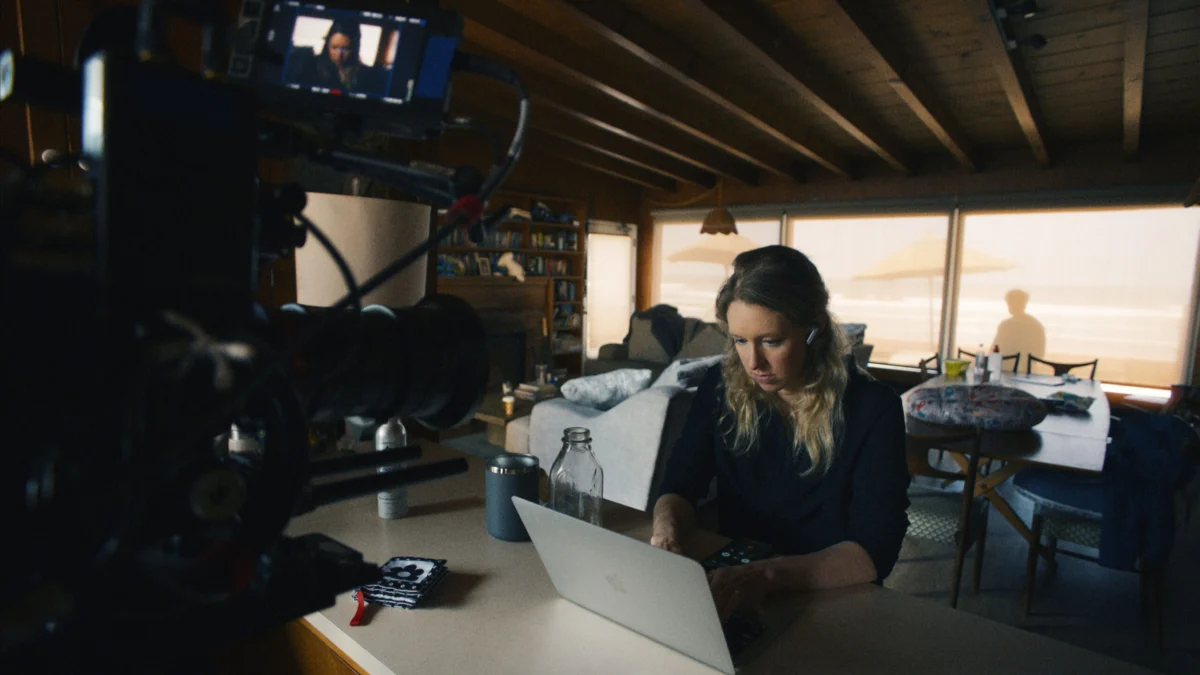
You Can See Everything, directed by Nathan Fielder and Lance Oppenheim, provides a jarring departure from previous investigative works. Filmed in the month leading up to Holmes’s incarceration, the documentary focuses on her life at home with her partner, Billy Evans, and their two young children.
The film is an exercise in discomfort. The cinematographic style relies heavily on extreme close-ups, forcing the audience to maintain a gaze with the subjects that feels invasive and intimate. Holmes, a woman historically defined by her cold, unblinking intensity, invites the camera into her private life in what appears to be a calculated bid to reshape her public image—positioning herself as a misunderstood, albeit "unusual," mind.
Watching the film, I found myself grappling with a flicker of empathy—a reaction that felt entirely wrong given the gravity of her crimes. But that is precisely the point. Holmes remains an effective manipulator. Throughout the film, she plants subtle seeds of doubt, not just in the filmmakers, but in the viewer. Is it possible she didn’t mean to lie? Was she caught in the momentum of her own myth? These are the questions she poses, and for a fleeting moment, she is convincing.
The Professional Hazard: Why We Fall for It
My internal struggle is not unique. Throughout the 2010s, seasoned journalists, investors, and scientists were all seduced by the Theranos narrative. Roger Parloff of Fortune, who once profiled Holmes, later admitted, "I blew it." Matthew Herper, writing for STAT, reflected on his 2015 interview with Holmes, noting that he was certain he had been lied to, yet he had struggled to reconcile that with her air of authentic conviction.
Even Tyler Shultz, a whistleblower who saw the internal rot firsthand, remarked that he could have a five-minute conversation with Holmes and walk away feeling like the company was truly changing the world. This raises a haunting question for any science journalist: If I had been in the room, would I have been taken in?
The Fragility of Peer Review in the Modern Age
The Theranos case is a masterclass in the failures of due diligence. One of the primary red flags was the company’s refusal to publish peer-reviewed data, citing "trade secrets." In the scientific community, peer review is the gold standard of verification—a slow, rigorous process where anonymous experts dissect conclusions and demand evidence.
However, the film highlights a systemic vulnerability. Scientists are fallible. Data can be massaged, findings can be exaggerated, and replicability—the bedrock of science—is often ignored in the rush for a breakthrough. In 2023 alone, over 10,000 research papers were retracted globally.
The environment is changing. We now see an influx of preprints on servers like bioRxiv and medRxiv, which bypass the scrutiny of traditional journals. While these platforms democratize knowledge, they also create a vacuum where bold claims can circulate as facts before they are ever verified. As a reporter, I am frequently presented with scientific "findings" that exist solely in press releases or social media threads. The temptation to report on a "revolutionary" discovery is high, but the responsibility to verify is paramount.
Implications for Science Journalism
The lesson of You Can See Everything is not that we should abandon our curiosity or our optimism about biotech, but that we must institutionalize skepticism. At MIT Technology Review, our standards involve treating every "breakthrough" as a hypothesis until proven otherwise. This requires us to reach out to disinterested experts—people who have no stake in the company’s success—to pressure-test claims.
The film is a stark, visual reminder that the most compelling narratives are often the most dangerous. While Holmes is an outlier, the environment that allowed her to thrive—a culture of "fake it until you make it"—still exists in the shadows of the venture capital world.
We must continue to interrogate the claims fed to us. We must demand data, even when we are told it is a "trade secret." And most importantly, we must recognize that the camera lens—or the journalist’s pen—is not a window into the absolute truth, but a subjective tool that can be manipulated if we are not vigilant.
As you watch You Can See Everything, don’t just watch the subjects. Watch your own reactions. If you feel yourself being persuaded, ask yourself why. The truth is rarely found in a charismatic pitch; it is found in the tedious, unglamorous, and often invisible work of verification.
This article first appeared in The Checkup, MIT Technology Review’s weekly biotech newsletter. To receive it in your inbox every Thursday, and read articles like this first, sign up here.
