





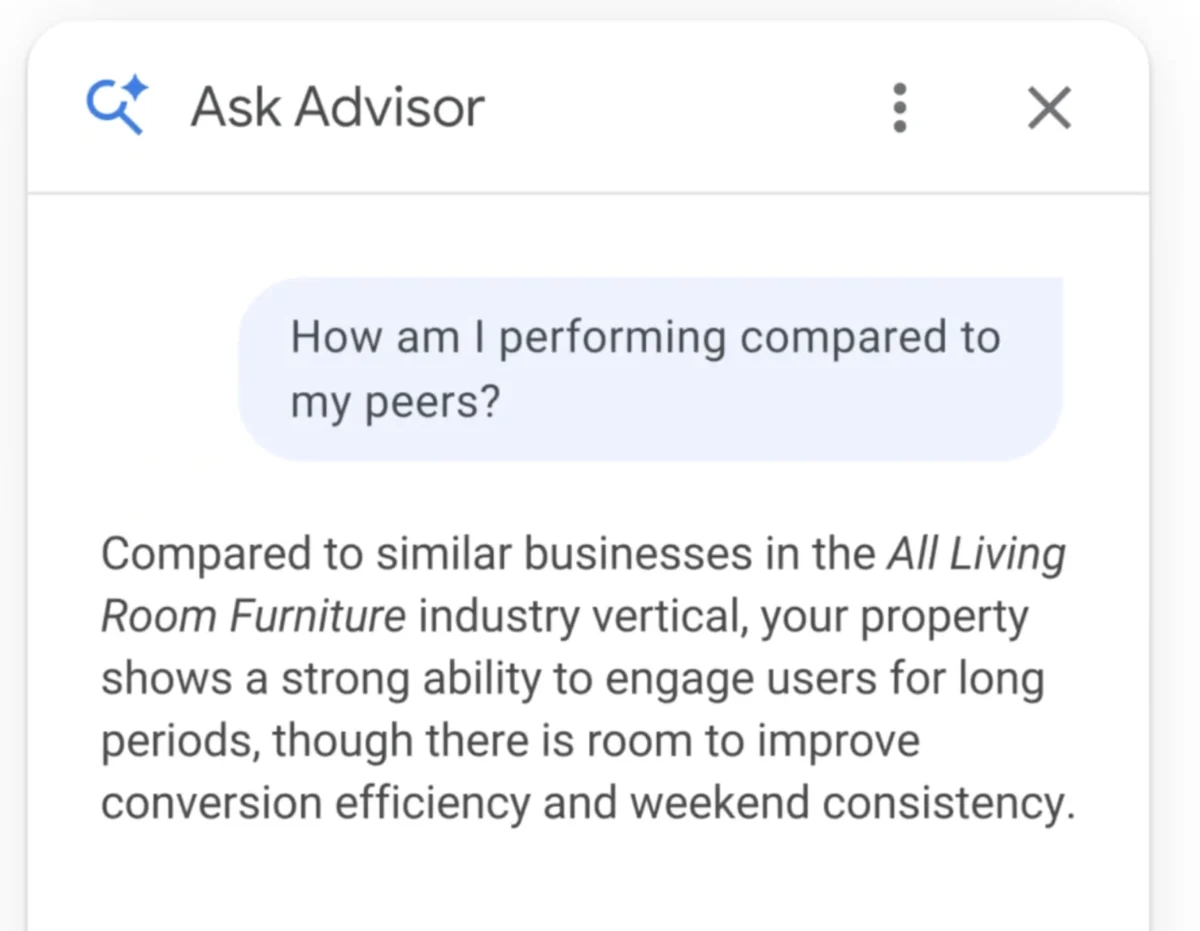
In a significant move to streamline how marketers interpret complex data, Google has announced a suite of AI-driven enhancements across its Google Ads and Google Analytics ecosystems. At the heart of this update is the integration of benchmarking capabilities into "Ask Advisor," the cross-product generative AI tool originally unveiled at Google Marketing Live in May.
This new feature allows advertisers to query their campaign performance against anonymized, aggregated data from similar businesses, effectively turning raw metrics into actionable competitive intelligence. As Google continues to push its "AI-first" agenda, these tools aim to reduce the time spent on manual data analysis, allowing marketing professionals to focus on high-level strategy rather than spreadsheet navigation.
Main Facts: What is Changing?
The core update is the arrival of Ask Advisor Benchmarking. For years, Google Analytics has provided basic benchmarking, but it was often tucked away in static reports. By moving this functionality into the conversational Ask Advisor interface, Google is transforming how users interact with their data.
Key Components of the Update:
- Conversational Benchmarking: Users can now ask, "How is my campaign performing compared to others in my industry?" in plain, natural language. The AI parses the request and provides a contextualized answer based on anonymized peer-group averages.
- AI-Powered Summaries: Google is rolling out "Analytics Overviews" that appear at the top of the dashboard upon login. These summaries act as a briefing, highlighting significant changes, performance shifts, or anomalies that occurred since the user’s last session.
- Generative Dashboards: Beyond mere reporting, Google is introducing a "Dashboards" feature that allows users to generate custom charts and visual data representations simply by typing text prompts.
- Personalized Ads Insights: Google Ads is receiving a facelift with personalized insight cards, designed to highlight specific opportunities or risks relevant to an individual account’s unique performance profile.
These features are currently in beta, restricted to English-language accounts, reflecting Google’s phased rollout strategy for its most sophisticated AI tools.
The Chronology of Google’s AI Integration
To understand the magnitude of this update, it is necessary to look at the timeline of Google’s aggressive pivot toward generative AI in the marketing space.
Q2 2026: The Foundation
The journey began in earnest at Google Marketing Live in May, where the company introduced "Ask Advisor." Designed as a cross-platform agent, it was built to bridge the gap between Google Ads, Google Analytics, Merchant Center, and the broader Google Marketing Platform. The promise was simple: a unified interface that understands the context of a brand’s entire digital footprint.

July 2026: The Pilot Phase
By mid-summer, Google began testing AI-driven reporting within the Merchant Center. While this pilot provided a glimpse into the future of data interpretation, it also highlighted a critical challenge: the lack of granular user control over peer-group data. This period of testing served as a trial run for the more robust, cross-platform integration we are seeing today.
August 2026: The Current Expansion
The latest announcement from Josh Moser, Senior Director of Product Management, marks the transition from isolated testing to a wider deployment. By integrating these tools directly into the daily workflows of Google Analytics and Ads, Google is signaling that AI is no longer an "add-on"—it is becoming the primary interface for their software.
Supporting Data and Technical Context
For marketers looking to leverage these tools, understanding the "how" is just as important as the "what." Google’s benchmarking system relies on a complex architecture of anonymized signals.
How the Peer Groups are Constructed
Google’s documentation clarifies that benchmarking reports utilize data from the median, the 25th percentile, and the 75th percentile of a peer group. This peer group is not arbitrary; it is derived from:
- Industry Category: Set at the property level during the initial setup of the Google Analytics account.
- Digital Fingerprinting: The AI analyzes signals from your URLs and app attributes to determine the nature of your business.
- User Customization: Crucially, Google provides 25 top-level categories, each with granular subcategories (e.g., "Athletic Shoes").
The "Modeling" Requirement
A critical hurdle for many users is the requirement for "Modeling contributions & business insights" to be enabled in the Admin settings. Without this setting active, the system lacks the necessary data depth to compare your property against others accurately. Whether Ask Advisor will bypass these existing permission gates remains a point of speculation, though initial reports suggest it will adhere to existing privacy and data-sharing configurations.
Official Responses and Strategic Intent
Josh Moser’s blog post framing these updates emphasizes "efficiency" and "clarity." From Google’s perspective, the primary friction point for advertisers is not a lack of data, but a lack of meaning.

"The goal," as stated in the announcement, "is to move from monitoring metrics to making decisions." By providing AI-generated summaries at login, Google is effectively acting as an automated consultant. The shift is from a "pull" model—where the user logs in and hunts for data—to a "push" model, where the most vital information is presented proactively.
However, industry experts have noted that while these summaries are powerful, they are not infallible. The reliance on "anonymized averages" means that if an account is incorrectly categorized, the benchmark becomes misleading. Consequently, Google has emphasized that users maintain control over their industry categorization, urging them to audit their settings to ensure the "peer group" reflects their actual competition.
Implications for Marketers
The introduction of Ask Advisor benchmarking and generative dashboards has profound implications for the digital marketing industry.
1. The Death of the "Report Builder"
Historically, junior analysts spent hours building custom dashboards in Looker Studio or GA4. With the ability to generate charts from text prompts, the technical barrier to entry for high-level data analysis is collapsing. Teams can now pivot their focus from creating reports to interpreting the story the data tells.
2. A Shift in Competitive Strategy
Benchmarking has long been a "nice-to-have." With it now integrated into the conversational flow of the platform, it will likely become a "must-have" for daily optimization. If an advertiser sees that their "Add to Cart" rate is at the 25th percentile compared to their peers, it creates an immediate, data-backed mandate for site improvements.
3. Data Integrity and Privacy
The move towards automated insights highlights the growing importance of "Data Governance." Because these AI tools depend on the accuracy of your account’s metadata (industry, category, URL signals), marketers must be more diligent than ever. An incorrectly labeled account will lead the AI to provide inaccurate benchmarks, potentially leading to flawed strategic decisions.

4. The "Black Box" Concern
Despite the benefits, there is a lingering concern regarding transparency. As Google’s AI begins to summarize "what changed" since the last login, marketers must ensure they are not blindly trusting the machine. There is a risk of "summary bias," where the AI highlights certain metrics while downplaying others that might be equally relevant. Experienced professionals will need to maintain a "trust but verify" approach.
Looking Ahead: The Future of the Dashboard
Google has remained tight-lipped regarding the precise rollout schedule for all accounts. However, the trajectory is clear: the dashboard of the future is not a collection of rows and columns, but a conversational interface that speaks the language of business strategy.
As these tools move out of beta, the defining skill for marketers will shift from "knowing how to pull the data" to "knowing what questions to ask the AI." The ability to construct precise, context-aware prompts for tools like Ask Advisor will likely become a core competency for the next generation of performance marketers.
For now, the advice for account managers is twofold:
- Audit your settings: Ensure your Google Analytics industry category is precise.
- Prepare your team: Familiarize yourselves with the new generative workflows before they become the industry standard.
As we move into this AI-augmented era, the data hasn’t changed, but the speed at which we can turn that data into a competitive advantage has shifted into a higher gear. Whether this will lead to a more efficient ecosystem or a more homogenous one remains to be seen, but one thing is certain: the era of the manual spreadsheet is officially coming to a close.
