




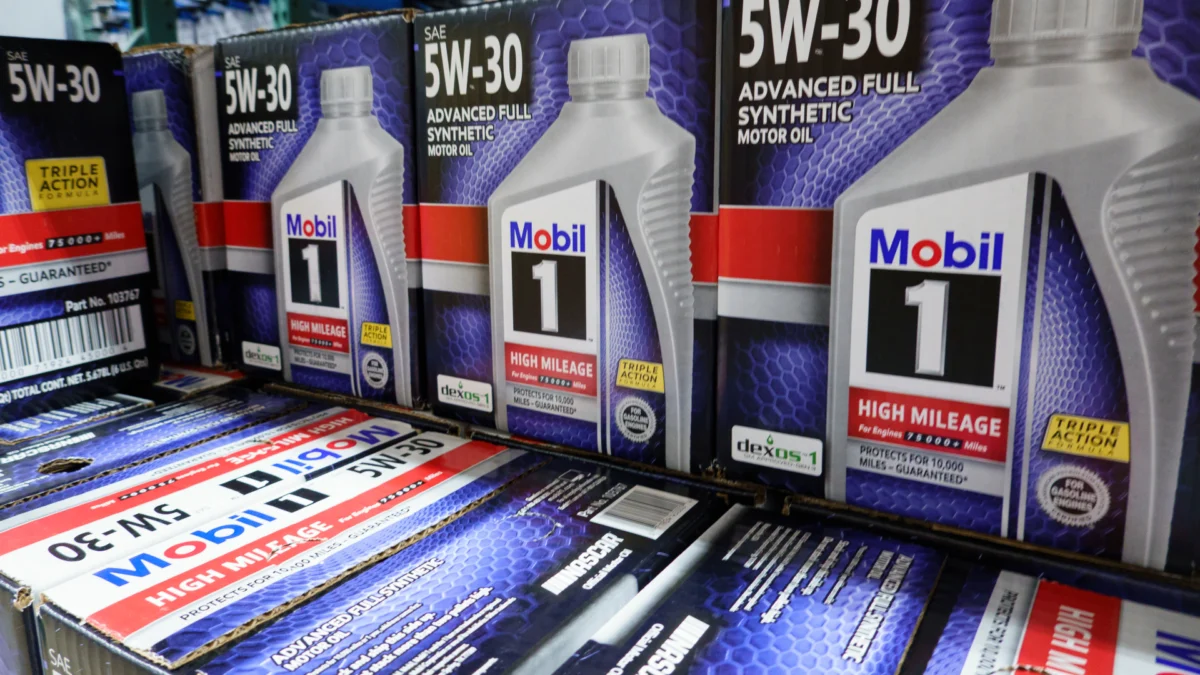
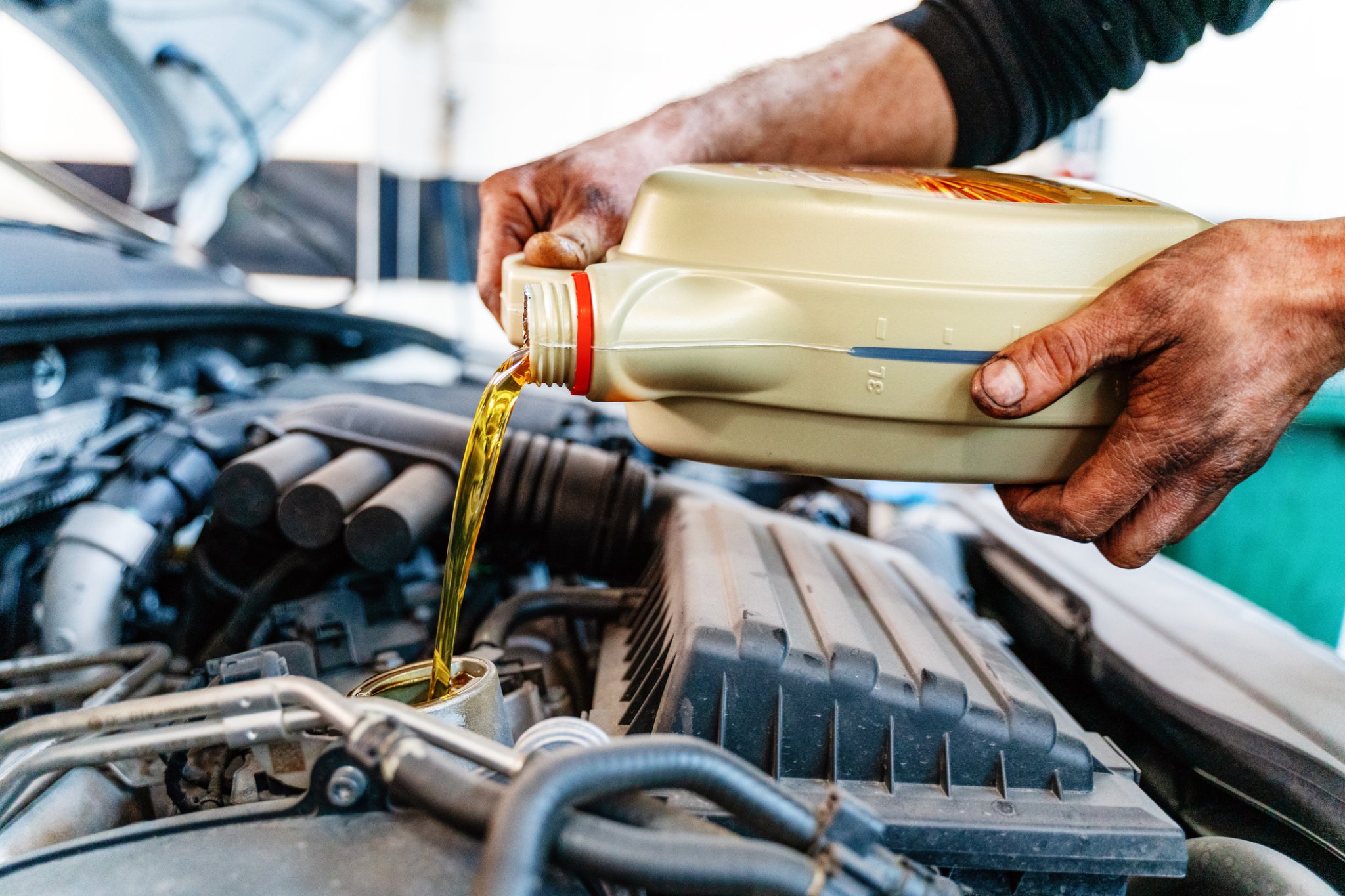
When a driver pours a quart of synthetic 5W-30 into an engine, they are engaging in a sophisticated dance with fluid dynamics. The oil must be thin enough to circulate instantly upon a cold start, yet viscous enough to maintain a protective film between pistons and cylinder walls when the engine reaches operating temperatures of 200 degrees Fahrenheit or more. Viscosity—the measure of a fluid’s resistance to flow—is the silent arbiter of mechanical longevity.
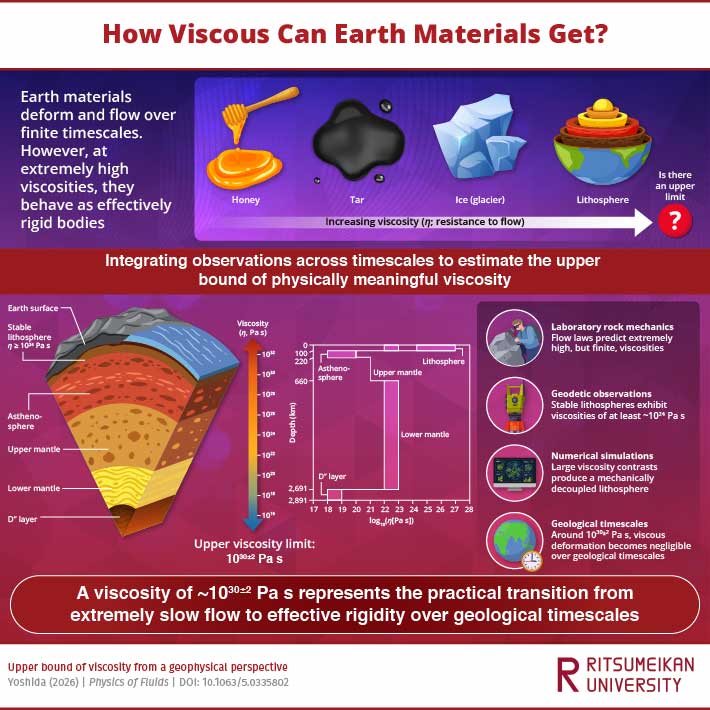
For decades, the scientific community has treated the upper reaches of this scale as effectively infinite. However, a groundbreaking study recently published in the journal Physics of Fluids by Professor Masaki Yoshida of Ritsumeikan University has shattered that assumption, establishing a definitive "absolute cosmic limit" for viscosity. By looking past the garage and into the mantle of the Earth, researchers have quantified the impossible, identifying a threshold where a substance ceases to behave like a fluid entirely.
Main Facts: What is the Absolute Limit?
At the core of the study is the determination of a specific numerical ceiling: 10³⁰ ± 2 pascal-seconds (Pa·s). To grasp the staggering magnitude of this figure, one must consider the standard reference points of our daily lives. Water, the baseline of fluid movement, possesses a dynamic viscosity of approximately 10⁻³ Pa·s. Common household honey, often cited as the archetype of a "thick" liquid, sits at roughly 10¹ Pa·s.
Professor Yoshida’s research suggests that when a material reaches 10³⁰ Pa·s, the rate of flow becomes so infinitesimally slow that it would take longer than the current age of the universe for the substance to exhibit measurable displacement. In this state, the distinction between a "highly viscous fluid" and a "solid" vanishes. The research provides a mathematical boundary that replaces the lazy, shorthand scientific placeholder of "infinite viscosity," which has historically been used to simplify complex equations in fluid dynamics.
Chronology of the Discovery
The journey to define this limit did not begin in a lab with motor oil, but in the deep, pressurized silence of the Earth’s interior. The chronology of this scientific breakthrough can be traced through three distinct phases:
Phase I: The Geological Foundation (1990s–2010s)
For decades, geophysicists struggled to model the flow of rock within the Earth’s mantle. While tectonic plates appear rigid on a human timescale, they behave like high-viscosity fluids over geological epochs—millions of years. Researchers relied on geodetic data, observing how the Earth’s crust deforms in response to ice sheets melting or volcanic activity.
Phase II: Laboratory Simulation (2015–2023)
Professor Yoshida and his team at Ritsumeikan University began synthesizing data from laboratory rock-deformation experiments. By subjecting minerals to extreme temperatures and pressures—mimicking the conditions thousands of kilometers beneath the surface—they sought to understand the "flow law" of silicate rocks.
Phase III: The Publication (2024–2025)
In the months leading up to the publication in Physics of Fluids, the team reconciled their experimental data with mathematical models of planetary physics. By mid-2024, the calculations stabilized at the 10³⁰ mark. The paper was peer-reviewed and released, marking the first time a "ceiling" for viscosity had been formally codified in academic literature.
Supporting Data: The Scale of Resistance
To appreciate why this number is so significant, we must look at how we measure flow in the automotive and industrial sectors versus the geological scale.
The Automotive Context
In the world of internal combustion, we operate in the millipascal-second (mPa·s) range. An oil’s "weight"—like 0W-8 or 10W-40—is determined by its kinematic viscosity, which is the dynamic viscosity divided by the fluid’s density. These fluids are "Newtonian" or "non-Newtonian" liquids that react to shear stress in predictable, rapid ways. When an engine oil is too thin, metal-on-metal contact occurs; when it is too thick, oil pressure spikes and internal friction destroys efficiency.
The Geological Context
The "cosmic limit" exists at the opposite end of the spectrum, involving rocks that flow due to mantle convection. Unlike motor oil, which relies on molecular chains to maintain integrity under heat, these geological materials rely on atomic diffusion and dislocation creep. The transition from a "fluid" to a "solid" at 10³⁰ Pa·s is not a change in chemical state, but a change in the observer’s timeframe. At this viscosity, a mountain range is effectively a slow-moving, high-viscosity "drip."
Official Responses and Theoretical Implications
The scientific community has lauded the study as a necessary step in refining fluid-dynamics simulations. Prior to Yoshida’s work, researchers often invoked "infinite viscosity" as a boundary condition to solve equations involving extremely sluggish materials.
In a formal press release, Ritsumeikan University noted: "By establishing a concrete, finite value for the upper limit of viscosity, we move from abstraction to empirical science. This finding serves as a cornerstone for future studies in mantle dynamics, planetary evolution, and the behavior of exotic materials under extreme conditions."
Some critics in the field of soft-matter physics have noted that the 10³⁰ threshold is so high that it may have little to no practical application in engineering or manufacturing. However, the study’s authors argue that the value is essential for "boundary-value problems" in mathematics, where a true infinity would otherwise lead to errors in computational fluid dynamics (CFD) software.
Implications for Science and Beyond
While the average car owner will never need to worry about their engine oil approaching the viscosity of the Earth’s mantle, the implications of this study are profound for several disciplines:
1. Planetary Science
Understanding the absolute limit of viscosity helps geologists create more accurate models of how the Earth’s core and mantle interact. This influences our understanding of tectonic plate movement, volcanic cycles, and even the magnetic field generated by the fluid motion of the outer core.
2. Materials Science
The study sheds light on non-Newtonian fluids—substances like ketchup, blood, or polymers—whose viscosity changes based on the force applied to them. By defining the "top" of the scale, scientists can better calibrate the "middle" of the scale, leading to advancements in everything from 3D printing resins to high-performance industrial lubricants.
3. The Philosophy of Physics
Perhaps the most intriguing implication is the shift in perspective. For decades, "infinity" was a convenient mathematical bin for "things that don’t move." By proving that there is no such thing as truly infinite viscosity, Yoshida has reinforced the idea that in our universe, everything is in motion—even if that motion requires the lifespan of a star to observe.
As we look at the evolution of lubricants, from the primitive oils of the early 20th century to the hyper-engineered synthetics of today, we are effectively working within a narrow, comfortable band of the viscosity spectrum. We now know that this band exists within a much larger, more rigid reality. The universe, it seems, is far more fluid than we once thought, and even the rocks beneath our feet are, in the grandest sense, simply moving very, very slowly.
