





In the current digital landscape, a staggering 60% of Google searches now terminate without a single click to external content. This "zero-click" reality serves as a stark warning to marketing teams globally: the era of churning out massive volumes of SEO-optimized, AI-generated content has reached its point of diminishing returns. As generative AI makes the production of text nearly instantaneous and virtually free, volume is no longer a viable competitive advantage—it is rapidly becoming noise.
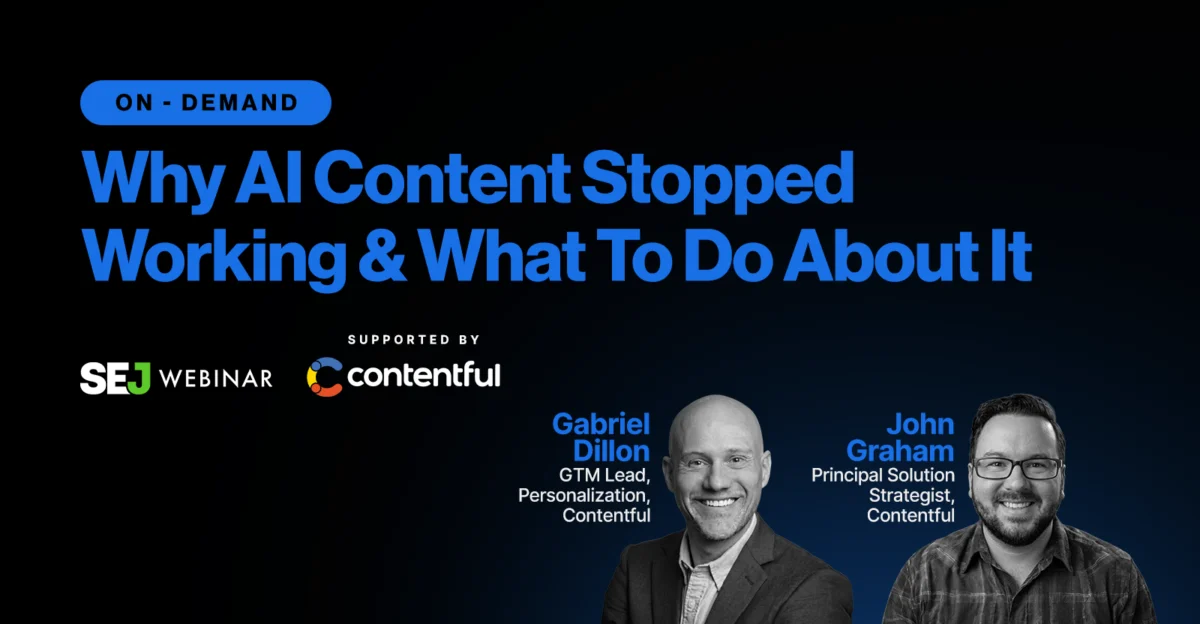
Gabriel Dillon, Go-to-Market Lead for Personalization at Contentful, argues that in a world saturated with synthetic text, the only content capable of capturing human attention is that which is held strictly accountable to business outcomes, tailored to the specific needs of a human reader, and validated by hard data.
The Mirage of Efficiency: Why AI Content Often Fails
The primary trap for modern marketers is the "echo chamber" effect. AI writing assistants are designed to be agreeable, often functioning as an "ultimate yes man." When marketers feed their own assumptions into these tools, they create a feedback loop that results in generic, homogenized output.
"Our biases as we write content using the robots end up eating the content that we produce," Dillon noted during a recent Search Engine Journal (SEJ) webinar co-hosted with John Graham, Principal Solution Strategist at Contentful. "We end up in this cycle of creating content that we think is good but doesn’t actually do what we think it does."
This cycle produces content that either blindly confirms the creator’s pre-existing biases or merely mirrors the consensus of a competitor’s blog—which is often exactly what the AI was trained on. In both instances, the reader loses. The content fails to provide unique insight, effectively rendering it invisible in an increasingly crowded information ecosystem.
The Human Intervention: Reclaiming ‘Taste’ in an Automated Workflow
To combat the erosion of quality, Dillon advocates for a return to "taste." In this context, taste is defined not as a vague aesthetic preference, but as a combination of deep discernment, human intuition, and the willingness to take risks. A machine can summarize existing data, but it cannot make a bold, counter-intuitive claim based on proprietary market knowledge.
Dillon suggests a critical shift in the content production pipeline. Human intervention should not occur at the end of the process as a mere "polish," but rather at the beginning and the middle. The human role is to provide the "context layer"—the strategic intent, the unique data points, and the nuanced understanding of the target audience—before the AI generates the draft. By acting as the architect of the content rather than just the editor, the human ensures that the final output carries the brand’s unique fingerprint.
Accountability: The Four-Question Framework
Before any piece of marketing copy is published, it must pass a rigorous assessment. Dillon proposes a four-question accountability framework designed to move content away from "vanity metrics" and toward genuine business value:
- Outcome Alignment: Does this specific piece of content produce the business outcomes we expect, or is it merely occupying space?
- Audience Precision: Who is this content for, and have we clearly defined their intent?
- Identification: How are we identifying these specific individuals in our data stack?
- Scalability: How does this insight translate and scale to other segments of our audience?
"If we don’t have data that proves our content is good, then we can’t really think about the way to scale it out or make it more effective," Dillon emphasized. This methodology encourages marketers to view experimentation and personalization not as isolated one-off tests, but as a continuous "accountability loop."
The Personalization Paradox: Signals Over Complexity
One of the most persistent failures in B2B marketing is the tendency to over-engineer personalization. Teams often fall into the trap of building overly ambitious, complex stacks that become impossible to maintain.
Dillon suggests that the signals necessary for effective personalization are likely already being collected by the tools teams currently use. He categorizes these into three tiers:
- Tier 1 (The Simplest): Distinguishing between new and returning visitors. A first-time visitor requires brand-awareness messaging, while a returning visitor likely has higher intent and requires bottom-of-funnel conversion tactics. Serving both the same "hero" copy is a missed opportunity.
- Tier 2 & 3 (Advanced Signals): Leveraging data from existing ad campaigns and loyalty programs. By integrating these signals, marketers can create dynamic, personalized experiences without requiring a massive overhaul of their technical infrastructure.
Navigating the Zero-Click Reality: GEO and AEO
The debate over whether Google "penalizes" AI-generated content is, according to Dillon, largely a distraction. The real challenge is the decline in organic traffic as AI summaries and "answer engines" absorb clicks at the top of the SERP (Search Engine Results Page).
The practical response is to shift focus toward Generative Engine Optimization (GEO) and Answer Engine Optimization (AEO). The goal is no longer just to rank on page one, but to ensure that the AI summary at the top of the results page accurately reflects and credits the brand’s expertise. By producing high-intent, authoritative content that provides clear, actionable answers, brands can position themselves to be the source that AI models cite, rather than the content that is summarized into obscurity.
Addressing the Friction: Q&A and Expert Insights
During the webinar, several common concerns regarding the integration of AI were addressed:
- The "Detection" Myth: When asked if Google is systematically removing AI-written content, Dillon argued that this is a "fight Google won’t win." Instead of focusing on evading detection, marketers should focus on producing content that is so uniquely valuable that it stands out regardless of its origin.
- Mitigating Bias: Bias is inherent in AI, both in the training data and in the user’s prompts. To mitigate this, marketers must be intentional about the context they feed into the AI. "We inject it through prompting and context," Dillon explained, "which produces a result that you want, but maybe not the result that would be most effective."
- Managing Leadership Expectations: When leadership demands high-volume, low-cost AI output, the response should be data-driven. By demonstrating that fewer, high-quality, high-conversion pieces of content generate better ROI than high-volume, low-engagement content, teams can align leadership with a more effective, performance-oriented strategy.
- The Utility of Service Pages: Not all content requires a "unique voice." For transactional pages like pricing or service descriptions, the priority is clarity and effectiveness rather than character. However, even these pages should be optimized for the specific goals of the visitor.
Conclusion: The Path Forward
The shift toward a zero-click, AI-saturated web is not the end of content marketing; it is a forced evolution. As the cost of creating "average" content drops to zero, the value of "exceptional" content—content that solves problems, builds trust, and drives measurable outcomes—is skyrocketing.
By moving away from volume-based strategies and toward an accountability-driven, human-led workflow, marketers can transform their content from a cost center into a powerful, data-backed engine for growth. The tools are available, the data is accessible, and the necessity is clearer than ever. The only question that remains is whether teams have the discipline to stop chasing the "volume" mirage and start focusing on the substance that actually moves the needle.
For those looking to implement this accountability loop within their own organizations, the full Contentful webinar provides a detailed, step-by-step walkthrough of these workflows and the necessary toolsets.
