





The digital landscape is undergoing a tectonic shift. For decades, the fundamental currency of the web was the "click"—a user would search, see a list of blue links, and navigate to a website. Today, that economic model is being systematically dismantled by Large Language Models (LLMs) like ChatGPT, Claude, and Perplexity.
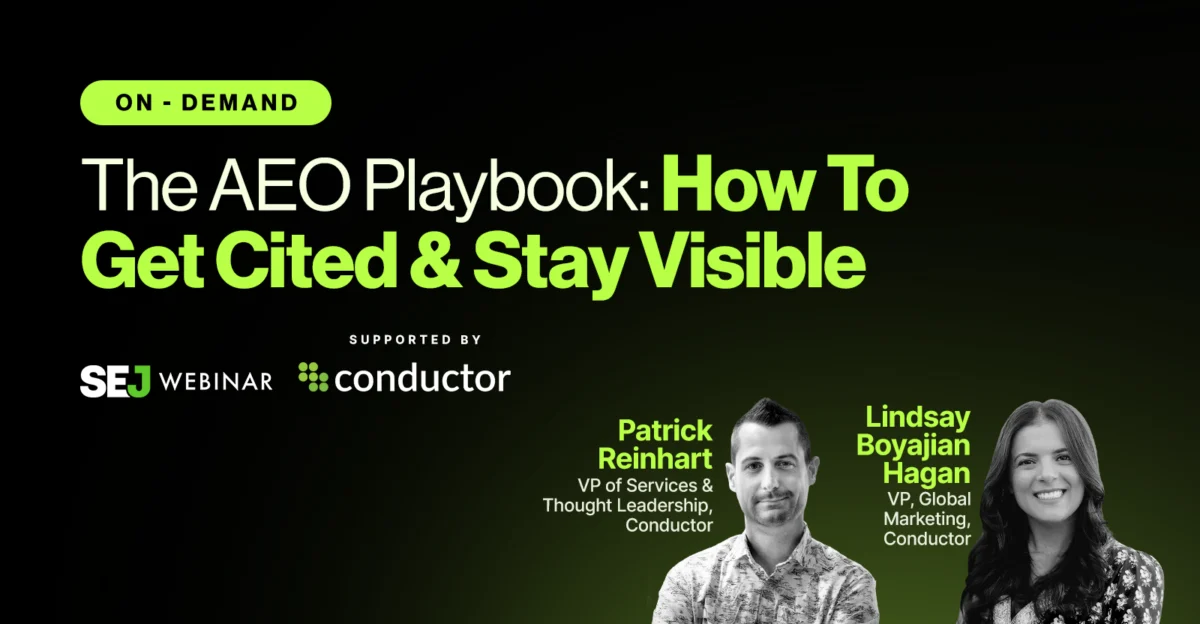
In a recent, high-impact webinar hosted by Search Engine Journal, Conductor’s leadership—Pat Reinhart (VP of Services and Thought Leadership) and Lindsay Boyajian Hagan (VP of Marketing)—outlined a sobering reality: AI crawlers are visiting your website thousands of times, yet they are sending back virtually zero traffic. This isn’t a failure of SEO; it is a fundamental rewrite of how information is consumed. As buyers increasingly find answers directly within AI-generated responses, the race to reach "page one" is being replaced by a more complex, high-stakes battle for "AI visibility."
The End of the Traffic Era: Understanding the Shift
To understand why organic traffic is stagnating even as search impressions climb, one must look at the "physics of the web." Historically, Google operated on a balanced exchange: it crawled your site roughly twice for every visitor it delivered to your doorstep. That ratio has shattered.
Today, AI crawlers perform deep-dive indexing of your content, visiting sites tens of thousands of times to synthesize information. However, because the LLM provides the answer directly in its interface, the user no longer feels the need to click through to the source. Conductor’s own internal data from Google Search Console reflects this clearly: businesses are seeing impressions rise as their content is indexed, while actual clicks plummet.
Pat Reinhart was blunt regarding the implications for modern marketing teams: "The goal here is not traffic, because traffic is going to naturally go down as people are educating themselves on LLM surfaces." For marketing leaders, this necessitates an immediate pivot in executive reporting. If your quarterly KPIs are still tethered primarily to organic sessions, you are measuring a metric that is rapidly becoming a relic of the past.
The Keyword Fallacy: Why Your 4-Word Strategy Is Failing
For years, the SEO industry was obsessed with "short-tail" keywords—the three-to-four-word phrases that defined search volume. However, the nature of human inquiry has changed alongside the technology.
The average AI prompt is now approximately 23 words long. This jump from four words to 23 represents a massive increase in contextual data. A user searching for "best running shoes" is a commodity lead; a user asking, "What are the best running shoes for a person with wide feet who runs on rough, uneven city terrain?" is a high-intent buyer seeking a specific, qualified recommendation.
Brands that continue to optimize for short keywords are missing the nuance that LLMs use to rank their answers. Conductor advocates for a "Custom Prompt Index"—a strategic roadmap that identifies the specific long-form questions your target audience is asking. By building this index before drafting content, brands can move from generic SEO to AI-native authority. Lindsay Boyajian Hagan described this methodology as a "big unlock" for her team, shifting the focus from volume-based keyword chasing to high-context answer engineering.
The Mention Spectrum: From Citations to Authority
Not all AI mentions are created equal. Conductor has mapped out a "Mention Spectrum" that classifies brand citations based on their value. At the bottom are passing mentions; at the top is the "positive recommendation"—the holy grail of AI search, where an LLM identifies your brand as the definitive authority for a category.
Achieving this status requires treating brand sentiment as a technical search problem. Interestingly, data suggests that video content—specifically YouTube—is the most frequently cited source across major LLMs. This finding has profound implications for content planners: if your brand is not leveraging video as a primary source of authority, you are likely missing out on the primary data feeds that LLMs use to construct their recommendations.
The "Reddit Signal": Why Your Competitors Are Winning by Default
One of the most revealing insights from the session concerns the prevalence of Reddit in AI search results. When ChatGPT or Perplexity cites a Reddit thread as the answer to a professional query, it is not because Reddit is inherently the best source of information; it is because the LLM could find no better, more authoritative answer from a primary brand.
"LLMs only really cite Reddit when there’s no other good source out there," Lindsay explained. "So if you see Reddit, that’s a good indicator that the LLM is craving content."
Pat Reinhart added a more urgent perspective: "They’re never going to not give you an answer. If you’re seeing Reddit there, that means that no brand out there has a really good answer and they’d rather quote the conversation happening on a subreddit, which is wild."
For brands, this represents a significant opening. If your industry is dominated by forum discussions in AI outputs, there is a vacuum of authority that your content could fill. By providing high-quality, structured information that directly answers the user’s specific "23-word" prompt, a brand can displace these user-generated threads and position itself as the primary expert.
Expert Q&A: Addressing the New Reality
During the webinar, the speakers addressed several critical questions that highlight the tactical challenges of this new era.
On Monitoring Performance
When asked how to track recommendations across thousands of potential prompts, the advice was clear: do not try to track everything. Teams that focus on "digestible chunks" of high-value prompts achieve significantly higher success rates than those trapped in the "analysis paralysis" of monitoring thousands of low-impact queries.
On Content Freshness
Regarding the obsession with "fresh" content, Pat cautioned against the common practice of simply changing a publication date. "If a page keeps earning citations, leave it be," he advised. AI models prioritize performance and depth over a calendar date. A refresh is only worth doing when it adds substantial value to the user’s query.
On Backlinks
Perhaps the most controversial point raised was the role of backlinks. While they remain essential for traditional Google search, their influence on AI-generated answers is minimal. "I haven’t built a link in like 20 years and I’ve never had a problem getting a site to rank," Reinhart noted, suggesting that for AI visibility, link equity is being superseded by content relevance, structure, and authoritative depth.
Implications for the Future of Marketing
The transition to an AI-driven web is not merely a change in algorithm; it is a change in the human-machine interface. As search moves from a "discovery" model to an "answer" model, the brands that win will be those that effectively function as a knowledge base for LLMs.
The "AEO Maturity Model" presented by Conductor suggests that most organizations are still in the early stages, clinging to legacy SEO practices that are losing effectiveness by the day. To remain visible, brands must:
- Develop a Prompt Index: Map the 23-word questions your customers are actually asking.
- Prioritize Authority over Keywords: Focus on becoming the primary source that LLMs cite, rather than just the destination for a click.
- Audit the "Mention Spectrum": Determine where your brand currently sits and what specific content activities move the needle.
- Fix the Technical Layer: Ensure your site is technically optimized so that AI crawlers can ingest your information without friction.
The era of passive traffic is ending. The era of intentional, AI-optimized visibility has begun. For marketing teams, the choice is clear: either adapt to the new physics of the web, or watch as your brand becomes an invisible participant in a conversation that is increasingly happening without you.
For those ready to move forward, the full Conductor playbook, including a live demonstration of how to map prompts and optimize for AI citations, is currently available on demand. The path to AI dominance is not built on backlinks or meta-tags—it is built on becoming the answer.
