





As the global astronomical community turns its gaze toward the next frontier of deep-space exploration, all eyes are fixed on the Nancy Grace Roman Space Telescope. Scheduled for launch as early as next month, this marvel of modern engineering is poised to execute one of the most sophisticated "disappearing acts" in the history of science. By deploying the first-ever space-bound "active" coronagraph, NASA is preparing to peer through the blinding glare of distant stars to reveal the elusive, dim worlds that have long remained hidden in the shadows.
Named in honor of Nancy Grace Roman, the agency’s pioneering first chief of astronomy, the mission represents a massive leap in capability. With a 300-megapixel wide-field camera, the telescope will capture images with a field of view 100 times larger than the Hubble Space Telescope’s widest exposures, while maintaining the same exquisite resolution. This is not merely an incremental improvement; it is a fundamental shift in how humanity observes the universe.
The Anatomy of a Vanishing Trick
To understand the scale of the challenge, one must consider the sheer difficulty of photographing an exoplanet. Imagine trying to spot a firefly hovering near a high-powered searchlight from thousands of miles away. The searchlight—the star—is billions of times brighter than the firefly—the planet. Conventional telescopes, including Hubble and the James Webb Space Telescope (JWST), have used stationary masks to block this light. While effective, they are passive instruments; they simply "cover" the bulb. Stray glare often leaks around the edges or reflects off the telescope’s own internal components, creating "speckles" that can easily be mistaken for planets or, worse, hide them entirely.
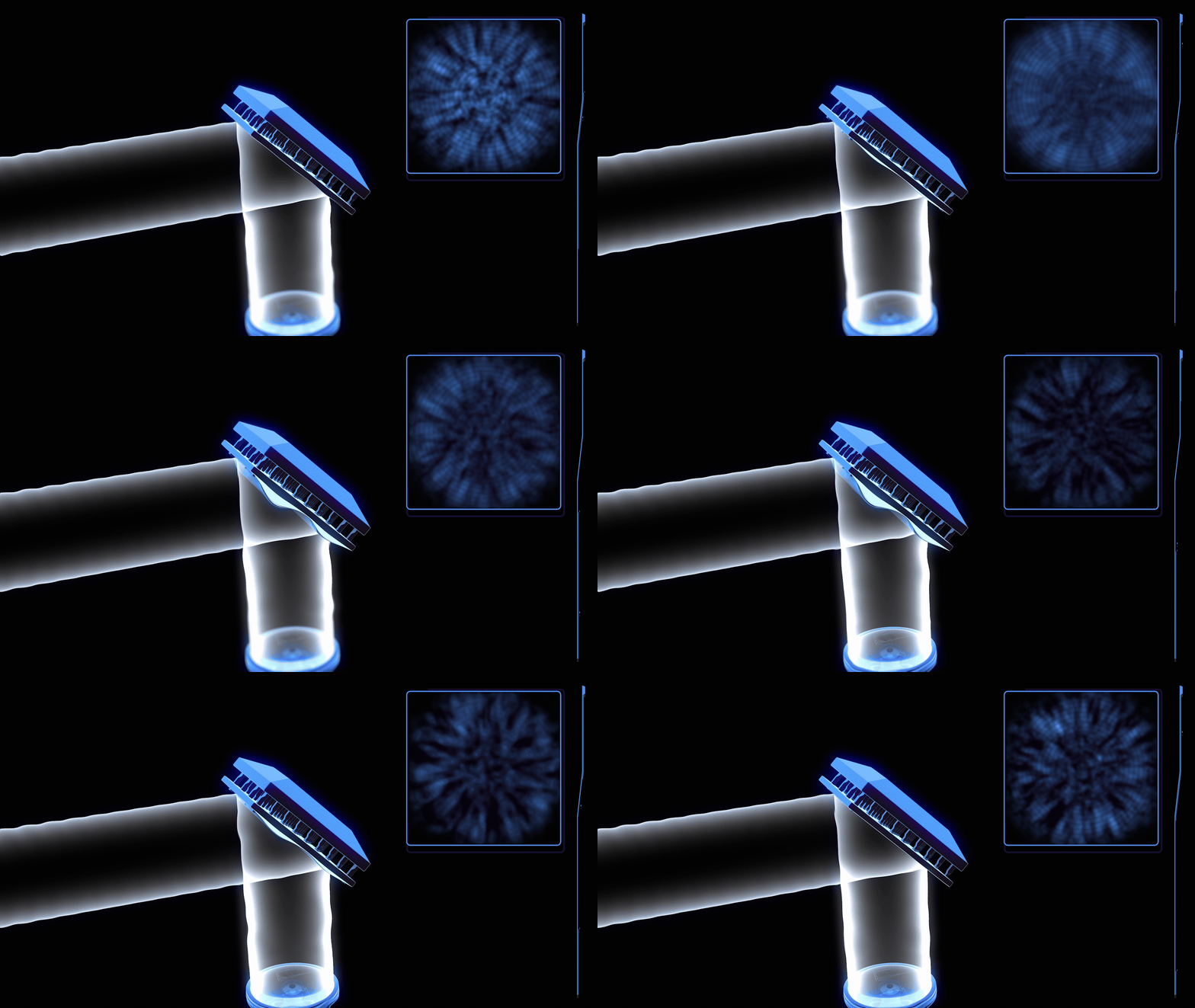
The Roman Space Telescope changes the game with active wavefront control. Its coronagraph is essentially a dynamic, intelligent shutter system. At the heart of this instrument are two deformable mirrors, each equipped with a 48-by-48 grid of "actuators"—tiny pistons that allow the mirror’s surface to be sculpted with surgical precision.
By applying a small amount of voltage, these actuators can deform the mirror surface by as little as 10 picometers—roughly one-tenth the diameter of a hydrogen atom. This allows the telescope to actively cancel out incoming waves of unwanted light, functioning much like noise-canceling headphones for photons. This process carves out a "dark doughnut" around a star, a region of suppressed light where the faint, reflected glow of orbiting planets can finally emerge.
Furthermore, the instrument utilizes "silicon grass"—a forest of microscopic spikes engineered to trap errant light. When a stray photon enters this thicket, it bounces deeper and deeper until it is absorbed, ensuring that the final detector remains clear of the chaotic reflections that have plagued previous observations.
A Chronology of Discovery and Development
The journey of the Roman Space Telescope has been a decade-long odyssey of iterative engineering.
- 2018: The project entered its critical design phase, with mechanical engineers like Brandon Creager focusing on the structural integrity of the coronagraph. The goal was clear: to build an instrument that could maintain its alignment despite the extreme thermal fluctuations of space.
- 2021–2023: The integration of the deformable mirrors marked a turning point. Testing confirmed that the active wavefront control could suppress stellar glare by a factor of up to 1,000 compared to legacy instruments.
- 2024: Final testing cycles were completed, validating the "silicon grass" technology and the software algorithms responsible for real-time mirror adjustment.
- Late 2024/Early 2025: The anticipated launch window. Once deployed, the initial phase will focus on calibrating the coronagraph, "digging" the dark regions around target stars, and verifying that the system can maintain stability as the spacecraft orbits.
- Post-Launch Era: Over the coming decades, the data returned by Roman will serve as a foundational dataset, potentially informing the next generation of space observatories.
Supporting Data: The Magnitude of the Mission
The sheer volume of data expected from the Roman mission is staggering. By leveraging its wide-field camera, the telescope is predicted to identify approximately 100,000 new exoplanets through gravitational microlensing—the process by which a planet’s gravity distorts the light of a background star.
Javier Viaña, a research scientist at Harvard, aptly compares this to moving from "interviewing a handful of people" to "conducting a global census." While previous missions were forced to hunt for planets in a piecemeal fashion, Roman will survey the galaxy on a grand scale.
The technical specifications are equally impressive:
- Camera Resolution: 300 megapixels.
- Observational Efficiency: 100x the field of view of Hubble.
- Coronagraph Sensitivity: 1,000x improvement in detecting faint exoplanets against stellar glare.
- Mirror Precision: Adjustments in 10-picometer increments.
Official Responses: Architects of the Future
For the scientists and engineers at NASA’s Jet Propulsion Laboratory (JPL), the project is deeply personal. Brandon Creager, the lead mechanical engineer for the coronagraph, views the instrument as a legacy project. "I hope it’s remembered for being that critical stepping stone for finding Earth 2.0," he says. For Creager, the mission is the culmination of years of labor, moving from theoretical designs to physical hardware currently sitting at the tip of a rocket.
Meredith MacGregor, a professor of astronomy at Johns Hopkins, echoes this sentiment but adds a note of pragmatic caution. "I’m honestly a little terrified about how we’re all going to deal with it, because I think it’s just so much data," she remarks. MacGregor emphasizes that the value of the Roman mission lies not just in the photos, but in the atmospheric chemistry that can be derived from the light the telescope collects. By analyzing the wavelengths of reflected light, astronomers can move beyond simply knowing a planet exists to understanding what it is made of—a vital precursor to determining habitability.
Ilya Poberezhskiy, the project systems engineer at JPL, underscores the collaborative nature of the "vanishing trick." He notes that the combination of the deformable mirrors and the photon-trapping masks creates a "succession of gates and hedges," ensuring that only the light of the target planet reaches the sensor.
Implications: The Quest for Earth 2.0
The broader implications of the Roman Space Telescope extend far beyond the immediate cataloging of gas giants. Currently, our understanding of exoplanets is heavily biased toward "Hot Jupiters"—massive, young, glowing planets that are easy to spot because they are essentially still radiating the heat of their own formation.
Roman will shift the focus to "Jupiter analogues"—mature, cool gas giants that reflect their parent star’s light, much like our own Jupiter. This is a critical step in understanding the architecture of solar systems similar to our own. By observing these mature worlds, astronomers will gain unprecedented insight into the evolution of planetary systems over billions of years.
Furthermore, the success of the Roman coronagraph is a prerequisite for the proposed Habitable Worlds Observatory. That future mission aims to do the impossible: directly image an Earth-sized planet orbiting a sun-like star. If Roman proves that we can "dig" the dark doughnut and keep it clean in the harsh environment of space, it will provide the technical roadmap for humanity to finally answer the age-old question: "Are we alone?"
As Creager prepares for the launch, he remains focused on the human element of this technological achievement. "Not too many people get to say, ‘I built something and it’s taking a picture of a planet that’s at a star that’s 50 light-years away,’" he reflects. When the first images arrive—likely little more than a smattering of pixels—they will not just be photographs. They will be the result of a decade of engineering brilliance, proving that even the most blinding stars can be tamed, and that the darkest corners of the universe are, at last, within our reach.
