


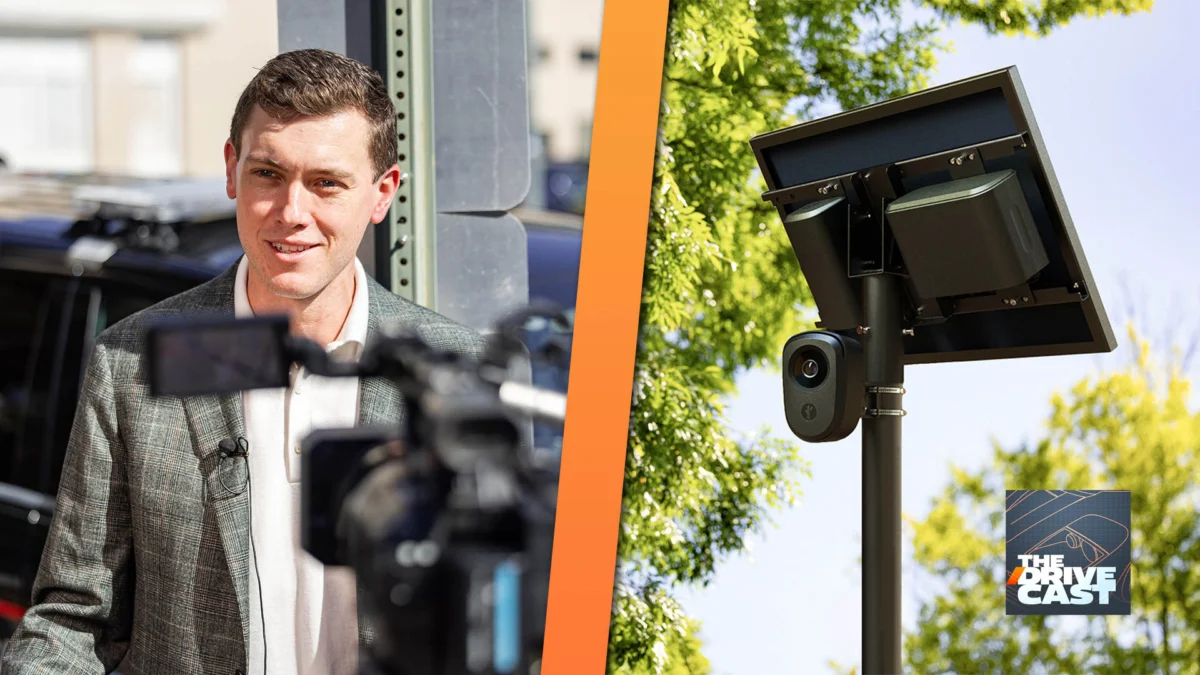
The modern American streetscape is undergoing a silent, technological metamorphosis. On thousands of intersections, unassuming cameras mounted on streetlights and poles are quietly scanning every passing vehicle. These aren’t traditional traffic cameras; they are sophisticated, AI-driven license plate readers (ALPRs) manufactured by Flock Safety.
While proponents herald them as a miracle of modern crime-fighting, a growing chorus of critics—and even those caught in the crosshairs of the technology’s flaws—are raising urgent questions about privacy, the Fourth Amendment, and the dangerous potential for systemic error. The debate hit a fever pitch recently when Joel Feder, an automotive journalist, found himself surrounded by four police officers in a parking lot, wrongly identified as a suspect in a criminal investigation.
On the latest episode of The Drivecast, Flock Safety Founder and CEO Garrett Langley stepped into the hot seat for a candid, no-holds-barred conversation about the company’s role in modern policing, the limitations of the data it relies on, and the future of public surveillance.
The Anatomy of an "Edge Case" Error
The impetus for this deep dive was a harrowing personal experience for The Drive’s own Joel Feder. While driving a $155,000 press-loaner Range Rover, Feder was tracked by Flock cameras for days. The technology, which utilizes machine learning to scan plates against national databases, flagged the vehicle as associated with a criminal incident.
The reality was far more mundane—and significantly more alarming. A law enforcement officer had manually entered an incomplete, incorrect license plate number into the FBI’s National Crime Information Center (NCIC) database. Flock’s system, programmed to find the "bone" it was tossed by the FBI, dutifully matched the partial string.
"Human error was involved," Feder notes, "but Flock cameras working off the company’s AI tech compounded everything at an exponential rate."
This incident highlights a critical systemic vulnerability: Flock does not maintain its own independent database of criminal activity. Instead, it acts as a high-speed conduit for the FBI’s NCIC, a system that experts describe as archaic. Because the system lacks a robust feedback loop, once an incorrect entry is made, it can propagate through the network, triggering alerts across multiple jurisdictions and turning innocent civilians into targets for police ambushes.
The Technical Reality: How Surveillance Works
During the discussion, Garrett Langley sought to demystify the technology that has become both a gold standard for police departments and a lightning rod for civil libertarians.
"We’ve tried to build around [the NCIC’s] archaic structure," Langley explained. "We have this concept called ‘suppression.’ A local agency might see that there’s a stolen plate out of California, but it’s already been resolved… They can, in Flock, suppress that: ‘Never alert us on that for the next year.’"
However, this suppression is localized. If a car is wrongly flagged, suppressing the alert in one suburb does not shield the driver from being stopped in the next. Langley argues that the solution lies in modernization. He advocates for a system where local law enforcement can verify and delete stale data—essentially creating a "collaborative cleanup" of the FBI’s static lists. He suggests that mandatory expiration periods for hot-list entries—perhaps seven or 30 days—would significantly reduce the number of false positives that lead to life-altering traffic stops.
Privacy, Policy, and the Fourth Amendment
The central tension regarding Flock Safety is the transition from "policing" to "surveillance." With the company now present in over 7,000 cities, critics argue that the cumulative effect of these cameras is a "digital map" of a person’s life, constructed without a warrant.
Langley, however, frames the issue as one of local democratic governance. "The Mayor of Plymouth and the City Council should make that decision," he stated, regarding data retention policies. He argues that if a community decides it only wants to use the system for Amber or Silver Alerts rather than general crime, the technology can be configured to meet those values.
"We don’t want to push our opinion as individual citizens," Langley insisted. "We just wish that more elected officials would do their research, do their homework, form an opinion, engage the community, and then set a standard that makes sense for them."
Yet, the "local control" argument is frequently tested by reports of police abuse. Across the country, there have been documented instances of officers misusing Flock technology to stalk ex-partners or track individuals without a legitimate law enforcement purpose. While Langley touts the company’s audit logs and "abnormal behavior detection" software as the gold standard for accountability, the fact remains that a powerful tool designed to protect the public can, in the wrong hands, become a weapon of harassment.
The Cost of Innovation: "Domestic Terrorists" or Concerned Citizens?
Perhaps the most controversial aspect of the company’s rise has been the visceral public pushback. In various cities, protesters have gone so far as to cut down, shoot, or cover Flock cameras with trash bags.
In a previous interview, Langley famously labeled those destroying the equipment as "domestic terrorists," a comment that sparked immediate backlash. On The Drivecast, he offered a clarification, acknowledging he should have been more precise.
"I clearly could have done a better job delineating between individuals who commit felonies—where… destruction of property is a felony in many states—and individuals who are promoting breaking the law," Langley said. He emphasized that he welcomes the voice of groups like the ACLU and DeFlock, who are exercising their right to protest surveillance. He maintained, however, that he cannot condone the illegal destruction of property, regardless of one’s political stance on privacy.
Implications: A Future of Ubiquitous Policing?
As the discussion concluded, the broader implications became clear. We are entering an era where the concept of "anonymous travel" is effectively vanishing.
Langley envisions a future where crime—particularly the "opportunistic" crimes that constitute the vast majority of theft and burglary—becomes so difficult to execute that they simply stop happening. He points to San Francisco as a "success story" where, after a surge in crime, the city’s partnership with Flock helped stabilize safety.
But for every success story, there is an uncomfortable question: What are we willing to trade for that safety?
The debate is no longer about whether the technology works—the high clearance rates and recovered stolen vehicles are data points that even critics have a hard time ignoring. The debate is about the infrastructure of trust. When a system is so efficient at tracking that it can turn a routine commute into a traumatic police interaction due to a typo, the margin for error must be non-existent.
As Congress weighs potential regulations and cities decide whether to renew contracts, one thing is certain: Flock Safety has changed the rules of the road. Whether that change represents a necessary modernization of justice or a step toward an uncomfortable, monitored reality remains the defining question of our time.
For now, the cameras continue to blink, the data continues to flow into the cloud, and the balance between security and liberty remains, as ever, on a knife’s edge.
Listen to the full interview with Garrett Langley on The Drivecast, available on Spotify, Apple Podcasts, and Amazon Music.
