





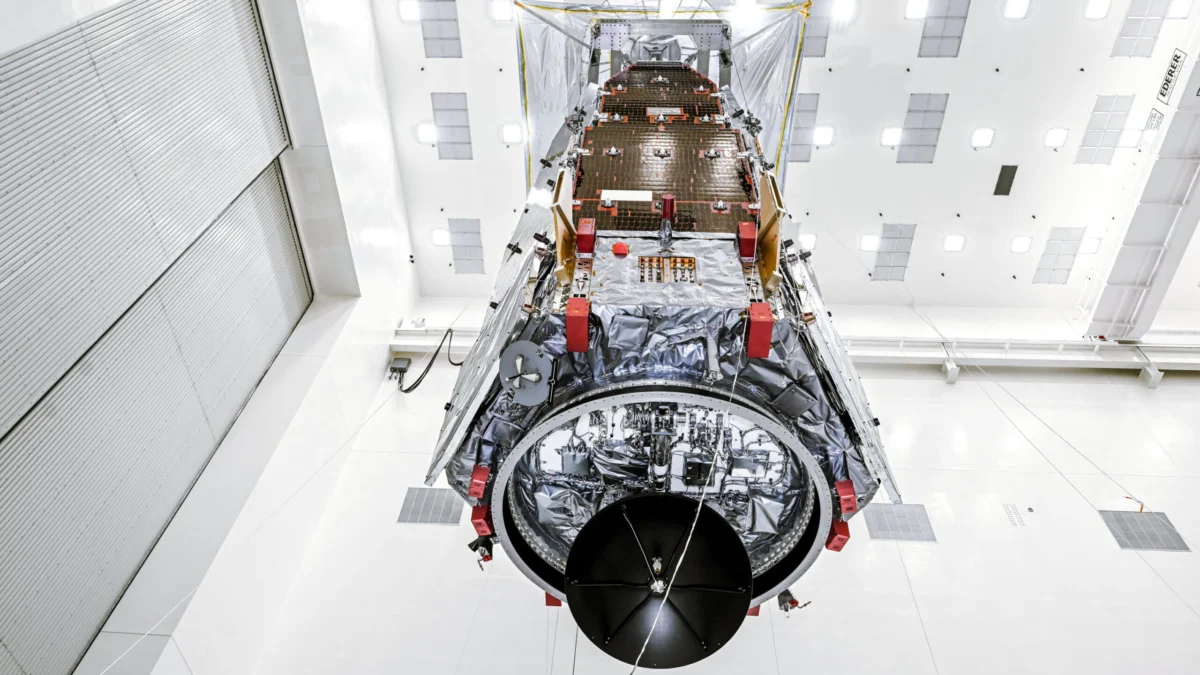
As NASA prepares for the late-August launch of the Nancy Grace Roman Space Telescope from the Kennedy Space Center, the agency is touting the observatory as a revolutionary tool for cosmology. Designed to unlock the mysteries of dark matter and dark energy, Roman is poised to survey over one billion galaxies and discover thousands of new exoplanets. However, as the mission nears its liftoff, a secondary, terrestrial-focused mission has emerged: the defense of Earth against potentially catastrophic asteroid impacts.
A New Frontier in Planetary Defense
While Roman was primarily engineered to peer into the deepest reaches of the universe, a multi-institutional team of planetary scientists and astronomers is now highlighting its secondary utility. In September, at the Europlanet Science Congress in The Hague, experts will present a detailed strategy on how Roman’s unique infrared capabilities and expansive field-of-view can be leveraged to scan for near-Earth objects (NEOs).
The telescope, named in honor of the "Mother of Hubble," NASA’s first chief astronomer, is equipped with a 300-megapixel infrared camera. This instrument allows Roman to capture a patch of space roughly 100 times larger than the view afforded by the Hubble Space Telescope. This massive "eye" in the sky, which can identify asteroids as small as 60 feet in diameter, could prove critical in identifying the "hidden" rocks that pose a danger to our planet.
The Chronology of a Mission
The path to Roman’s dual-purpose status has been anything but linear. The mission has faced significant political and budgetary volatility, including intense threats of cancellation and funding cuts by the Trump administration in 2020 and again in mid-2025.
In July 2025, as budgetary pressures mounted, Rick Cosentino, a planetary scientist at NASA, emphasized to his colleagues the importance of demonstrating Roman’s versatility. By positioning the telescope as a vital asset for planetary defense, the mission team aimed to secure its longevity by proving its tangible value to taxpayers and lawmakers. Bryan Holler, a researcher at the Space Telescope Science Institute, notes that this tactical shift in the narrative was essential to ensure the project remained a priority despite the shifting sands of political support.
The timeline for planetary defense is accelerating. With the upcoming launch of the NEO Surveyor in 2027—a mission specifically built for asteroid hunting—the scientific community is building a layered, multi-telescope defense network. Roman will act as a force multiplier in this architecture, filling critical observational gaps left by ground-based systems.
Supporting Data: The Scale of the Threat
The necessity for such a robust observational network is underscored by the sheer number of objects in our cosmic neighborhood. NASA’s Planetary Defense Coordination Office estimates that there are approximately 25,000 asteroids at least 460 feet wide in near-Earth orbits, with more than half still undiscovered. An impact from an object of this size would cause catastrophic regional destruction.
Even smaller threats, such as the 60-foot-wide asteroid that exploded over Chelyabinsk, Russia, in 2013, demonstrate the danger. That event released the energy of 500,000 tons of TNT, injuring 1,500 people. Scientists estimate there are roughly 230,000 such "city-killer" objects orbiting near Earth, with less than 10 percent currently accounted for.
Roman’s data will be processed to identify these threats. While the telescope is programmed to discard "streaks" caused by cosmic rays or sensor glitches, astronomers intend to analyze these discarded data points. By isolating the streaks caused by moving asteroids, they can track trajectories, sizes, and compositions with unprecedented accuracy.
Official Responses and Strategic Integration
NASA officials have been clear that Roman will not act in isolation. Instead, it will function as part of a sophisticated "telescope relay."
"Roman will sample such a large volume of the cosmos that we’ve long known it will offer vast opportunities for a range of additional science," says Alise Fisher, the astrophysics communications lead at NASA Headquarters.
The strategy for planetary defense relies on this teamwork:
- Detection: The NEO Surveyor, positioned between the Earth and the Sun, will use infrared to spot elusive asteroids that ground-based telescopes miss.
- Refinement: If a potential impactor is detected, Roman will be directed to that sector of the sky. Its wide-angle view allows it to observe multiple asteroids simultaneously, refining their orbits by several orders of magnitude in just days.
- Characterization: By utilizing infrared signatures, Roman can determine if an asteroid is metallic, stony, or carbon-rich. This information is vital for determining the "nudge" required for deflection missions or the explosive yield needed for mitigation.
- Follow-up: Once Roman narrows down the threat, specialized instruments like the James Webb Space Telescope (JWST) can be tasked to provide high-resolution, long-term monitoring of the most dangerous candidates.
Implications for Global Security
The integration of Roman into the planetary defense pipeline addresses a long-standing weakness: limited observation time. Ground-based telescopes are often hampered by atmospheric interference and limited viewing angles. Even the Vera Rubin Observatory in Chile, which is expected to identify nearly 90,000 near-Earth asteroids over the next decade, cannot act alone.
Because telescope time is highly oversubscribed, Roman provides a strategic advantage by filtering out benign travelers and highlighting only the most critical targets for follow-up. "Roman can provide infrared observations of more asteroids than JWST could hope to observe in a reasonable amount of observing time," says Holler.
The implications for humanity are profound. Knowing the composition of an asteroid—whether it is a loose "rubble pile" or a solid metallic rock—is the difference between a successful deflection mission and a failure. If an object is found to be on a collision course, this intelligence allows agencies to decide whether to attempt a "kinetic impactor" mission (like the DART mission) or, in extreme cases, more drastic measures to vaporize or deflect the threat.
Conclusion: A Multi-Purpose Sentinel
As the Nancy Grace Roman Space Telescope readies for its launch, it represents the marriage of pure scientific discovery and pragmatic survival. While its primary directive remains the exploration of the dark universe, its secondary mission is a testament to the maturation of human spacefaring capabilities.
We are moving from a reactive state of "discovering" asteroids only when they are nearby to a proactive state of constant surveillance. By turning its massive, 300-megapixel eye toward the darkness, Roman will not only reveal the history of our universe but also help ensure that we have a future within it. For the eight billion inhabitants of Earth, the telescope serves as a silent, infrared sentry—a cosmic shield hidden in plain sight, ensuring that if a threat does emerge from the void, we will not be caught unaware.
