




In the rapidly shifting landscape of Generative AI, the mechanisms governing how models retrieve and synthesize information are often hidden behind a veil of proprietary code. However, for those monitoring the network traffic of ChatGPT, the "black box" is becoming increasingly transparent.
Between August 16 and August 20, 2026, OpenAI quietly rolled out a fundamental shift in how ChatGPT handles web searches. This update represents more than a minor technical tweak; it is a structural overhaul of how the AI interacts with the internet, signaling a shift toward more deterministic, specialized, and widget-driven information retrieval.
The Shift: From JSON to Pipe-Delimited Precision
On August 16, a standard web search query from ChatGPT was contained within a structured JSON payload:
"system1_search_query":["q":"site:intercom.com Fin AI Agent pricing 2026"]
By August 20, that JSON format had vanished. In its place, OpenAI implemented a compact, proprietary query language that uses pipe-delimited lines to communicate instructions. A typical tool call now looks like this:
fast|Zendesk AI agents pricing 2026|30|zendesk.com
This change is not merely cosmetic. The new format includes metadata fields—specifically numerical values and specific domain targeting—that were previously absent or buried within deeper, more complex structures. The elimination of the search_queries metadata field means that legacy tools designed to parse ChatGPT’s "fan-out" (the process of expanding a single user prompt into multiple search queries) are now effectively blind.

Chronology of a Silent Deployment
The transition occurred in a tight four-day window. By mapping eight distinct questions across categories including commercial products, physical goods, local search, news, and finance, researchers have been able to reverse-engineer the syntax of this new "Search Language."
- August 16: The traditional JSON-based search architecture was active.
- August 17-19: Observers noted a transition period where internal logs began showing fragmented payloads.
- August 20: The new, highly structured, pipe-delimited syntax was fully operational across user accounts.
This rapid, unannounced migration underscores the agility of OpenAI’s development cycle. For AI SEO (Search Engine Optimization) and GEO (Generative Engine Optimization) professionals, this highlights a critical reality: the ground is constantly moving. Strategies that relied on parsing specific JSON fields are now obsolete, necessitating a new approach to auditing AI behavior.
Deciphering the New Syntax: Five Core Pillars
The new language reveals that OpenAI has moved toward a "verticalized" search approach. Each line in a tool call is a specific instruction, categorized by a call type.
1. The "Fast" Search and the Freshness Window
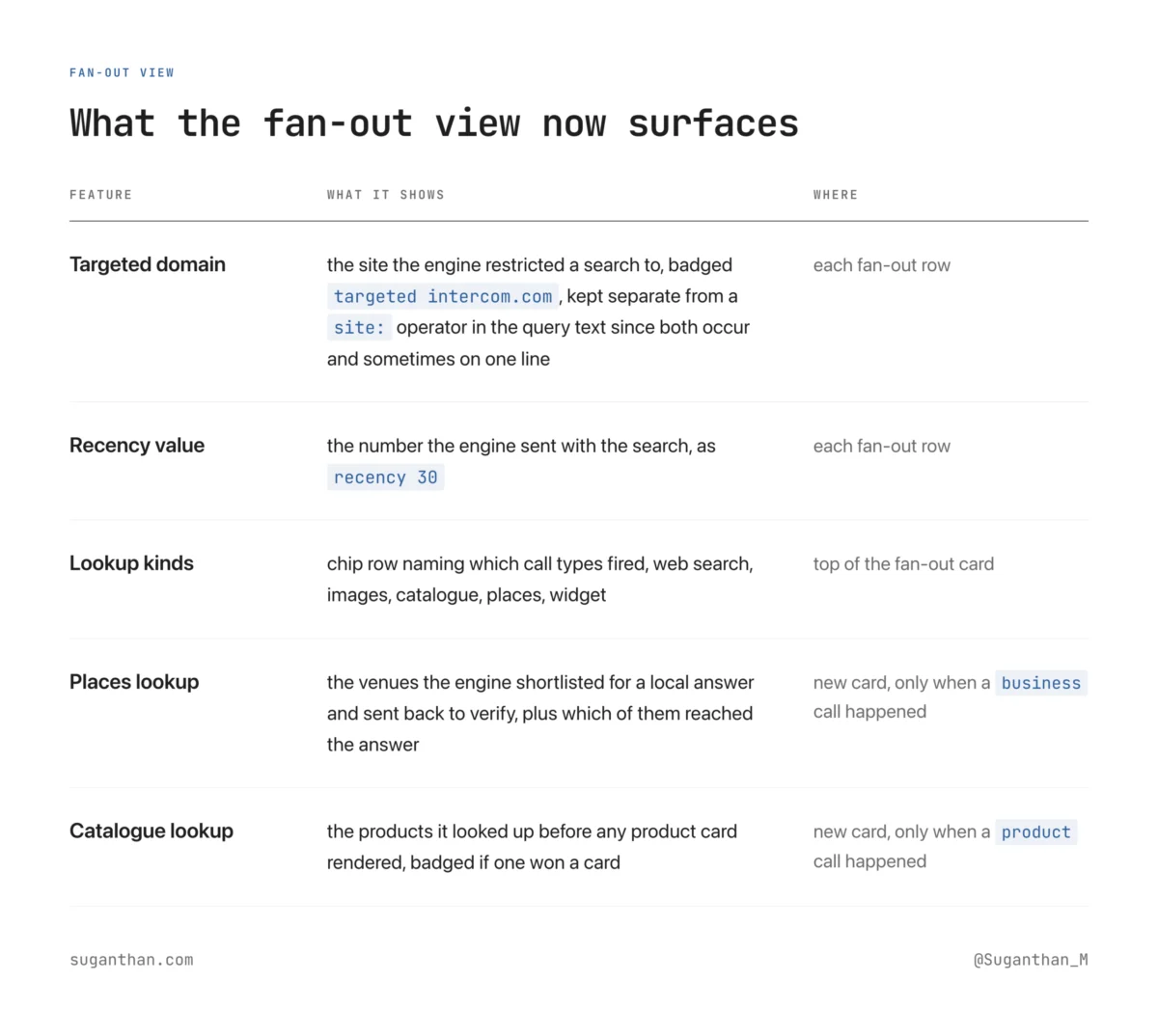
The fast call type is the direct successor to the old fan-out mechanism. The most intriguing aspect of the new format is the integer following the query. For example, a search for Nvidia stock prices might be assigned a 2, while a general query about live chat software might be assigned a 30.
The consensus among analysts is that this number represents a recency window in days. It acts as a constraint on how "stale" the retrieved information can be. If a brand’s pricing page has not been updated within this window, the model may perceive the information as unreliable, potentially demoting that content in favor of fresher, date-stamped alternatives.

2. Product Catalogs vs. Web Crawls
For physical goods, ChatGPT now uses a product call type. Unlike standard web searches, which parse text, product calls appear to trigger lookups within a specialized catalog. If your product appears in these calls, you are participating in a "catalog game" that exists independently of your website’s SEO. If you are not in the catalog, no amount of blog post optimization will result in a "product card" in the AI’s response.
3. The "Business" and "Image" Verticals
For local SEO, the business call type manages location-based queries. It operates in two stages:
- A search for relevant entities in a specific area.
- A verification process where the AI checks specific business names against web results.
If your business name does not appear in the second, verification-focused business call, your visibility issue is likely not with your website, but with your entity presence in local business listings.
4. The Rise of "GenUI" Widgets
Perhaps the most significant departure is the genui_run call. This command does not fetch a website; it triggers an internal interface widget. Whether it is a stock chart or an English Premier League schedule, these widgets are hosted on OpenAI’s own infrastructure.
When a query is answered by a widget, the "citation game" effectively ends. Because the AI is serving the data directly via its own UI, there is no link to click, and no traditional traffic to be gained. For publishers whose business model depends on being the "answer" to simple factual queries, this represents a significant threat to click-through rates.

5. The Reddit Paradigm
The most sophisticated use of the new language involves the treatment of social forums like Reddit. In several observed instances, the AI explicitly targeted Reddit with a 365-day (or even 3,650-day) window.
The strategy appears to be twofold:
- Upstream Candidate Selection: The AI identifies brands from memory.
- Opinion Mining: It then uses Reddit specifically to gather "sentiment" or "social proof" regarding those candidates.
Crucially, in many of these cases, the threads are fetched as "context" but are never explicitly cited in the final answer. This explains why some publishers have seen a drop in Reddit citations—the platform is being used as a source of truth for the model’s internal reasoning, rather than as a link-out destination for the user.
Implications for Digital Strategy
The implications of this architectural shift are profound for any organization tracking its "AI footprint."
The Death of Traditional Optimization
Old-school tactics—such as keyword stuffing or basic link building—are increasingly ineffective. If the model determines a brand via internal "shortlists" before it even executes a search, your visibility is determined by your presence in the model’s training data and your brand authority, not your ability to rank for a specific keyword in a search engine.

The Two-Minute Audit
To maintain visibility, stakeholders must adopt a new audit process. By using the Network tab in a browser’s Developer Tools, users can capture the conversation payload and search for the fast| string.
What to look for:
- Brand Inclusion: Is your brand being queried alongside your competitors?
- Domain Accuracy: Is the model targeting the correct URL? (Many brands lose visibility because the AI persists in searching an old or incorrect domain).
- Freshness: Does your content meet the "recency window" required for your category?
Official Responses and Industry Context
While OpenAI has not released a public manual for this query language, the shift aligns with the company’s broader goals of reducing hallucinations and improving the "utility" of the ChatGPT experience. By using widgets and specialized lookup tools, OpenAI is effectively tightening its control over the user experience.
The integration of Reddit data, following the 2024 licensing deal, suggests that OpenAI is prioritizing high-density, human-verified opinion data to counteract the dilution of low-quality web content. However, this shift places the power firmly in the hands of the platform provider.
Conclusion: Adapting to the New Reality
The era of the "Search Engine" as a neutral gateway is fading. In its place is a "Generative Engine" that acts as a curator, analyst, and widget-provider.

For businesses, the new rule is clear: you must be the entity that the model "remembers" to check. You must ensure your data in the places it looks (listings, catalogs, and social forums) is current and accurate. Most importantly, you must stop measuring success solely through clicks and start measuring it through AI visibility—the extent to which your brand occupies the model’s "shortlist" before it ever triggers a search.
The landscape is volatile, but the data is there for those willing to look. As we move deeper into 2026, the ability to read the "wire" will be the defining skill of the modern digital marketer.
