





Six months after the first US-Israeli strikes ignited a firestorm across the Middle East, the geopolitical map of energy has been fundamentally redrawn. As the Strait of Hormuz—the world’s most critical maritime oil artery—was transformed into a volatile naval battleground, the global economy has been forced to confront the fragility of its fossil-fuel dependency. The conflict, which began on February 28, 2026, has acted as a brutal catalyst, exposing deep vulnerabilities in traditional supply chains and, paradoxically, accelerating the world’s pivot toward renewable energy at a pace previously deemed impossible by market analysts.
The New Economic Reality: A $330 Billion Tax
The most immediate consequence of the war has been a staggering transfer of wealth. According to the Helsinki-based Centre for Research on Energy and Clean Air (CREA), global fossil fuel importers have been saddled with more than $330 billion in "war premiums" since the onset of the conflict. To put this figure into perspective, it is roughly equivalent to the entire 2025 gross domestic product of Finland.
This massive outflow of capital has destabilized developing nations and strained the budgets of major industrial powers. While the global community has spent the last half-year reeling from these costs, the conflict has created a clear dichotomy of winners and losers. Nations that had already diversified their energy portfolios prior to the war have demonstrated significantly higher economic resilience. China, for instance, managed to offset nearly $8 billion in potential fossil fuel import costs between March and July by leaning heavily on the renewable capacity it had painstakingly built since 2020.
Chronology of a Crisis: From Stability to Chaos
The transformation of the global energy landscape did not happen overnight. The following timeline outlines the rapid descent into volatility and the subsequent market response:
- February 28, 2026: Initial hostilities commence. US and Israeli strikes target Iranian energy infrastructure. Global oil markets react with immediate, historic volatility.
- March 2026: The Strait of Hormuz effectively closes to civilian traffic. Global export losses from Gulf states peak at an estimated $2 billion per day.
- April 2026: Consulting firm Rystad Energy assesses $58 billion in damage to energy facilities, including Saudi Arabia’s largest oil refinery and a critical Qatari LNG terminal.
- May–June 2026: As fuel prices remain at record highs, developing nations begin implementing radical energy-saving mandates, including four-day workweeks and rapid infrastructure shifts toward solar.
- July 2026: Data reveals that despite the war, global greenhouse gas emissions have remained relatively flat, rising only 0.2%, signaling that the clean energy boom is successfully offsetting the need for coal and oil.
The Winners: Clean Tech Titans and Western Producers
In the wake of the conflict, a new hierarchy of energy influence has emerged. China, leveraging its near-monopoly on green technology manufacturing, has positioned itself as the primary architect of the post-war energy order. As the rest of the world scrambled to find alternatives to expensive, unreliable oil, they turned to Chinese-made solar panels, batteries, and electric vehicles (EVs).
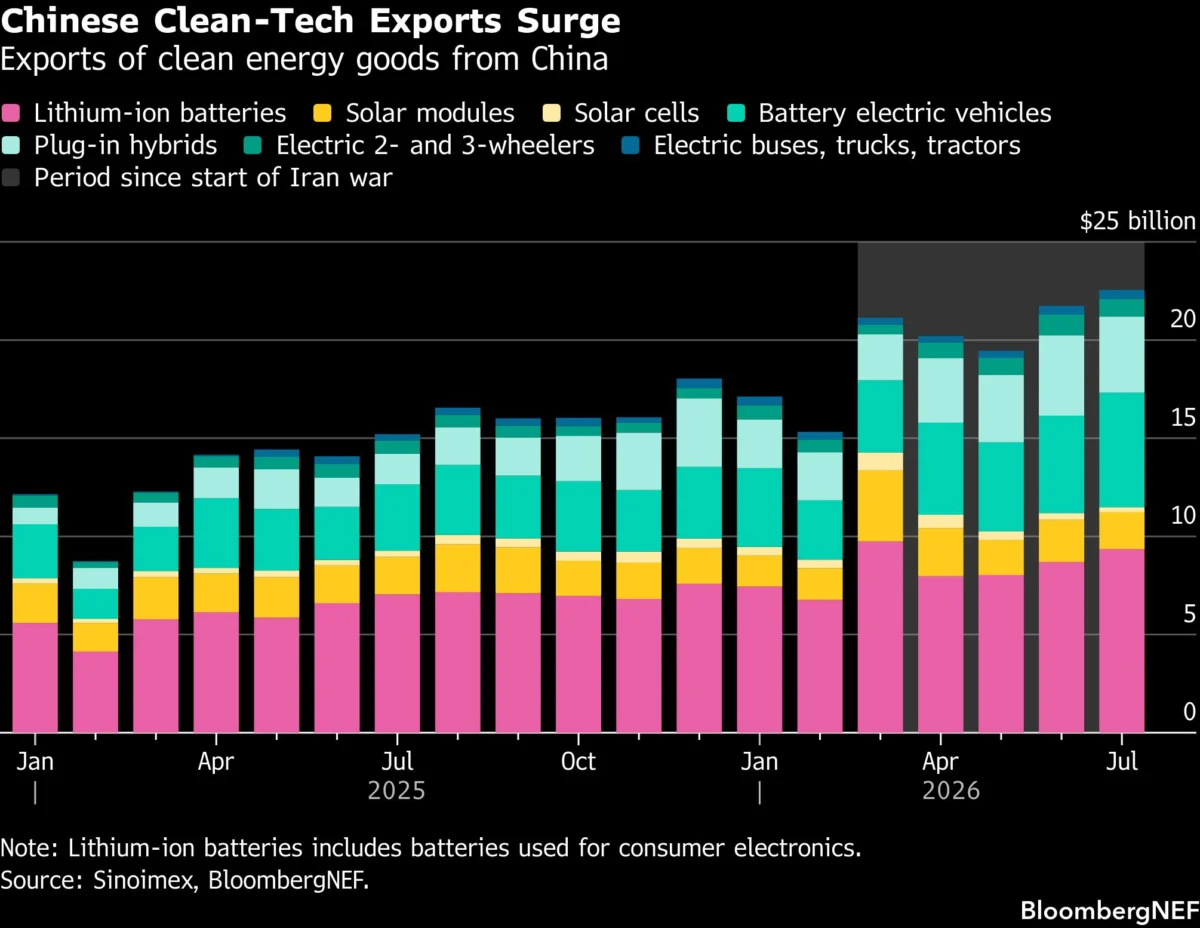
BloombergNEF reports that China has experienced five consecutive months of record clean tech exports. By July, Chinese EV manufacturers were shipping over half a million units to overseas markets, representing a staggering 150% increase year-over-year. This manufacturing dominance has effectively turned China into the primary beneficiary of the global shift away from Middle Eastern oil.
Concurrently, oil-and-gas producers in North and South America have reaped unexpected windfalls. With buyers shunning Gulf suppliers due to the high risk of transit through the Strait of Hormuz, US, Canadian, and Latin American producers ramped up extraction to fill the supply vacuum. Analysts expect these shifts to have long-term consequences; specifically, the boost to the mining sectors in countries like Chile and Peru is likely to persist, as the world’s appetite for copper and lithium grows in lockstep with global electrification.
The Losers: Gulf Instability and Import-Dependent Economies
For the Persian Gulf, the war has been an unmitigated disaster. Beyond the physical destruction of facilities, the region is facing a crisis of capital. The "risk premium" associated with Gulf debt has soared, making it nearly impossible for regional powers to finance the green energy transition they had planned prior to the war.
Meanwhile, nations that historically relied on the Strait of Hormuz for their primary energy intake—most notably Japan and South Korea—have been forced to absorb catastrophic price spikes. The collateral damage, however, has been felt most acutely in the Global South. In Africa, many net-importing nations have faced severe economic contraction. Ethiopia, as a primary example, saw its currency plummet as the central bank exhausted foreign exchange reserves in a desperate attempt to stabilize the economy against the surging price of refined petroleum.
Supporting Data: The Burden of the Transition
The economic data provided by CREA paints a harrowing picture of inequality. Poorer nations spent an additional 1% of their total GDP to absorb the energy price shock—a burden more than double that borne by the world’s wealthiest states. This has forced a "scramble for green" across the African continent. BNEF data indicates that African nations imported 37% more solar equipment from China in the first half of 2026 than in the same period of the previous year.
The Philippines serves as a microcosm for this trend. After government mandates forced a four-day workweek to curb consumption, the demand for solar technology skyrocketed, with imports of Chinese solar equipment surging 262% year-over-year in March alone. Similar trends are visible in Indonesia and India, where EV adoption rates have accelerated rapidly, reaching monthly passenger sales that would have been unimaginable just eighteen months ago.
Official Responses and Implications
Climate policy experts, while wary of the human cost of the conflict, have expressed surprise at the environmental outcome. "Renewables continue to grow. That does seem like good news," says Ting So, lead analyst for Climate Trace. However, he remains cautious regarding long-term projections. "The volatility of disruptions in the Strait of Hormuz makes it hard to predict long-term trends," he added.
Despite the chaos, the much-feared "return to coal" did not materialize. As energy prices hit record highs, the global market favored the immediate deployment of renewables over the sluggish, expensive reactivation of coal-fired power plants. This is a critical development in the fight against climate change; the first half of 2026 showed that the world’s largest polluters—the US and China—managed to stabilize or even slightly reduce emissions, effectively balancing out the increases seen in India and Brazil.
Looking Forward: A Permanent Pivot?
The central question remaining for the international community is whether these changes will survive a potential ceasefire. While a cessation of hostilities would undoubtedly lower the war-induced premiums on fossil fuels, analysts argue that the infrastructure investments made during this period of crisis are unlikely to be reversed.
"In countries where consumers are not being well shielded from higher fuel prices, they are moving very quickly to adjust their energy consumption patterns," notes Ethan Zindler, a BNEF analyst. This behavioral shift, combined with the massive influx of solar and EV technology, suggests that the world has passed a point of no return.
The Iran war, as tragic as it has been for the region and for the economies of vulnerable nations, has effectively broken the inertia of the global energy market. What was once a slow, policy-driven transition to green energy has become an urgent, market-driven necessity. As the dust begins to settle on the battlefields of the Middle East, the world finds itself standing on the precipice of a new, albeit forced, energy era—one defined less by the tankers of the Strait of Hormuz and more by the silicon of the solar panel.
