



As the European Union navigates the complex aftermath of the energy price shock triggered by Russia’s 2022 invasion of Ukraine, a new wave of geopolitical instability in the Middle East has reignited fears of supply-side constraints. With energy prices once again trending upward, European policymakers are dusting off a controversial fiscal tool: the windfall profit tax.
Initially conceived as a temporary emergency measure, the "solidarity contribution" and its national counterparts have evolved into a permanent fixture in some member states. However, as these taxes move from emergency stopgaps to long-term policy, their structural flaws—ranging from market distortion to the potential stifling of green investment—are sparking intense debate among economists, the European Central Bank (ECB), and the business community.
The Genesis of the Solidarity Contribution
The concept of a windfall tax—a one-time levy on unexpected, exogenous gains—is not new, but its application in the EU took on unprecedented scale in 2022. Following the energy crisis, the European Commission’s REPowerEU communication recommended that member states introduce temporary taxes on energy providers to capture "supernormal" profits that were not the result of increased efficiency or innovation, but rather the consequence of global market volatility.
In October 2022, the Council of the European Union finalized an agreement for an EU-wide "solidarity contribution" targeting the fossil fuel sector (oil, gas, coal, and refining). Simultaneously, a revenue cap was placed on "infra-marginal" electricity generators—those using nuclear, renewables, and lignite—whose production costs remained low even as wholesale electricity prices skyrocketed. The objective was clear: raise capital to provide immediate relief to households burdened by soaring utility bills.
A Chronology of Fiscal Intervention
The rollout of these measures was swift, though inconsistent.
- 2022: The EU launches the solidarity contribution, with a projected revenue target of €140 billion across two policies (solidarity contribution and electricity price caps). The UK follows suit, implementing a specific Energy Profits Levy targeting oil and gas extraction.
- 2023: Implementation varies wildly across the bloc. While 16 EU countries adopt the solidarity contribution and eight others introduce national alternatives, the results are fragmented.
- 2024: As energy prices normalize, the original justification for the tax begins to fray. However, instead of sunsetting the policies, several nations pivot the tax scope toward the financial and banking sectors.
- 2025: A European Commission report confirms that while total revenues reached €26.15 billion, the policy covered only a fraction (7%) of the €340 billion spent on total energy support measures.
- 2026: Six EU countries officially reiterate calls for a renewed, bloc-wide windfall tax mechanism, even as the European Central Bank and industrial leaders warn of long-term economic damage.
Evaluating the Revenue vs. Reality
The 2025 Commission report provides a sobering assessment of the policy’s efficacy. While the €26.15 billion collected slightly exceeded the initial €25 billion estimate for the solidarity contribution, the execution was far from uniform.
The data reveals significant gaps:
- Reporting Discrepancies: Out of 27 member states, only 19 provided usable revenue data.
- Inactive Participants: Countries like Luxembourg, Latvia, and Malta reported no in-scope companies.
- Revenue Zeroes: Finland, Lithuania, and Sweden reported zero revenue from the policy, while Cyprus chose not to adopt the regulation entirely.
- Scope Creep: Croatia, having applied a broader windfall tax across all sectors, could not isolate energy-specific revenues, complicating the EU-wide analysis.
Ultimately, the solidarity contribution failed to be the fiscal panacea that was promised. By covering only 7% of the €340 billion cost of energy support, the policy proved to be more of a symbolic political gesture than a sustainable funding mechanism for national social safety nets.
Official Responses and Economic Resistance
The persistence of these taxes has drawn sharp criticism from the highest levels of European financial governance. The European Central Bank (ECB) has been particularly vocal, issuing formal objections to windfall taxes imposed on the banking sector in Spain, Italy, and Lithuania.
The ECB’s concerns are rooted in three areas:
- Capital Erosion: Windfall taxes drain the retained earnings of banks, limiting their ability to build capital buffers against potential future recessions.
- Credit Contraction: By reducing bank profitability, these taxes can inadvertently lead to a tightening of credit supply, hindering small and medium-sized enterprises (SMEs) that rely on bank loans to fuel growth.
- Investor Sentiment: Investors view unpredictable, retroactive, or sector-specific taxes as a sign of an unstable regulatory environment, which increases the cost of capital for European firms.
The Structural Flaw: Double Taxation and Market Distortion
Beyond the political optics, the structural design of many current windfall taxes is fundamentally flawed. Economists argue that many of these measures function as "excise taxes" rather than true taxes on excess profits. By taxing gross sales (as seen in Spain) or imposing arbitrary price thresholds, governments are effectively penalizing companies for success rather than for "windfall" gains.
Furthermore, the risk of double taxation is acute. Because these companies already pay standard corporate income taxes on their profits, an additional, non-deductible windfall levy can create a tax burden that exceeds the economic reality of the company’s performance.
Perhaps most damaging is the impact on the "Green Transition." In the UK and Spain, evidence suggests that windfall taxes have directly threatened domestic renewable energy projects. When a company cannot predict its future tax environment, its willingness to commit to long-term, capital-intensive investments—such as wind farms or solar infrastructure—drops significantly. By targeting energy companies regardless of whether they are reinvesting in sustainable transition technologies, governments are creating a paradox: they are taxing the very entities required to build the energy-independent future that the EU claims to desire.
Implications for the Future of European Tax Policy
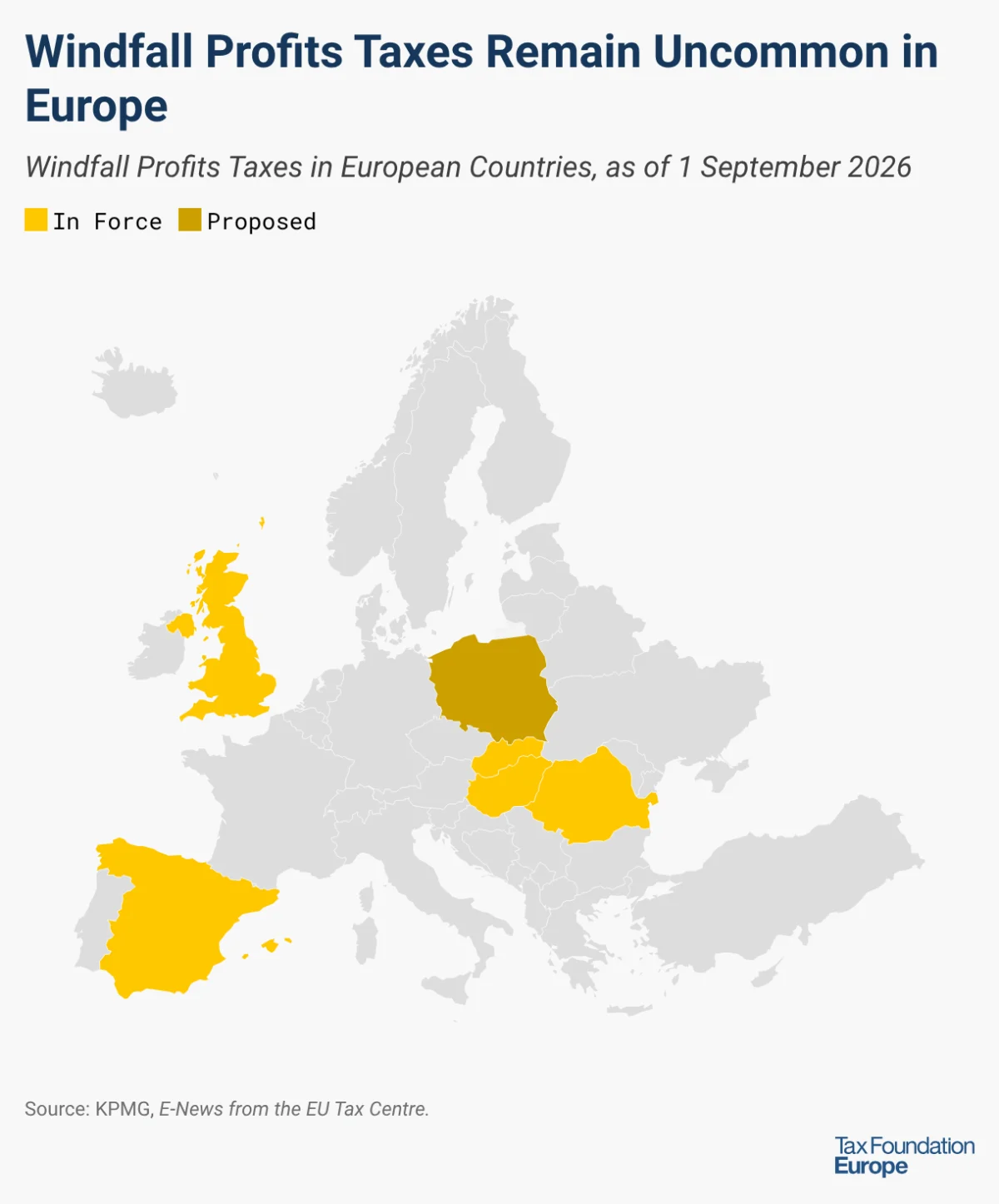
As of 2026, the temporary nature of these taxes has been largely abandoned. Hungary, Slovakia, and Spain have maintained their levies, and Romania has made its bank-sector windfall tax permanent. The UK has signaled it may keep its levy on fossil fuel companies until 2030.
This transition from "crisis-response" to "permanent revenue source" is a dangerous precedent. When emergency taxes become permanent, they distort competition, discourage foreign direct investment, and create a "patchwork" tax landscape that makes the EU less competitive globally.
Recommendations for Policymakers
To move toward a more stable economic future, the European Union must transition away from reactive, sector-specific taxation. The following principles should guide future reform:
- Sunset Clauses: Any emergency fiscal measure must include a hard sunset clause that is strictly enforced. Crisis measures should not be allowed to drift into long-term fiscal policy.
- Broad-Based Taxation: Policymakers should focus on broadening the tax base rather than increasing rates on narrow, volatile sectors. Broad bases allow for lower, more stable rates that do not distort market behavior.
- Neutrality: Taxes should be neutral, meaning they should not influence business decisions regarding production levels, investment, or innovation. Current windfall taxes, by contrast, explicitly penalize production.
- Stability: Predictability is the cornerstone of investment. If the EU wishes to remain a hub for innovation and energy development, it must ensure that its tax system is transparent and predictable.
The lessons from the last four years are clear: while windfall taxes offer a quick political win, they offer poor economic long-term stability. As Europe looks to secure its energy future, it must replace the blunt instrument of the windfall tax with a more sophisticated, principled approach to fiscal policy that fosters—rather than punishes—the industries of tomorrow.
