





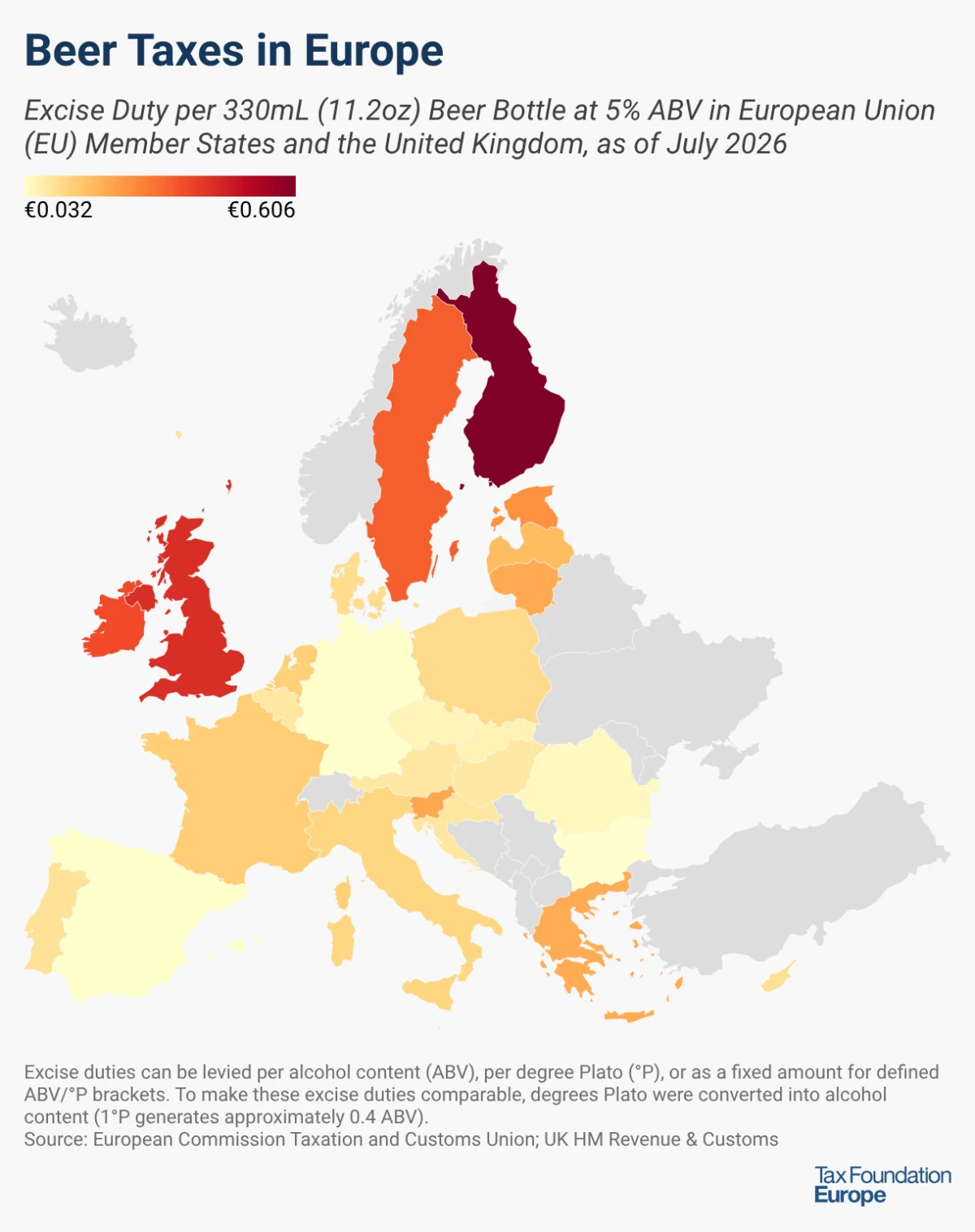
As the global beverage market undergoes a radical transformation driven by craft innovation and changing consumer preferences, the mechanisms used to tax these products are increasingly failing to keep pace. By 2026, many European nations will face a critical juncture: continue to rely on antiquated, category-based excise tax systems, or transition toward a modernized, alcohol-content-based model that promises efficiency, fairness, and economic transparency.
The Foundations of Excise: A Blunt Instrument
The rationale behind excise taxes on alcohol has remained largely unchanged for centuries. Governments levy these taxes primarily as a "sin tax"—a blunt instrument intended to discourage the consumption of socially disdained products while securing a reliable stream of revenue from goods with broad, inelastic demand.
However, the efficacy of this "blunt tool" is under fire. Critics argue that when tax policy relies on rigid definitions—categorizing products simply as "beer," "wine," or "spirits"—it fails to account for the modern reality of the beverage industry. In many jurisdictions, these taxes are not merely fiscal policy; they are moral stances codified into law, yet they often create perverse market incentives that do little to address public health concerns while simultaneously imposing significant administrative burdens on businesses.
Chronology of a Changing Landscape
The evolution of alcohol taxation has been a reactive process, trailing years behind market innovation.
- Pre-2010: The "Three Pillars" era. Tax systems were strictly divided between beer, wine, and spirits, with little overlap in regulation.
- 2010–2020: The Craft Revolution. The explosion of independent craft breweries and the rise of high-ABV (alcohol by volume) beer styles challenged the standard "beer" tax bracket.
- 2020–2024: The Rise of RTDs (Ready-to-Drink). The commercial success of canned cocktails, often made with neutral spirits but marketed to compete with beer, created a "grey market" for tax classification.
- 2025: Current administrative strain. Revenue authorities across Europe report record-high costs for monitoring compliance due to the complexity of distinguishing between fermented and distilled product bases.
- 2026 (Projected): The "Modernization Horizon." Proposed reforms in several EU member states and the continued implementation of the UK’s post-Brexit alcohol duty reforms set the stage for a standardized, ABV-based approach.
The Categorical Conundrum: Why Old Definitions Fail
The European alcohol tax landscape is notoriously fractured. While beer is often subject to specific excise regimes, wine—a product with arguably similar health profiles—often enjoys preferential treatment, with several countries imposing zero excise tax on it. Spirits, conversely, are taxed at significantly higher rates.
This discrepancy was manageable when the market was defined by clear boundaries. Today, those boundaries are functionally obsolete.
Innovation Blurring the Lines
Innovation in the alcohol industry has systematically dismantled the logic behind category-based taxation. The craft brewing movement introduced beers with higher alcohol content and complex flavor profiles that defy traditional beer classifications. Simultaneously, the rise of "malt liquors" and hard seltzers has created products that look and feel like beer but are treated differently under the law, or vice-versa.
The most significant disruption has come from Ready-to-Drink (RTD) cocktails. These products are often distilled spirits diluted with mixers. When they reach the consumer, their ABV is often identical to that of a standard craft beer. Yet, because of their lineage, they are taxed as spirits. This creates an artificial price distortion that punishes innovation and confuses consumers.
Supporting Data: Efficiency vs. Complexity
The contrast between European systems and the United Kingdom’s recent reforms offers a compelling case study. While many EU nations still rely on a mix of product-based and alcohol-content-based taxation, the UK has moved toward a more uniform duty rate based strictly on ABV.
The Administrative Cost of Complexity
The cost of compliance is an often-overlooked factor. For small-to-medium enterprises (SMEs) in the craft industry, navigating the disparate excise regimes across European borders acts as a significant barrier to trade. If a brewery in Germany wishes to export to France or Italy, it must calculate its tax liability based on different classification standards—some using degrees Plato, others using percentage ABV, and others using volume-based volume metrics.
Research indicates that administrative costs for alcohol excise tax compliance are disproportionately high for smaller producers. A move toward a standardized ABV tax would not only simplify domestic compliance but would also streamline the European Single Market, allowing smaller brewers to compete more effectively with global conglomerates.
Official Responses and Policy Outlook
Policy analysts and tax economists have increasingly advocated for a total shift in philosophy. The Tax Foundation and similar organizations argue that the "clunky categorical system" currently in place is a relic that inhibits economic growth.
The Case for Neutrality
Official commentary from economic reform bodies suggests that a tax based on alcohol content is inherently more neutral. By taxing the ethanol content rather than the "category" of the drink, governments can achieve three goals:
- Transparency: Consumers and producers know exactly how much tax is paid per unit of alcohol.
- Public Health Alignment: If the goal is to reduce harm, taxing the potency of the alcohol is a more precise mechanism than taxing the type of beverage.
- Market Fairness: It eliminates the "protectionist" tax regimes that currently favor one industry (e.g., winemakers) over another (e.g., brewers) without a clear public policy rationale.
However, pushback remains. Traditional wine-producing nations are often resistant to any tax reform that would harmonize rates with spirits or beer, citing cultural heritage and economic stability for rural agricultural regions.
Implications for 2026 and Beyond
As we approach 2026, the implications of this shift are profound for both the industry and the consumer.
For the Beverage Industry
The industry should prepare for a transition that prioritizes "ABV-centric" compliance. Companies that rely on tax loopholes—such as manipulating product recipes to fall into a lower-taxed category—will find these advantages disappearing. Conversely, companies that focus on quality and product development will benefit from a more predictable, level playing field.
For the Consumer
Consumers may see a rebalancing of prices. High-ABV beers that were previously taxed as "standard" may see price increases, while RTDs or lower-alcohol spirits may become more competitively priced. While this may lead to sticker shock in the short term, the long-term benefit is a market where the price of a drink is truly reflective of its alcohol content rather than arbitrary regulatory labeling.
For Public Policy
The 2026 horizon suggests a move toward "smart regulation." By discarding the outdated categorical systems, governments can reduce the administrative burden on tax authorities. The transition will require a significant investment in updating tax software and educating manufacturers, but the result will be a more resilient and transparent fiscal structure.
Conclusion: A More Efficient Future
The debate over alcohol taxation is no longer just about revenue or public health; it is about the modernization of the regulatory state. As the lines between beer, wine, and spirits continue to dissolve, the tax systems that govern them must follow suit.
Modernizing alcohol taxation is not a radical act of deregulation; it is an act of rationalization. By moving to a system that taxes the alcohol itself, rather than the container or the marketing category, European nations can create a more efficient, equitable, and transparent market. As we look toward 2026, the question is not whether the system should change, but how quickly governments can adapt to the realities of a global, innovation-driven alcohol industry.
For more information on the impact of excise tax reforms and to view detailed country-by-country analysis, visit the Tax Foundation’s research portal.
