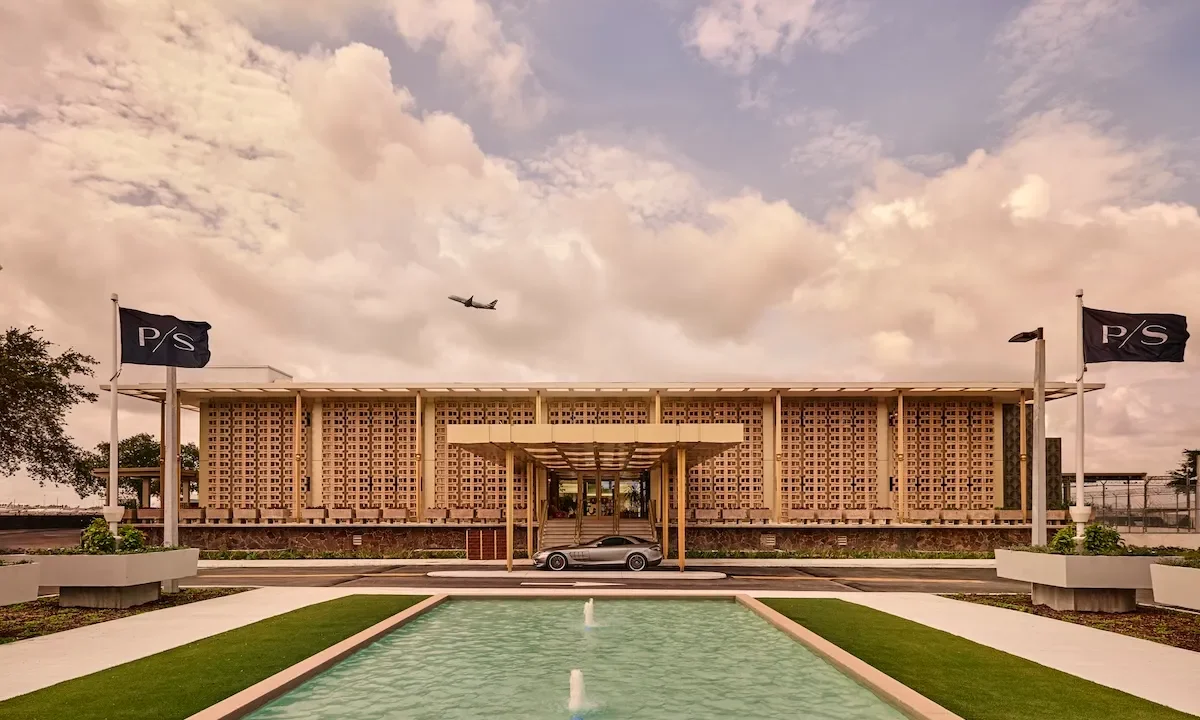



When a traveler pulls up to a nondescript, high-security entrance at one of the country’s busiest airports, they aren’t looking for a lounge; they are looking for an escape. At PS (formerly The Private Suite), the promise is not merely comfort—it is the total erasure of the friction that has defined commercial air travel for the last half-century.
As one steps into the PS terminal at Los Angeles International Airport (LAX), the experience is immediate. A team member greets the guest by name, recalling their preferred beverage or a specific dietary quirk from a visit months prior. It is a level of hyper-personalized service that most five-star hotels—let alone private terminals—struggle to achieve. In an era where the “members’ club” model has become ubiquitous and often diluted, PS has managed to maintain a level of operational intimacy that feels less like a service and more like a private residence.
The Genesis of an Elite Infrastructure
The company, founded in 2017 as "The Private Suite," began with a singular, audacious premise: What if the most grueling part of the commercial flying experience—the terminal itself—could be skipped entirely?
The model is straightforward but logistically daunting. PS provides a private terminal where guests arrive via a dedicated entrance, undergo a private TSA screening process, and are then chauffeured across the tarmac directly to the aircraft door in a luxury vehicle. For international arrivals, the process is reversed, with customs and immigration services cleared on-site within the private facility.
A Chronology of Expansion
- 2017: The inaugural terminal opens at LAX, introducing the concept of the "private commercial terminal" to the U.S. market.
- 2023: After refining its operational playbook, PS expands its footprint to Hartsfield-Jackson Atlanta International Airport (ATL), tapping into the world’s busiest airport.
- Summer 2026: In a significant scaling maneuver, the company doubles its presence by launching operations at Dallas-Fort Worth (DFW) and Miami International (MIA), signaling a transition from a boutique LA experiment to a national luxury infrastructure network.
The Operator’s Philosophy: Amina Belouizdad Porter
To understand how PS has scaled without sacrificing the "remembered preference" that defines its brand, one must look to its leadership. CEO Amina Belouizdad Porter is a study in professional duality. With a background rooted in both private equity and high-end hotel development, she approaches the business with the cold, hard discipline of a financier and the tactile, emotional intelligence of a seasoned hotelier.
"The business is exceptionally complicated," Porter notes, describing the regulatory hurdles involved in operating private security checkpoints within public airport ecosystems. "You are managing a high-stakes, high-security environment that requires the seamless flow of a five-star hotel. It’s an exercise in extreme logistics hidden behind a veil of calm."
Porter’s strategy has been to treat the terminal not as a transit hub, but as a "members’ club" with an aviation overlay. By focusing on the "invisible" nature of the service, PS has effectively decoupled the commercial flight experience from the airport infrastructure, effectively creating a "flight within a flight."
The Economics of Frictionless Travel
While the price point for PS membership and individual suite access is undeniably high, the value proposition is driven by time, privacy, and the elimination of stress. Supporting data from the luxury travel sector suggests that the ultra-high-net-worth (UHNW) demographic is increasingly prioritizing "time-wealth" over mere luxury goods.
According to industry analysts, the demand for "airport bypass" services has surged post-pandemic. Travelers are increasingly willing to pay a premium to avoid the crowded concourses, the unpredictable TSA queues, and the general unpredictability of modern terminal environments.
For PS, the business model is inherently scalable but operationally intensive. Unlike a standard airport lounge, which relies on high-volume throughput, PS is a low-volume, high-margin enterprise. The capital expenditure required to secure private space on airport property, coupled with the rigorous TSA compliance standards, creates a formidable "moat" around the business. Competitors struggle to replicate the specific synergy of luxury hospitality and federal security integration that PS has perfected.
Official Responses and Strategic Positioning
When asked about the challenge of maintaining service standards during a period of rapid expansion, the PS leadership team emphasizes a "culture of anticipation."
"We don’t just wait for requests," a spokesperson explained. "We utilize a proprietary internal data system that allows our teams in Miami to know exactly how a guest prefers their coffee, even if they have only ever visited us in Los Angeles. The goal is for the guest to feel like they never left their own private club, regardless of the city."
This focus on data-driven hospitality is what differentiates PS from traditional luxury airline lounges. While airline lounges are designed to manage the flow of passengers, PS is designed to manage the individual. By investing heavily in staff training and retention, PS ensures that the "human element"—the ability to remember a guest’s last order—remains the core of the value proposition.
Implications for the Future of Aviation
The success of PS signals a broader shift in the aviation industry. As airports become more crowded and the gap between "standard" travel and "premium" travel widens, the market for "private commercial" infrastructure is expected to grow.
The "Terminal-as-a-Service" Model
The PS model essentially treats the airport as a landlord, while PS acts as the hospitality curator. As more airports look to monetize their real estate and improve the experience for their most lucrative passengers, we can expect to see more partnerships between private operators and airport authorities.
Impact on Global Travel
The expansion into hubs like DFW and Miami is no accident. These cities serve as primary gateways for Latin American and domestic corporate travel. By establishing a presence in these markets, PS is positioning itself as an essential partner for the modern executive who views the airport as a liability rather than a necessity.
The Sustainability of Luxury
Critics might point to the carbon footprint of private chauffeur services across the tarmac, but the company argues that by optimizing the flow of passengers and reducing congestion at security checkpoints, they are contributing to a more efficient overall airport ecosystem. Moreover, the brand is increasingly looking at how it can integrate green vehicle fleets into its tarmac operations as part of its long-term ESG (Environmental, Social, and Governance) strategy.
Conclusion: The Luxury of Being Forgotten
Ultimately, the power of PS lies in its ability to make the most stressful part of travel entirely forgettable. In a world where every touchpoint is tracked, digitized, and often chaotic, the ability to walk from a car to a plane without interacting with a single public queue is the ultimate luxury.
As Amina Belouizdad Porter continues to steer the company through its next phase of growth, the challenge will be to ensure that the "institutional memory" of the brand—the ability to remember exactly how a guest likes their drink—is never lost in the scale. If PS can maintain this delicate balance, it will not just remain a leader in the luxury airport space; it will define the standard for how the world’s most demanding travelers choose to navigate the globe.
For the guest, the experience is simple: arrive, relax, and vanish. In the chaotic landscape of modern aviation, that is not just a service; it is a profound relief.
