





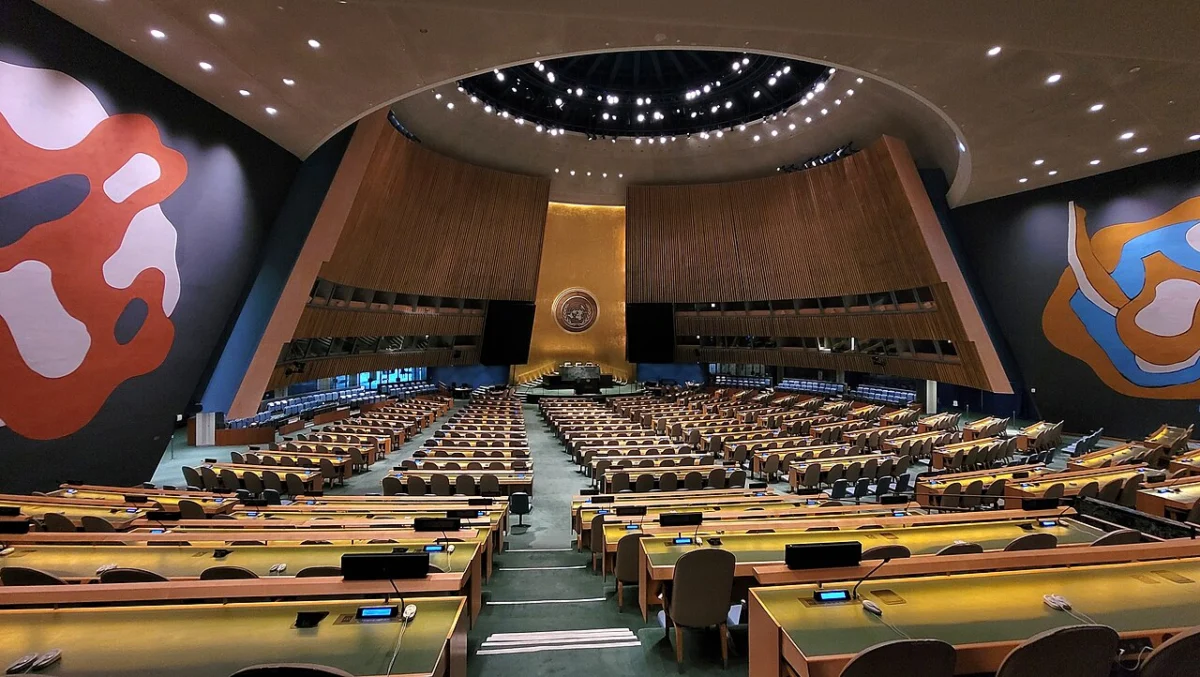
In a historic move that underscores the existential urgency of the climate crisis, world leaders at the United Nations General Assembly have formally adopted the UN Declaration on Sea Level Rise. This consensus-driven framework represents the first comprehensive, UN-wide political effort to address the multifaceted legal, humanitarian, and socioeconomic consequences of rising oceans. As global sea levels hit record-breaking heights, the declaration serves as both a clarificatory instrument for international law and a rallying cry for the international community to safeguard the sovereignty and survival of the world’s most vulnerable coastal populations.
I. Main Facts: A Framework for an Uncertain Future
The adoption of the declaration arrives at a pivotal moment. For years, the international community has grappled with the physical reality of a warming planet, but the legal frameworks governing maritime borders, statehood, and human rights were largely designed for a stable, unchanging geography.
The new declaration addresses this disconnect by calling for:
- Enhanced International Cooperation: A unified approach to sharing data, climate-resilient technologies, and adaptation strategies.
- Accelerated Mitigation: An urgent push for deeper, faster emissions reductions to curb the thermal expansion of the oceans.
- Financial Resilience: A commitment to increasing adaptation and resilience funding, specifically targeting the unique needs of Small Island Developing States (SIDS) and low-lying coastal nations.
- Legal Continuity: A consensus that climate-induced territorial changes should not automatically result in the loss of sovereign rights, maritime zones, or statehood.
II. Chronology: From Scientific Warning to Global Consensus
The path to this declaration was not linear; it was forged through years of rigorous legal analysis and escalating diplomatic pressure from those on the front lines of the crisis.
- 2019: The UN International Law Commission (ILC) officially adds "sea-level rise in relation to international law" to its work program, recognizing the potential for widespread legal instability.
- 2023: The Pacific Islands Forum releases its landmark Declaration on Statehood and the Protection of Persons, asserting that statehood is an enduring status regardless of physical territory.
- 2024: The International Tribunal for the Law of the Sea (ITLOS) issues a historic advisory opinion, confirming that greenhouse gas emissions are a form of marine pollution under UNCLOS.
- 2024: The UN General Assembly passes Decision 78/558, formally mandating the creation of an action-oriented declaration on sea-level rise.
- 2025: The ILC concludes its multi-year study, providing the foundational legal arguments for the protection of maritime baselines and the continuity of sovereignty.
- 2026 (September): Following intense negotiations, the UN General Assembly reaches a consensus, adopting the Declaration on Sea Level Rise during a high-level plenary meeting.
III. Supporting Data: The Scale of the Crisis
The scientific data underpinning the need for this declaration is nothing short of alarming. According to reports cited during the Assembly, nearly 900 million people currently reside in low-lying coastal zones—areas that are increasingly susceptible to inundation, saltwater intrusion, and catastrophic storm surges.
Projections indicate that this number could climb to over one billion by 2050. During the 2026 session, UN Secretary-General António Guterres highlighted a harrowing statistic: global sea levels rose by nearly six millimetres in 2024 alone, marking the highest annual increase ever recorded. Without aggressive intervention to meet the Paris Agreement targets, experts warn of a potential one-metre rise by the end of the century. Such an increase would effectively erase parts of the map, turning existing land into submerged memory and forcing mass migration on an unprecedented scale.
IV. Official Responses: A Divided but Converging World
The adoption of the declaration was met with a mixture of relief and cautious optimism. UN Secretary-General Guterres, a vocal advocate for climate action, characterized the declaration as a necessary shield against the "rising tide of inequality and physical destruction."
The Small Island Perspective
For nations like Tuvalu, the Marshall Islands, and the Maldives, the declaration is a validation of their long-standing struggle. These nations have championed the concept of "legal permanence." By securing international recognition that their maritime zones—and therefore their sovereign resources—do not vanish just because their land does, they have secured a vital economic and political lifeline.
The Legal Community’s Stance
Legal scholars and the ILC have shifted the paradigm regarding the UN Convention on the Law of the Sea (UNCLOS). Historically, maritime zones were fixed to the physical coastline. The ILC’s findings now establish a more stable, "fixed-baseline" approach. Under this interpretation, states are not required to update their geographical coordinates or shrink their exclusive economic zones (EEZs) even if their shores retreat. This provides a critical buffer, preventing a "domino effect" of territorial loss and resource depletion.
V. Implications: Navigating the Legal and Humanitarian Unknowns
While the declaration is a monumental achievement, it is not a panacea. The text highlights several "grey zones" that will require further, intensive negotiation before the end of the 84th General Assembly session.
1. The Challenge of Statehood and Sovereignty
What happens when a government no longer has a physical population on its territory? Or, conversely, when a population is forced to reside entirely within the borders of another state? The declaration asserts that human rights, self-determination, and nationality protections remain, but the mechanics of "government-in-exile" or "transnational sovereignty" remain untested in modern international law.
2. Migration and Human Rights
The declaration touches upon the rights of those displaced by climate change, but the world lacks a comprehensive international treaty governing "climate refugees." As cross-border displacement becomes inevitable, the UN faces the difficult task of reconciling national immigration policies with the fundamental human right to safety and nationality.
3. Economic Entitlements
The loss of access to Exclusive Economic Zones (EEZs) represents a multi-billion-dollar threat to the fishing, mineral, and energy security of island nations. The consensus that baselines should remain fixed is a victory for these nations, but the practical enforcement of these maritime rights against more powerful, encroaching neighbors remains a looming geopolitical challenge.
4. Implementation vs. Recognition
The focus is now shifting from the legality of the problem to the implementation of solutions. This involves creating a global fund for climate adaptation that is not merely based on voluntary aid, but on the concept of climate justice—the idea that those most responsible for historic emissions have a legal and moral obligation to provide for those suffering the worst impacts.
Conclusion: A New Era of Climate Governance
The adoption of the UN Declaration on Sea Level Rise is a testament to the power of multilateralism. It signals that while the physical world may be changing, the international community is committed to upholding the rules-based order that defines our modern era.
However, as the General Assembly looks toward the 84th session, the message is clear: words on a page will not hold back the tide. The legal frameworks established in 2026 provide the structure, but the survival of coastal communities will ultimately depend on the political will to finance resilience, protect human rights in the face of displacement, and, most importantly, halt the emissions that are driving the seas to rise. The world has successfully defined the legal problem; now, the true test of this decade begins in the implementation of the solutions.
