




The landscape of search engine optimization (SEO) has undergone a seismic shift. As generative AI models—ranging from Google’s AI Overviews to platforms like ChatGPT, Claude, and Perplexity—redefine how users access information, the industry has been plagued by a fundamental measurement crisis. For months, SEO professionals have relied on snapshots, sampling, and anecdotal evidence to gauge their performance in AI-driven interfaces.
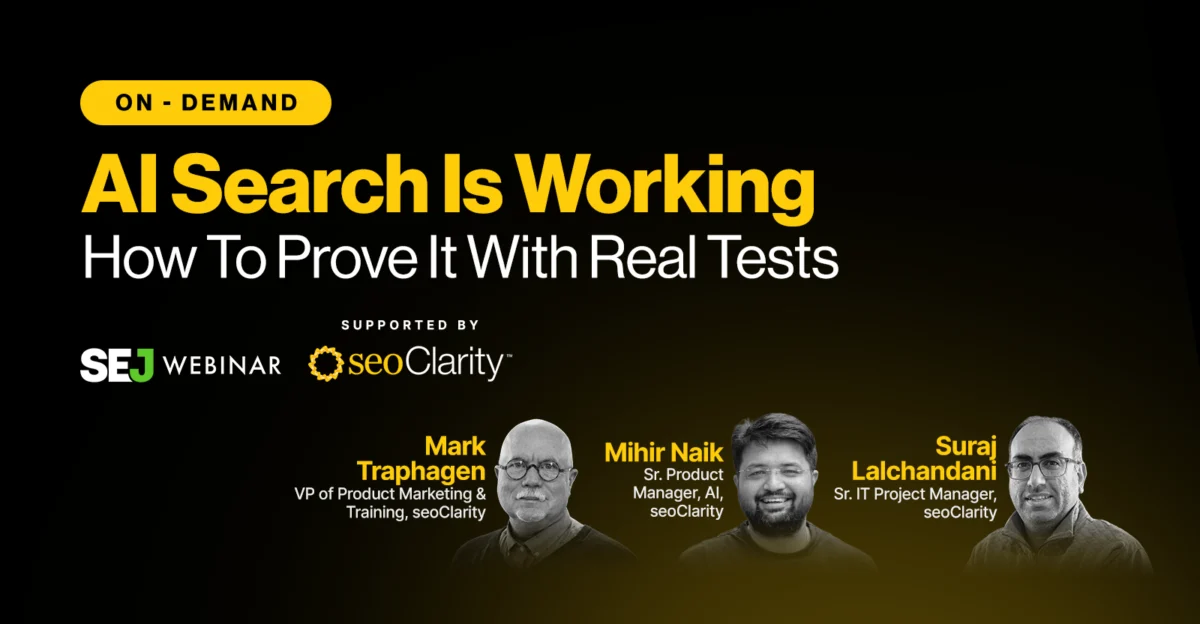
However, a recent masterclass hosted by the enterprise SEO platform seoClarity has introduced a rigorous, scientific standard to the conversation: the transition from mere correlation to verifiable causation. Featuring Mark Traphagen (VP of Product Marketing & Training), Mihir Naik (Senior Product Manager, AI), and Suraj Lalchandani (Sr. IT Project Manager), the webinar outlined a sophisticated split-testing methodology designed to strip away the "noise" of the AI era.
The Problem with Modern Measurement
In the traditional SEO world, metrics were relatively straightforward: crawlability, keyword rankings, and organic traffic. In the AI era, however, "visibility" has become an elusive concept.
The seoClarity team argues that while visibility scores tell a brand if they appeared in an AI response, they fail to explain why. To understand the "why," organizations must shift their focus to page-level performance and controlled experiments. Without a robust testing framework, teams are merely reacting to algorithmic volatility rather than proactively optimizing their content to be cited by large language models (LLMs).
Chronology of a Breakthrough: The FAQ Experiment
The most compelling evidence presented during the session was a controlled experiment involving FAQ sections. The methodology was elegant in its simplicity and devastating in its clarity:
- Baseline: The team measured citation rates across a set of test pages over a specific window.
- Intervention: They injected FAQ sections into the test pages.
- Observation: AI citations for those pages rose significantly.
- Reversion: To prove causation, they removed the FAQ sections.
- Result: Citation rates plummeted back to baseline levels.
This "reversion" is the gold standard of scientific proof. It demonstrates that the FAQ implementation—and not some external change in the model or the competitive landscape—was the direct driver of the improved performance. This level of granular, replicable data is what currently separates top-tier SEO strategies from the rest of the pack.
Integrating First-Party Data: Google Search Console’s New Role
On June 3, the industry received a much-needed boost in transparency when Google launched dedicated Search Console reports for AI Overviews and AI Mode. This development marks a pivotal moment for SEO practitioners who have long been forced to rely on third-party estimation tools.
Suraj Lalchandani labeled this the "biggest measurement upgrade" in the short history of AI search testing. By providing page-by-page visibility data directly from Google, the search giant has eliminated the need for guesswork regarding whether a URL appeared in an AI Overview.
The Limitations of First-Party Data
While the new Search Console data is invaluable, the seoClarity team offered a necessary caveat: it is not a panacea.
- The Scope Gap: Google’s internal reports only cover a segment of the broader AI search landscape.
- The Cross-Platform Necessity: ChatGPT, Claude, and Perplexity operate on different architectures and remain outside the scope of Google’s internal reporting. These platforms still demand structured, third-party tracking to ensure that a brand’s presence is being monitored across the entire generative web.
The consensus from the experts is clear: use the new Search Console data as a foundational layer, but build a secondary, platform-agnostic testing program to ensure comprehensive coverage.
Developing a "Golden Set" of Prompts
A common pitfall for brands entering the AI space is testing too broadly. The seoClarity team advocates for the creation of a "golden set of prompts"—a curated collection of queries that span the entire marketing funnel, from awareness to retention.
The strategy involves tiering these prompts based on current performance:
- Tier 1: "Easy wins." These are scenarios where the brand is already relevant to the query, but the AI simply hasn’t been given a specific, high-quality URL to cite. These prompts serve as the primary laboratory for testing structural changes.
- Tier 2: "Heavy lifts." These require more substantial content and authority building to overcome competitive barriers.
By prioritizing Tier 1, organizations can secure quick wins, which provide the political capital and internal buy-in required to tackle more complex, long-term optimization strategies.
Scientific Methodology: How to Split-Test an LLM
Because it is impossible to split live traffic between two versions of an AI response, the team proposed a "control group" methodology. By identifying a set of correlated pages that are not subjected to the experimental changes, teams can create a noise filter.
"Without a control group, every result would be guesswork," Lalchandani noted. "With one, you can tell a real win from the background noise."
Furthermore, the timing of these tests is critical. The methodology dictates a strict baseline period followed by a minimum testing window. Because AI models do not update in real-time, rushing to conclusions leads to the interpretation of "noise" as data. A disciplined, time-bound approach is essential for any brand serious about AI search.
Implications: The Future of Authority and Strategy
The webinar addressed several lingering questions that have divided the SEO community.
1. The Question of Authority
How do you measure authority when no "AI Authority Score" exists? The experts suggest stacking signals. By measuring citation share across top-tier prompts and maintaining cross-engine consistency, brands can build a picture of their perceived authority. When an LLM consistently cites a brand across different platforms, that brand effectively becomes the definitive source for that category.
2. Collapsible Content: Friend or Foe?
There is a widespread fear that AI bots cannot read content hidden behind "read more" toggles or accordion menus. The seoClarity team clarified that it is not about the UI element itself, but the implementation. If the HTML is structured correctly, AI crawlers can access the content. If implemented poorly, the content becomes invisible. Their advice? "If you’re unsure, test it. It takes effort, but it will give you a sure answer."
3. The ROI of the Unclicked Citation
A common concern is: "What is the value of a citation if it doesn’t lead to a click?" The team argued that the value lies in narrative control. In competitive landscape queries, the brand cited in the AI response shapes the narrative. Even if a user doesn’t click, they are consuming your value proposition, your differentiators, and your messaging. Failing to be cited is essentially surrendering the conversation to competitors.
4. Traditional SEO as a Foundation
Perhaps the most reassuring takeaway was the confirmation that traditional SEO remains foundational. Mark Traphagen emphasized that sites with strong technical health and high-quality, well-optimized content are consistently outperforming those that ignore the basics. AI optimization is not a replacement for SEO; it is the "extra layer" on top.
Conclusion: The Era of Evidence
As the session concluded, the message was one of empowerment. Mihir Naik framed the testing journey as an evolution of mindset: "Every result is a win, because you have evidence instead of guesses."
For organizations looking to navigate the complexities of AI search, the path forward is clear. It is no longer enough to hope for visibility. By constructing golden prompt sets, utilizing correlated control groups, and obsessively measuring the impact of structural changes, brands can move from being passive participants in the AI revolution to active architects of their own digital presence.
The era of speculation is ending. The era of empirical, controlled AI optimization has begun. For those willing to put in the work, the competitive advantage is significant.
