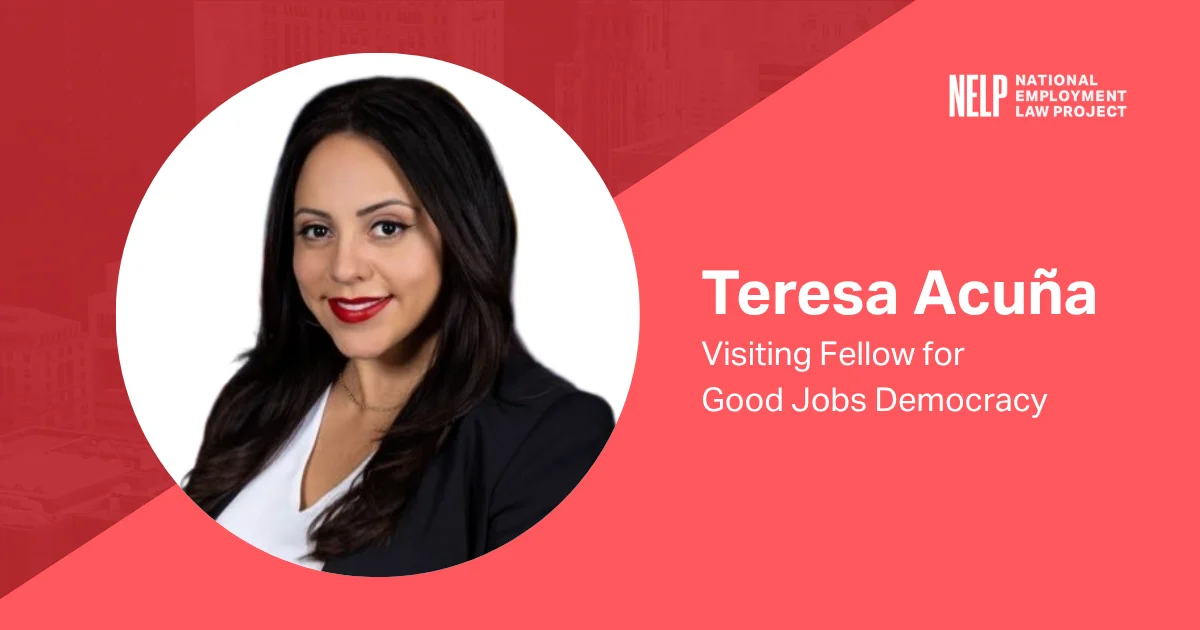




WASHINGTON, D.C. — In a strategic move designed to bridge the gap between high-level economic research and legislative advocacy, the National Employment Law Project (NELP) announced on August 19, 2026, the appointment of Teresa Acuña as the new Visiting Fellow for Good Jobs Democracy.
This appointment marks a significant turning point for the 57-year-old advocacy organization, signaling an increased focus on the intersection of federal industrial policy and worker-centric labor protections. As the nation grapples with the long-term impacts of massive investments in infrastructure, clean energy, and domestic manufacturing, Acuña’s mandate will be to ensure that these macro-economic shifts translate into tangible, high-quality job opportunities for the American workforce.
The Intersection of Policy and Practice
The "Good Jobs Democracy" fellowship is a new pillar within NELP’s broader policy framework. Working in concert with NELP’s existing senior policy fellows, Acuña is tasked with moving the organization’s pioneering research and development into actionable advocacy strategies. The goal is to move beyond abstract economic modeling and toward a concrete framework that strengthens the bargaining power and economic stability of workers across the United States.
Acuña joins NELP with a distinguished career in public service, having navigated the complex legislative landscapes of both Capitol Hill and the California State Legislature. Her background as a legislative director provides her with the institutional knowledge necessary to maneuver in high-stakes political environments, while her recent executive branch experience offers a nuanced understanding of how federal agencies implement policy on the ground.
A Chronology of Leadership and Public Service
To understand the significance of this appointment, it is necessary to examine the trajectory of Acuña’s career, which has consistently centered on the advancement of pro-worker policy.
- State-Level Advocacy: Early in her career, Acuña served in the California State Legislature, where she gained firsthand experience in the mechanics of state-level labor protections and economic development programs.
- Congressional Service: Transitioning to the federal level, she served as a legislative director for members of the U.S. House of Representatives, honing her skills in policy drafting, coalition building, and legislative strategy.
- The Good Jobs Initiative: Most recently, Acuña served as the Director of the Good Jobs Initiative at the U.S. Department of Labor (DOL) during the Biden-Harris administration. Under the guidance of Acting Secretary Julie Su, she played a pivotal role in operationalizing the federal government’s commitment to labor standards.
- Strategic Pivot (August 2026): Acuña transitions to the non-profit sector with the National Employment Law Project, where she will formalize her work on "Good Jobs Democracy," focusing on the long-term sustainability of the labor market in an era of rapid technological and industrial transition.
Supporting Data: Why "Good Jobs" Matter Now
The urgency of Acuña’s work is underscored by the current economic landscape. Over the past several years, the U.S. has seen an unprecedented influx of federal funding into infrastructure and green manufacturing. However, the creation of jobs—in and of itself—is no longer viewed by policy experts as a sufficient metric for economic success.
NELP’s research has consistently highlighted the distinction between "jobs" and "good jobs." According to internal and independent data, the definition of a "good job" in the 2026 landscape includes:
- Wage Adequacy: Pay that not only exceeds the poverty line but sustains a middle-class standard of living.
- Worker Agency: The right to organize, bargain collectively, and participate in workplace decision-making.
- Stability and Benefits: Reliable scheduling, health insurance, paid leave, and retirement security.
- Equity and Inclusion: Targeted pathways into high-growth sectors for historically marginalized communities, ensuring that the transition to a clean-energy economy does not leave behind the workforce of the industrial past.
NELP’s track record supports this emphasis. Over the last decade, the organization’s advocacy efforts have reached an estimated 100 million workers and their families, influencing minimum wage laws, fair chance hiring policies, and worker safety regulations nationwide.
Official Responses and Strategic Vision
The appointment of Acuña has been met with significant enthusiasm from labor advocates and policy analysts, who view her experience at the Department of Labor as a major asset for NELP’s ongoing initiatives.
"Teresa’s experience in translating policy ideas into tangible wins for workers and their communities is critical to advancing NELP’s vision of an inclusive democracy where all workers have the economic foundation to contribute to and share in progress," said NELP CEO Rebecca Dixon in a statement released on Monday.
Dixon’s remarks emphasized the philosophical underpinning of the new fellowship: "Good jobs enable people to be active citizens." This framing—connecting the quality of one’s employment to the health of the nation’s democracy—is expected to be a recurring theme in Acuña’s work. The argument posits that economic precariousness is a primary driver of democratic erosion; when workers feel secure and valued, their capacity to participate in the civic process increases.
Acuña herself has noted that her transition from the DOL to NELP is a natural evolution. "The federal government has set the table with historic investments," Acuña noted in internal briefings. "The work now, at the non-profit and community level, is to ensure that those investments are tethered to enforceable, high-road labor standards that prioritize the worker over the short-term bottom line."
Implications for the Future of Work
The establishment of the Visiting Fellow for Good Jobs Democracy comes at a time when the labor movement is facing a period of both transition and opportunity. As the United States continues to implement industrial policies designed to combat climate change and shore up domestic supply chains, the "Good Jobs" framework will be tested against the demands of global competition and corporate pressure.
Potential Policy Impacts
- Standardizing Federal Contracting: Acuña is expected to leverage her knowledge of the Good Jobs Initiative to push for more robust labor stipulations in federal contracts, ensuring that government spending mandates high-quality employment.
- Bridging the "Skills Gap": By working with state partners, the fellowship aims to develop apprenticeship and training programs that are not just "job training," but pathways to career-ladder jobs.
- Defending Labor Rights: As new industries emerge, there is a risk of a "race to the bottom" in terms of wages and safety. NELP’s new focus will likely include proactive litigation and policy drafting to prevent the erosion of worker protections in new, non-traditional sectors.
A New Chapter for NELP
Founded in 1969, NELP has long served as a backbone for the American labor movement. By integrating a seasoned executive branch official like Acuña into its ranks, the organization is clearly preparing for a new era of governance where the lines between industrial policy and worker protection are increasingly blurred.
As the 2026 calendar continues, all eyes will be on how this "Good Jobs Democracy" framework is implemented. If successful, Acuña’s work could provide a blueprint for how civil society organizations can hold the government accountable for the quality—and not just the quantity—of jobs created by public investment.
In a rapidly changing global economy, the collaboration between policy architects like Acuña and the long-standing advocacy network of NELP represents a significant attempt to ensure that the future of work is equitable, sustainable, and fundamentally democratic. As NELP continues its mission to build a just and inclusive economy, the "Good Jobs Democracy" fellowship stands as a testament to the idea that the dignity of the worker must be the cornerstone of any national economic strategy.
