





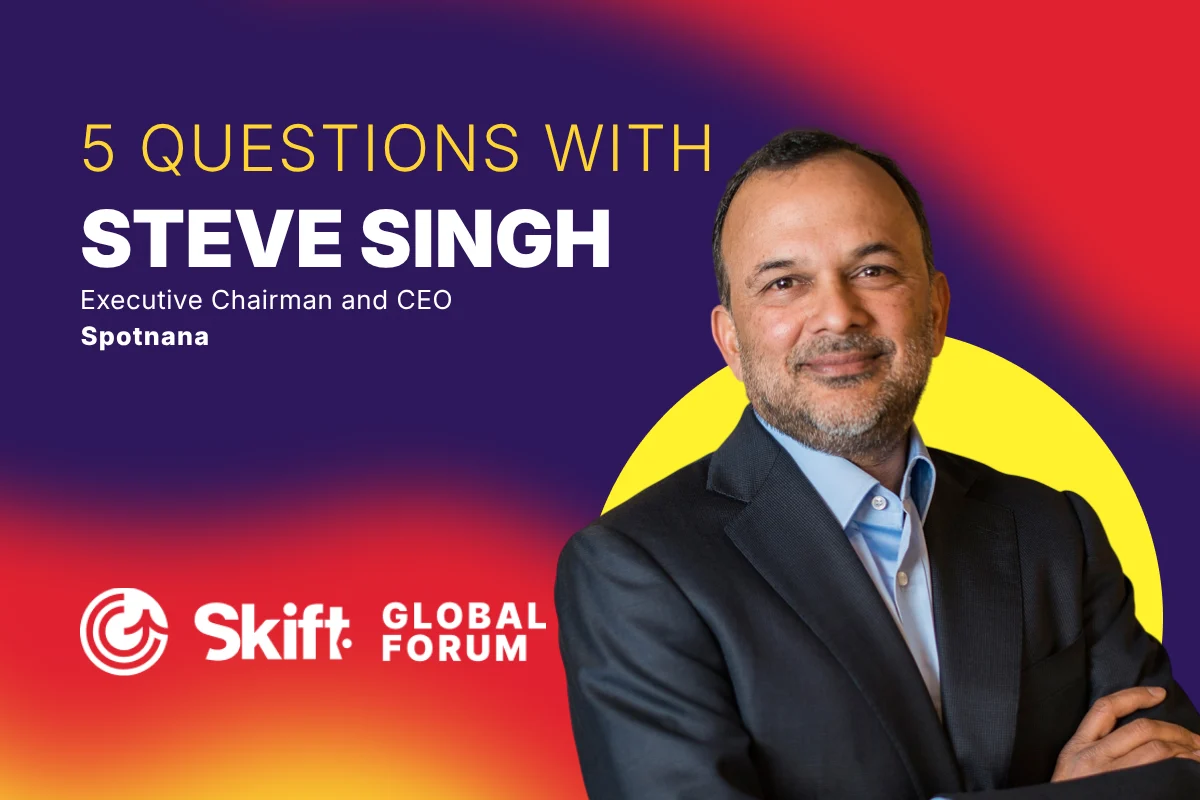
In the high-stakes world of online travel, the industry’s collective gaze has remained fixed on a single, glittering prize for decades: the initial booking. From metasearch engines to slick mobile booking apps, billions of dollars have been poured into optimizing the "discovery and conversion" funnel. Yet, according to Steve Singh, the executive chairman and CEO of Spotnana, the industry has been looking at the value proposition entirely backward.
As the travel ecosystem matures and consumer expectations skyrocket, Singh argues that the true battlefield for brand loyalty—and the primary source of operational inefficiency—is not the search bar, but the "unglamorous" work that begins the moment a traveler hits the "confirm" button. Ahead of his highly anticipated appearance at the Skift Global Forum in New York, Singh is challenging the industry status quo, positing that artificial intelligence is poised to trigger a 50% reduction in servicing costs while simultaneously elevating the quality of the traveler experience.
The Half Nobody Talks About: Shifting the Economic Paradigm
The travel industry has long operated under the assumption that the sale is the finish line. However, the post-purchase experience—the complex, often messy world of cancellations, rebookings, refunds, and policy changes—is where the traveler’s perception of a brand is solidified.
"We talk endlessly about search, distribution, and booking," Singh observes. "What really matters is what happens after the trip is purchased."
Historically, this "after-purchase" phase has been a labor-intensive, human-heavy process. When a flight is canceled or a business trip is disrupted, the industry has relied on armies of support agents to manually navigate disparate airline systems, process refunds, and rebook passengers. This model is not only costly but inherently prone to friction, delays, and human error.
Spotnana’s internal data suggests a massive, untapped opportunity for structural change. By integrating AI into the servicing workflow, the company is demonstrating that routine, repetitive tasks—which once clogged the queues of human agents—can be resolved autonomously. Singh estimates that by automating these workflows, companies can reduce their servicing overhead by 50% or more. This isn’t just about cutting costs; it’s about a fundamental redistribution of human capital. When AI handles the "heavy lifting" of transactional servicing, human agents are freed to focus on high-touch, complex scenarios where empathy and nuanced problem-solving are required.
Chronology of an Industry Pivot: From Manual to Autonomous
To understand the scale of this shift, one must look at how the industry has historically managed service. For years, the "service" model was reactive. A disruption occurred, the customer contacted a travel management company (TMC) or an airline, and a human agent searched through legacy GDS (Global Distribution System) screens to find a solution.
Phase 1: The Legacy Era (Pre-2015)
In this era, servicing was synonymous with telephone support. If a booking changed, the traveler was often left on hold for hours. The cost of servicing was directly tied to headcount, and the "Cost Per Booking" often included a significant, hidden "Cost Per Service" that was rarely optimized.
Phase 2: The Digital Transition (2015–2022)
As mobile apps became ubiquitous, companies attempted to automate simple tasks like checking flight status or updating seat preferences. However, complex servicing—such as handling unticketed flights or partial refunds—remained firmly in the realm of human labor. The industry struggled with fragmentation; a change made on an airline’s website often wouldn’t sync with the agency’s booking platform, leading to data silos and "broken" itineraries.
Phase 3: The AI-Driven Servicing Era (2023–Present)
We are currently in the midst of a transition where AI agents act as the primary interface for servicing. Spotnana, among others, has begun deploying AI that doesn’t just "talk" to the customer, but "executes" on the backend. By building direct, API-first connections to travel suppliers, these systems can now automatically rebook segments, process refunds, and reconcile tickets without human intervention. This is the shift Singh describes: a move from "human-in-the-loop" to "human-on-the-exception."
Supporting Data: The Efficiency Gap
The economic argument for this transition is compelling. In a traditional travel agency, servicing costs can represent a significant percentage of the total transaction value. If a booking is low-margin, a single complex service interaction can turn a profitable transaction into a loss.
Singh’s assertion of a 50% reduction in costs is supported by several factors:
- Reduced Handle Time: AI agents operate at machine speed, pulling data from multiple sources simultaneously, which cuts the average handle time (AHT) from minutes to seconds.
- Accuracy at Scale: Human agents are susceptible to fatigue and training gaps. AI, when properly calibrated, ensures that the policy logic applied to a refund or change is consistent every time.
- Proactive Resolution: Because AI can monitor thousands of flights in real-time, it can detect a delay or cancellation before the passenger even knows, initiating the rebooking process autonomously. This prevents the "panic" phase of the customer experience, reducing the volume of inbound support calls.
Official Responses and Strategic Implications
As AI begins to dictate which options are presented to a traveler—a process known as "conversational curation"—the relationship between travel suppliers and their intermediaries is evolving.
"Anyone can sell a ticket," Singh says. "The hard part is delivering service, and service is where trust is earned or lost."
The Rise of Conversational Curation
As the industry moves toward conversational AI, the traditional "grid-based" display of 50 flight options is disappearing. In its place are curated recommendations. This shift creates a new competitive dynamic. If an AI agent is only presenting the "top three" choices to a traveler, providers that fail to supply rich, accurate, and structured data will find themselves invisible.
"The bar is now higher for every travel provider," Singh notes. "They must deliver rich product information with accurate details on rates, fares, ancillary services, and amenities. We find that direct integrations are the best source of this information."
The Trust Factor
For Spotnana, the strategy is to "solve for the traveler." By creating a platform that synchronizes booking changes across all systems, they ensure that a change made via a mobile app is instantly reflected in the agent’s dashboard and the airline’s system. This seamlessness is the bedrock of modern trust. If a traveler can’t trust that their itinerary is accurate, the "search and book" phase becomes irrelevant.
Implications for the Future: A New Competitive Landscape
What does this mean for the future of the travel agency and the corporate travel manager?
First, it signals the death of the "transactional agent." Roles that focus solely on data entry and routine rebooking are being rapidly phased out. In their place, we are seeing the rise of the "Travel Experience Specialist"—a role that requires higher-order emotional intelligence and the ability to manage the AI systems that handle the logistics.
Second, it implies a consolidation of the tech stack. As Singh points out, the "fragmented content landscape" is a reality of modern travel. Companies that cannot aggregate this content and make it "serviceable" (meaning, capable of being changed or canceled automatically) will struggle to maintain relevance. The competitive advantage no longer belongs to those with the best search algorithms alone; it belongs to those who own the "servicing lifecycle."
Finally, for the traveler, this is a significant shift in power. The expectation of "assistance anywhere" is becoming the new baseline. When a traveler can use natural language to demand a specific hotel room—"high floor, ocean view, early check-in"—and the AI delivers it, the definition of a "good booking experience" changes forever.
Conclusion: The Long Road Ahead
As the industry prepares to gather at the Skift Global Forum, the message from leaders like Steve Singh is clear: the era of obsessing over the "first click" is ending. The next decade of growth in travel will be defined by the "after-purchase" experience.
By offloading the drudgery of routine servicing to artificial intelligence, the industry is not just cutting costs—it is reclaiming the opportunity to deliver on the fundamental promise of travel: a seamless, reliable, and personalized journey. While the search for the perfect flight will always remain a core component of the business, the true value, and the true test of trust, lies in what happens when things go wrong, and how effectively the industry can put them right.
As we look toward the future, one thing is certain: the companies that survive will be those that realize that in the digital age, the most important service you can provide isn’t just getting the traveler to their destination—it’s ensuring that every step of the journey, even the unexpected ones, feels effortless.
