





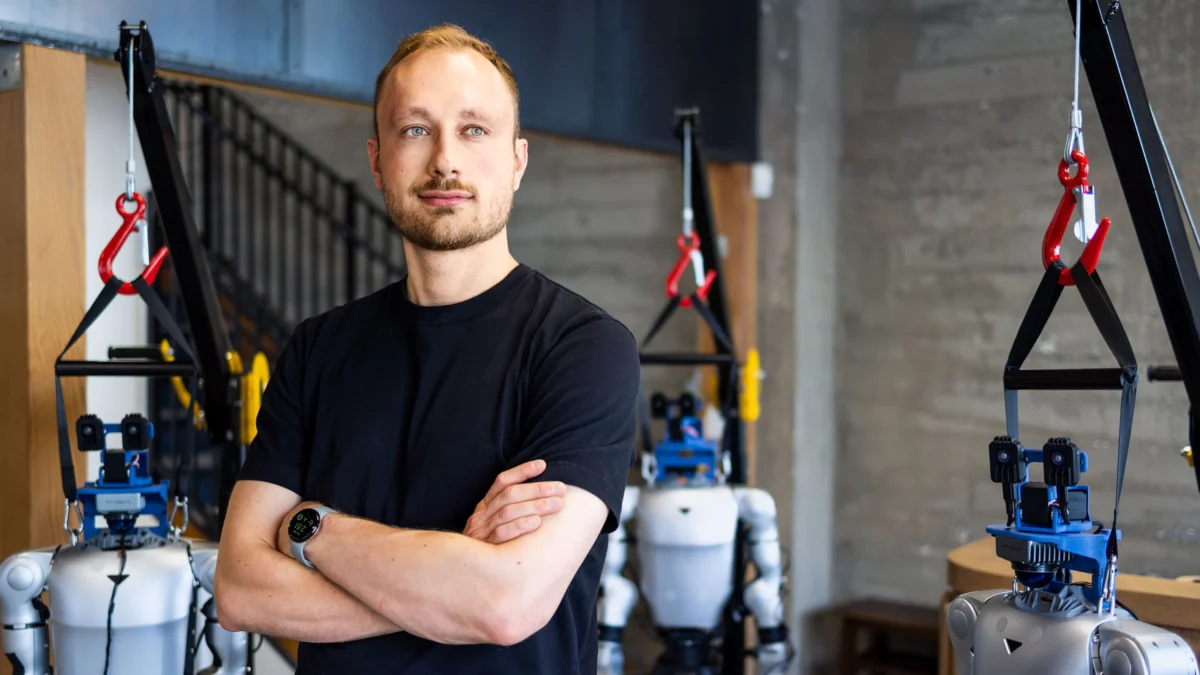
In the heart of San Francisco’s SoMa district, a quiet, sparsely furnished office space belies a revolutionary undertaking. There are no corporate logos on the glass, no bustling rows of cubicles, and no grandiose reception area. Instead, the center of the room is dominated by a series of racks from which human-shaped robots hang like marionettes.
This is the headquarters of an unnamed, stealth-mode startup led by 31-year-old AI prodigy Danijar Hafner. Having recently departed the prestigious halls of Google DeepMind, Hafner is on a mission that sounds like science fiction: he is teaching machines to "dream" their way into the physical world. By leveraging model-based reinforcement learning, Hafner aims to solve the "generalization problem"—the primary hurdle preventing robots from leaving the controlled confines of factories and entering the unpredictable, chaotic environments of our homes.
The Core Innovation: Moving Beyond Trial and Error
For decades, the standard approach to robotics has been arduous and inefficient: "real-world trial-and-error." To teach a robot to pick up a cup, engineers would have to force it to fail thousands of times in a physical space, often damaging the hardware and requiring human intervention to reset the scene.
Hafner’s approach flips this paradigm. He specializes in world models—sophisticated AI architectures that emulate the laws of physics and the dynamics of reality. Within these digital simulations, an agent (the AI "brain") is embedded. The agent doesn’t just react to stimuli; it predicts future outcomes based on its internal model.
"It’s essentially dreaming," Hafner explains. By simulating thousands of scenarios in a virtual environment, the agent learns how to navigate, interact with objects, and recover from unexpected jolts or shifts—all without ever touching a physical object. When these agents are finally downloaded into the imported humanoid hardware in his San Francisco office, they possess a "mental map" of how the world works. This allows them to enter a room with a floor plan or furniture arrangement they have never encountered before and navigate it with human-like intuition.
A Chronology of Brilliance: From Potsdam to DeepMind
The trajectory of Danijar Hafner’s career is as rapid as the algorithms he builds. Growing up in a small, rural town in northeastern Germany, the son of two classical musicians, Hafner found his true rhythm not in sonatas, but in code. Taught the basics of programming by a neighbor, he turned his curiosity toward the ultimate question: How does thinking work?
The Early Years (2015–2018)
Hafner’s formal entry into the global stage began in 2015. While a second-year undergraduate engineering student at the Hasso Plattner Institute in Potsdam, he secured a coveted spot as a student researcher at Google Brain. This was not merely an internship; it was an apprenticeship under the titans of the field.
He worked alongside Geoffrey Hinton, the "Godfather of AI," and Ashish Vaswani, the co-author of the seminal 2017 paper "Attention Is All You Need." That paper introduced the transformer architecture, the very foundation of today’s Large Language Models (LLMs) like GPT-4. These early years forged in Hafner a deep understanding of how to scale intelligence, though he chose to pivot from the linguistic focus of his mentors toward the physical embodiment of intelligence.
The Rise of the "Dreamer" Era (2019–2024)
Hafner’s path to his current startup was paved with a series of algorithmic breakthroughs that pushed the boundaries of reinforcement learning:
- PlaNet (2019): His first major breakthrough, which allowed AI agents to execute complex tasks by planning multiple steps into the future.
- Dreamer 2: A watershed moment in AI research, where an agent achieved human-level performance on Atari 2600 games entirely through a learned world model.
- Dreamer 3: This model solved the infamous "Minecraft Diamond challenge." For the first time, an agent could autonomously navigate the complex, infinite space of Minecraft to locate and mine a diamond without explicit human guidance.
- Dreamer 4: This iteration pushed the frontier further by learning to perform tasks using only offline, pre-recorded video data of human players, eliminating the need for the agent to play the game itself during the training phase.
By the fall of 2025, having conquered virtual worlds, Hafner decided that the simulation was no longer enough. He resigned from Google DeepMind to pursue the "DayDreamer" vision—a project he began at Google to bridge the gap between virtual foresight and physical reality.
Supporting Data: Why "Dreaming" Matters
The necessity of Hafner’s work is underscored by the current limitations of robotics. Most current industrial robots are "brittle." They function perfectly on an assembly line because every bolt and conveyor belt is in the exact same position, every single day. If a human moves a chair in their way, or if a child leaves a toy on the floor, these robots often halt or malfunction.
Hafner’s research suggests that the bottleneck is not mechanical, but cognitive. Data from his "DayDreamer" projects shows that robots trained with world models are significantly more resilient to "novel environments." In one experiment, a robot trained using his algorithms was pushed over; rather than freezing, it utilized its internal model of physics to reorient its joints and pull itself up—a behavior it had never been explicitly programmed to perform, but had "imagined" during its training phase.
The Industry Consensus: A Singular Talent
Within the insular world of AI research, reputations are built on technical papers and the "brute force" of intellectual output. Hafner is widely considered an outlier.
Timothy Lillicrap, a prominent researcher at Google DeepMind and one of Hafner’s former managers, provides a rare look into the regard in which his peers hold him. "I get to interact with a lot of really smart people in research at Google, and he easily sits in the top half of 1%," Lillicrap remarks. "In many cases, he would build, single-handedly, things it would take entire teams of engineers to build."
This assessment is supported by his publication record. Hafner’s work is frequently cited as the gold standard for how to combine deep learning with planning, moving the needle from machines that "predict the next token" to machines that "anticipate the next consequence."
Implications: The Future of Embodied AI
What happens when these robots leave the office in SoMa? The implications are profound. If a machine can learn to navigate a home by watching videos and simulating physics, the barrier to entry for personal robotics collapses.
1. The Home Assistant
The ultimate goal is a robot that doesn’t require a specialized environment. A robot that can walk into a messy kitchen, identify a spilled glass of water, find a towel, and clean it up—without needing to be reprogrammed for the specific brand of towel or the specific floor plan of the kitchen.
2. Economic Efficiency
By replacing physical training with virtual simulation, the cost of developing sophisticated robotics could drop by orders of magnitude. Smaller startups, rather than just multi-billion-dollar corporations, could potentially develop specialized robots for elderly care, construction, or logistics.
3. Safety and Ethics
Hafner’s "dreaming" approach inherently improves safety. Because the agent understands the physical consequences of its actions in a simulation, it is less likely to engage in erratic movements that could harm humans in the real world. However, the move into physical spaces brings new challenges, particularly regarding privacy and the autonomy of machines in private dwellings.
Conclusion: The Quiet Before the Storm
As I left Hafner’s office, the "marionette" robots hanging from the racks remained still. There is a sense of calm before a seismic shift. Hafner is uncharacteristically coy about the specifics of his new startup, refusing to divulge the company name or the exact timeline for a public launch.
Yet, his ambition is clear. When asked about his ultimate goal, he doesn’t talk about venture capital or market share. He talks about the problem. "I was interested in solving a problem," he hints, "that would change the world."
In an industry currently obsessed with the digital output of LLMs, Hafner is playing a different game. He is betting that the true "holy grail" of AI is not just the ability to speak, but the ability to walk, to reach, to manipulate, and ultimately, to understand the physical world as we do. If his track record is any indication, the world should be prepared for the day his robots stop hanging from the ceiling and start walking out the door.
