





The global race to build Artificial Intelligence infrastructure is often characterized as a frantic search for "more": more GPUs, more water for cooling, and, most crucially, more power. Headlines are dominated by the need for new nuclear reactors, massive wind farms, and an overhaul of high-voltage transmission lines. However, the most critical vulnerability in the AI revolution isn’t the availability of electrons—it is the archaic way data centers handle them.
As the industry pivots toward massive, gigawatt-scale AI campuses, the standard electrical architecture used for decades is failing. Recent history in Ashburn, Virginia—the epicenter of the world’s data center industry—proves that when thousands of AI-ready facilities act in unison, they become a systemic risk to the grid. To survive the next wave of AI deployment, the industry must fundamentally rethink the "power stack," moving protection out of the building and into the medium-voltage path.
The Chronology of a Systemic Failure
The grid’s fragility regarding data centers was exposed in a series of alarming events in Northern Virginia. On July 22, 2026, a routine transmission line fault triggered a cascade that saw more than 3 gigawatts of load drop off the grid in mere seconds. This was not a localized flicker; it was a massive, near-instantaneous removal of power demand that threatened the stability of the entire PJM Interconnection.
This incident followed a chilling precedent set two years earlier. In that 2024 event, a single failed surge arrester at a substation triggered a protection response that caused roughly 60 data centers to disconnect from the grid simultaneously, resulting in the loss of 1,500 megawatts of load.
In both instances, the facilities were not "broken." They were functioning exactly as they were engineered to. Their internal protection logic, designed to guard billions of dollars in compute hardware, perceived the grid’s minor fluctuations as catastrophic threats. Following standard safety protocols, they tripped offline, inadvertently turning the world’s most advanced computing hubs into the primary agents of grid instability.
Supporting Data: Why the "Old Stack" Is Cracking
To understand why these outages happen, one must look at the standard data center power stack, which has remained largely unchanged since the early 2000s. The traditional model involves medium-voltage power arriving at a site, being stepped down by transformers, and then passed through low-voltage Uninterruptible Power Supply (UPS) units before reaching the server racks.
This architecture is buckling under three specific stressors:
- The "Spare Tire" Fallacy: Current UPS systems are designed as short-term emergency buffers. They function like an undersized spare tire—fine for a few minutes of battery backup during a minor hiccup, but wholly incapable of smoothing out the extreme, volatile load swings inherent to AI training runs.
- The Bypass Trap: Because legacy converters are energy-inefficient, most operators run them in "eco-mode." This means the power feeds the racks directly from the grid, bypassing the filtering systems. Consequently, sub-millisecond grid transients hit the servers raw, while the sudden, massive power surges caused by AI training cycles are pushed directly back into the grid without any dampening.
- Outdated Protection Logic: The software governing these systems was written when a "large" load meant 50 megawatts. It lacks the visibility to distinguish between a transient grid dip and a permanent failure. In the 2024 Virginia event, the automated logic counted the voltage dips and, as programmed, disconnected the facility on the third dip. It was not a failure of equipment, but a failure of outdated logic that cannot comprehend the scale of modern AI demand.
The Paradigm Shift: Moving Up, Out, and In
Engineers at the forefront of the power sector are proposing a radical, three-part architectural shift to stabilize the AI load:
- Move it Up: Transition from 480-volt low-voltage systems to medium-voltage (13.8kV and higher). By handling power at the same voltage level as the grid, operators eliminate the inefficiency of constant step-down transformations.
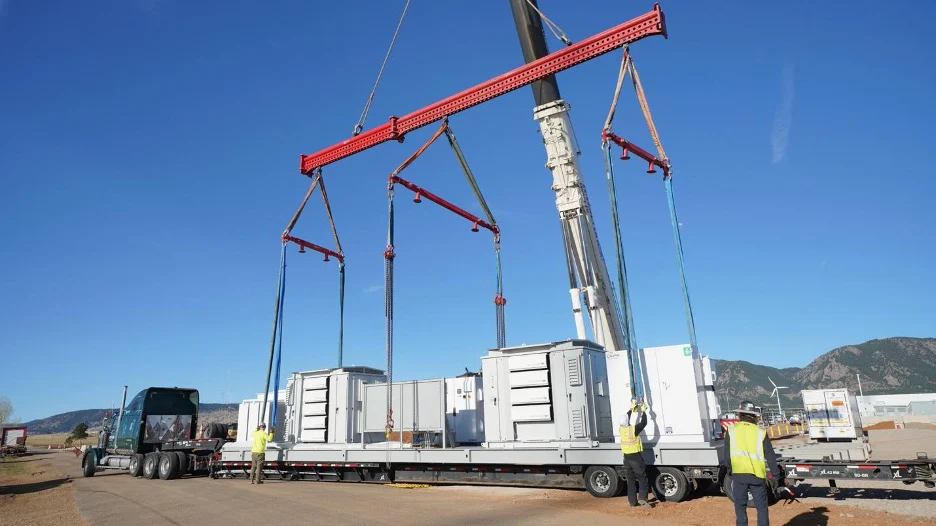
- Move it Out: Relocate the power conditioning hardware from the interior of the data hall to modular, weather-hardened enclosures near the substation. This clears floor space for compute and cooling, effectively increasing the density of the data center.
- Move it Into the Path: Abandon the "reactive" battery approach. By implementing an inline system where every electron passes through the conditioning logic, the system acts as a permanent buffer. There is no switch to trip and no detection delay; the power is constantly smoothed, rendering the grid immune to the data center’s load swings, and vice versa.
Official Responses and Empirical Validation
The theoretical viability of this architecture was put to the test in early 2026 at the National Laboratory of the Rockies. As the only facility in the Western Hemisphere capable of replicating real-world grid faults alongside AI-scale load swings, the lab provided a "stress test" environment that the industry has never seen before.
The testing protocol involved hitting the system with full-scale medium-voltage AI load profiles while simultaneously inducing grid-side failures, including a complete zero-voltage event. The results were definitive: the compute load remained undisturbed, and the grid-side equipment successfully cleared the most stringent voltage ride-through requirements mandated by the Electric Reliability Council of Texas (ERCOT).
For grid operators, this is a game-changer. It transforms a "difficult neighbor" into a "useful one." By providing a flat load profile and the ability to absorb volatility, these medium-voltage systems satisfy compliance requirements "out of the box," potentially shaving months off the regulatory and interconnection permitting timelines that currently stifle data center growth.
Strategic Implications: From Liability to Asset
The shift to medium-voltage, inline architecture changes the economic calculus of data center operations. Traditionally, backup power is viewed as an expensive insurance policy—a sunken cost that sits idle 99% of the time.
By utilizing equipment that stores its own energy and interacts directly with the medium-voltage grid, the backup power system becomes an revenue-generating asset. These facilities can participate in grid services such as peak shaving and demand response. When the grid is stressed, the data center can modulate its demand or provide stability services, turning the facility into a grid stabilizer rather than a liability.
Furthermore, this architecture offers a massive competitive advantage in construction. With the UPS equipment moved outside the building, the square footage previously dedicated to battery rooms can be repurposed for additional GPU capacity. This increases the density of compute per dollar of construction, a metric that is currently the primary KPI for the global AI arms race.
Conclusion: Defining the Future of the AI Factory
We are currently witnessing a defining moment for infrastructure engineering. The AI buildout is testing the limits of 20th-century grid architecture. The industry has yet to adopt a formal name for this new, medium-voltage, inline layer, but the choice facing operators is clear: they can either build factories that strain the grid to its breaking point, or they can build factories that act as the grid’s new, essential layer of strength.
The engineering to accomplish the latter already exists. As the next wave of massive AI campuses moves from the planning stage to construction, the adoption of medium-voltage, outside-the-fence, inline power architecture will likely become the standard for any organization serious about scale, reliability, and long-term economic viability. The grid of the future will not be defined by the size of its power plants, but by the intelligence of its architecture.
