




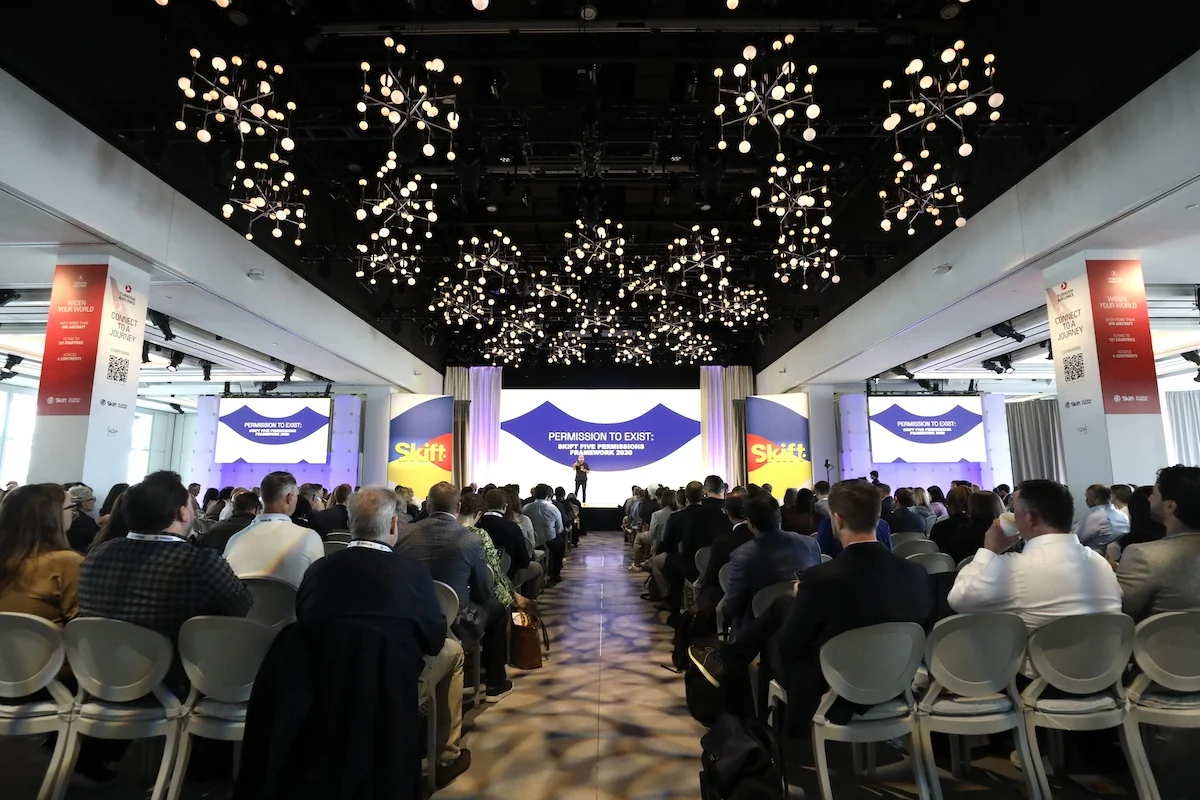
As the global travel industry gathers for the 2026 Skift Global Forum, the atmosphere is defined not by the usual optimism of growth, but by a profound sense of urgency. Travel leaders are currently engaged in a high-stakes recalibration, attempting to determine whether their strategic pivots are designed for the immediate market fluctuations of today or the structural realities of the next decade.
The fundamental assumptions that have underpinned the travel sector for the past twenty years—the predictability of search funnels, the primacy of human-led service, and the clear distinction between legacy incumbents and nimble challengers—are rapidly dissolving. In their place, a new, more volatile reality has emerged.
The Core Tension: Technology vs. Trust
The travel industry is currently gripped by two conflicting forces. First, the global travel market continues to expand in sheer size, yet its internal architecture is shifting beneath the feet of operators. Second, technology is evolving at an exponential rate, significantly outstripping the consumer and corporate trust required to effectively utilize it.
According to Skift Research’s State of Travel 2026, the industry is currently divided into four distinct layers: consumers, commerce, operations, and experiences. Every travel company is now under pressure to prove its future relevance in each of these layers. If a brand cannot provide enough intrinsic value to justify its position, it risks being abstracted away by new technological intermediaries.

Chronology of Disruption: From Search to AI Agents
The evolution of the "travel funnel" has been the most visible casualty of recent years. The industry has moved from a "search-scroll-compare" model to an "ask-shortlist-decide" paradigm.
2023–2024: The Early Adoption Phase
Two years ago, AI in travel was largely experimental, accounting for roughly 10% of startup funding. Industry giants were focused on incremental efficiency, using machine learning to optimize backend operations rather than attempting to redefine the customer relationship.
2025: The Investment Pivot
By mid-2025, the landscape had shifted violently. AI-enabled companies commanded 45% of all travel startup funding. During this period, the industry saw the first major divergence in strategy:
- The Incumbents: Companies like Booking Holdings and Expedia focused on protecting their massive distribution infrastructure, treating AI as a tool for internal cost-cutting rather than a threat to their funnel.
- The Challengers: Entities like Airbnb began a more radical transformation, attempting to rebuild their platforms as "AI-native" ecosystems.
2026: The Trust Gap
As of September 2026, the industry faces a paradox. While 30% of travelers report "extensive" use of AI for trip planning—a doubling of usage in just twelve months—the willingness to actually transact through these systems remains remarkably low. Only 2% of leisure travelers currently trust AI to complete their bookings. This creates a dangerous "visibility trap": companies that structure their data for AI agents gain visibility but cede control over how their brand is represented, while those that protect their direct funnel risk being ignored by the next generation of discovery tools.

Supporting Data: The Metrics of Uncertainty
The financial data emerging from the 2026 season highlights the fragility of the current market.
- The Premiumization Gamble: Airlines are moving aggressively toward premium-heavy cabin configurations. Delta reported that premium revenue rose 7% in 2025, while main cabin revenue contracted. However, this strategy relies heavily on the continued spending power of the affluent. With 62% of global travelers indicating they will cancel or modify plans due to cost, the industry is effectively betting on a deepening of income inequality to maintain margins.
- The AI Impact: AI is proving its worth in efficiency, with Airbnb cutting support costs per booking by approximately 16% in a single year. Yet, referral traffic from AI agents to platforms like Booking.com remains negligible, accounting for less than 1% of total room nights.
- Inbound Recovery: The volatility of global travel is best illustrated by the revision of U.S. inbound recovery forecasts, which were pushed from 2025 to 2029 in a single analytical cycle. This move highlights the dangers of long-term planning in an environment where geopolitics and economic conditions shift on a quarterly basis.
Official Responses and Strategic Perspectives
During the Skift Global Forum, the industry’s most powerful leaders are being forced to justify their path forward. The primary debate centers on the choice between Incumbency or Reinvention.
The Case for Protecting Scale
Established incumbents argue that their massive distribution networks and cash reserves are their greatest assets. They view AI as a "feature" to be integrated into existing workflows rather than a foundation to be replaced. Their strategy is to defend the existing funnel, betting that consumer trust in established brands will outweigh the convenience of AI-native agents.
The Case for the "AI-Native" Rebuild
Conversely, leaders like Brian Chesky have signaled that a retrofit of legacy systems is insufficient. The "AI-native" argument posits that the next decade will be dominated by interfaces that do not resemble current websites or apps. By building for the AI agent today, these companies hope to capture the traffic of tomorrow, even if it requires short-term pain to rebuild core business architectures.

The Human-Machine Balance
A critical point of contention is the role of human service. As hotel brands rush to automate, there is a mounting concern regarding the "mid-market vacuum." Many brands are cutting headcount to improve margins, but in doing so, they are stripping away the very human touchpoints that serve as their primary differentiators. The consensus among analysts is that while AI can handle the "commerce" layer, the "experience" layer remains stubbornly human.
Implications: The Decision to Act
The overarching theme for the 2026 Skift Global Forum is the high cost of hesitation. The industry has reached a point where "wait and see" is no longer a viable strategy.
Navigating the Bifurcated Market
Companies are being forced to choose between two paths:
- The Premium Hedge: Continuing to optimize for the top-tier traveler to ensure profitability during economic downturns, despite the risk of alienating a broader, price-sensitive customer base.
- The Operational Efficiency Drive: Leveraging AI to strip costs out of the organization to survive a period of high-interest rates and labor shortages.
The Future of Discovery
The most significant implication for the coming years is the loss of control over the discovery process. If AI agents become the primary gatekeepers of travel information, brands will lose the ability to manage their own messaging. The "Shortlist" becomes the new "Search Engine Results Page." Brands that fail to make their data readable and accessible to these agents will simply cease to exist in the eyes of the future traveler.

Conclusion: Building for the Next Decade
As the Forum concludes, the takeaway for attendees is clear: the travel industry has successfully navigated the post-pandemic recovery, but it has yet to conquer the post-AI transition. The companies that will thrive in 2030 are those currently making the difficult, often counter-intuitive decisions to prioritize long-term adaptability over short-term stability.
Whether it is the airline executive redesigning the cabin to serve a shrinking, high-net-worth segment, or the hotelier struggling to balance AI-driven booking with the need for a human concierge, the challenge remains the same. The ground is moving. The leaders gathered at this year’s forum are not just forecasting the weather; they are attempting to redesign the ship while it is already in the middle of a storm. The success of their ventures depends entirely on whether their recalibrations are truly built for the decade ahead, or merely designed to survive the one that just passed.
