





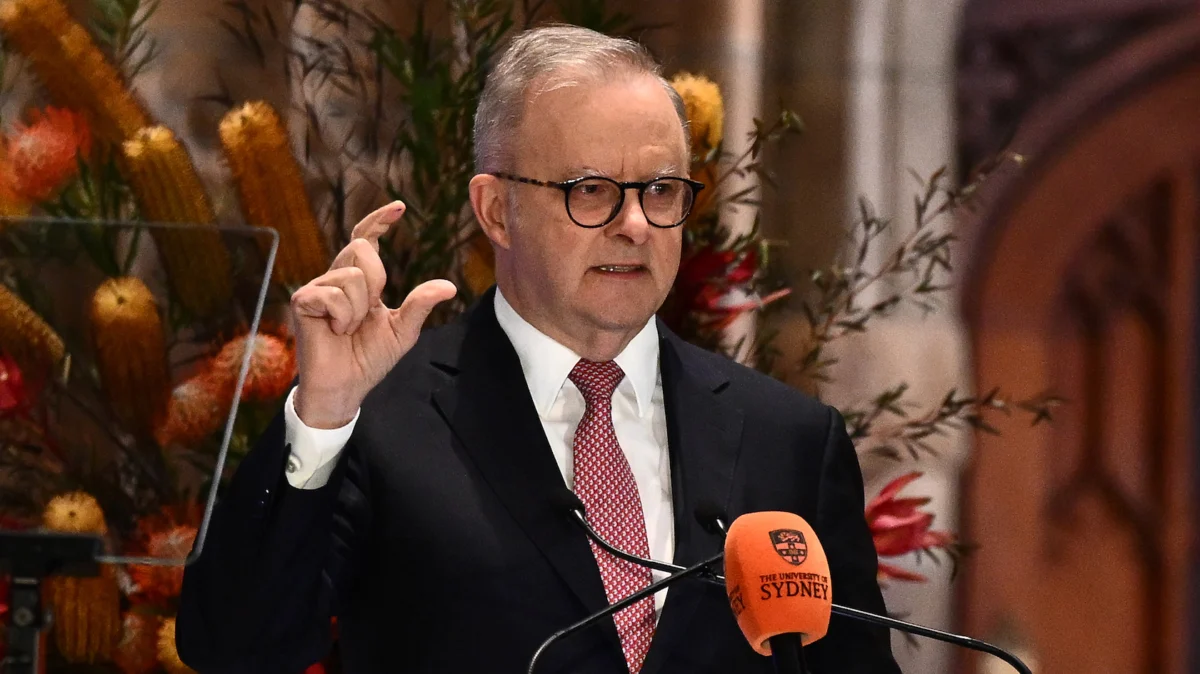
Prime Minister Anthony Albanese has unveiled his vision for Australia’s artificial intelligence (AI) future, painting a picture of national sovereignty, economic resilience, and protected intellectual property. However, as the dust settles on his recent address at the University of Sydney, a critical question remains: will this "Very Big Vision" materialize into tangible national progress, or will it succumb to the hallmark "Albo Delivery Scale"—a spectrum ranging from bold promises to a pattern of deferment, dilution, and drift?
The Main Facts: Defining the AI Frontier
The Prime Minister’s address was a carefully choreographed effort to quell growing public anxiety. Australians are increasingly wary of an AI revolution that threatens to replace human labor with automated systems while simultaneously bracing for the physical disruption caused by a rapid influx of power-hungry, water-intensive data centers across the country.
Albanese framed his strategy around national interest, positioning the government not as a passive observer, but as a proactive regulator. The centerpiece of the policy is the creation of a national framework for AI data centers, expected to arrive next month, with formal legislation slated for 2027. By centralizing the Office of AI within the Department of the Prime Minister and Cabinet, the government hopes to create a "single desk" for high-stakes negotiations with foreign tech titans, ranging from Microsoft and Google to Anthropic and OpenAI.
The government’s stated goal is to avoid the "digital quarry" trap: a scenario where Australia provides the cheap electricity and water necessary for AI infrastructure, only to watch foreign corporations mine Australian data and export the profits, leaving the nation as the lowest link in the global digital supply chain.
Chronology: From Speech to Legislation
The path forward, as outlined by the government, follows a structured but ambitious timeline:
- Late 2024/Early 2025: The government will release its national framework for AI data centers. This document is expected to outline the rules for energy consumption, water usage, and physical placement of infrastructure, aiming to mitigate rising community resistance in regional centers.
- Ongoing: The Office of AI begins its role as a cross-departmental hub, coordinating between defense, education, and infrastructure portfolios to ensure a unified approach to tech investment.
- 2027: Full legislative implementation. The government aims to have robust regulatory guardrails in place, covering data sovereignty, copyright protections, and competition standards.
Supporting Data and Economic Realities
The urgency of the PM’s intervention is underscored by the recent performance of the Australian tech sector. Local "tech heroes" like Atlassian and Xero have seen their market valuations slashed by nearly half over the past 12 months, battered by global economic headwinds and the relentless disruption of foreign AI models.
Furthermore, the physical footprint of AI is becoming a local political flashpoint. Companies like Firmus are already navigating fierce community pushback regarding proposed data centers in regions like Tailem Bend, South Australia, and Tasmania. As energy prices remain a sensitive topic for voters, the government’s ability to balance the demands of "hyperscalers" with the needs of local communities will be a litmus test for the administration’s competence.
Critically, the economic model is currently skewed. Without specific mandates, the "token bill shock"—the skyrocketing cost of accessing computing power—is already causing anxiety among startup CFOs. While the government invites foreign giants to build "Bunnings warehouses" of chips and models, there is little in the current plan to ensure that Australian startups have affordable access to the GPU power required to compete globally.
Official Responses and Sectoral Friction
The Prime Minister’s speech was designed to be a "soothing balm" for various stakeholders, but it was also a masterclass in political balancing.
The Creative Sector: Perhaps the most decisive part of the speech was the warning issued to tech giants regarding copyright. Albanese explicitly stated: "No company should use Australian books, music, art or news to build or train AI without the artist’s control." He framed this as a matter of basic ethics, warning that anything less constitutes theft. This was a direct response to reports that companies like Anthropic have sought to link their $16 billion investment proposals to relaxed Australian copyright settings.
The Tech Industry: Foreign hyperscalers were given a clear message: Australia is "open for business," provided they play by local rules. The strategy shifts the conversation from passive compliance to active negotiation.
The Community: Regional voters were promised that the era of unfettered data center expansion is over. By instituting a national framework, the government is attempting to ensure that projects are developed "on our terms."
Implications: The Missing Strategy for Startups
Despite the broad, positive intent of the PM’s vision, the policy architecture for local startups remains thin. When compared to international counterparts, Australia’s approach feels reactive rather than foundational.
The UK, for instance, has implemented an AI Opportunities Action Plan that actively supports local innovation through sovereign compute, AI Growth Zones, and the strategic use of government procurement to favor domestic firms. Singapore has taken a similar path, offering a S$150 million Enterprise Compute Initiative that provides startups with direct access to cloud compute, tools, and engineering support.
In contrast, the Albanese government’s strategy is currently devoid of a "government as first customer" procurement plan. For startups, the biggest barrier to entry is not just the technology, but the risk-averse nature of government departments. If the government is serious about national priorities like health, agriculture, and climate adaptation, it must develop challenge-based procurement pathways that allow small, agile Australian companies to secure government contracts without being suffocated by years of bureaucratic assessment.
Furthermore, the government must address the "billion-pound gorilla" in the room: the oligopolistic nature of the AI industry. With US tech giants already forming a well-worn path to Canberra, the risk of "cloud lock-in" and monopolistic pricing is high. If the government fails to address interoperability and API pricing, the digital landscape of the future may resemble the current state of Australia’s toll roads—expensive, locked-in, and privately controlled.
The "Albo Delivery Scale": A Final Assessment
The Albanese government has correctly identified the major risks: the loss of national data sovereignty, the exploitation of creative industries, and the physical strain on national energy grids. By placing the Office of AI under the Prime Minister’s Department, they have acknowledged that this is a whole-of-nation issue rather than a niche tech concern.
However, historical precedent suggests that the transition from a "Very Big Vision" to a concrete, successful outcome is where the current administration often falters. Whether it is gambling ad reform or the protection of religious freedoms, the pattern of "delay, defer, dilute, and drift" looms large over this new agenda.
To succeed, the government must move beyond generalities. They need to secure a "social dividend"—similar to an affordable housing quota—that guarantees reserved compute capacity for Australian researchers and startups at non-predatory prices. They must also move toward licensing national datasets in health, climate, and agriculture to foster a uniquely Australian AI ecosystem that isn’t entirely reliant on foreign-owned models.
The Prime Minister ended his speech with an inspirational tone, invoking the spirit of national progress and the long history of Australian innovation. But as the tech sector knows all too well, generative AI can produce beautiful, persuasive words that mask the lack of a functional engine underneath. The question for the Office of AI is not whether they can draft a vision, but whether they have the political backbone to ensure that the "Backbone of the Australian economy"—our small businesses and startups—can actually benefit from it.
Time will tell where this AI agenda lands on the Albo Delivery Scale. For now, the nation remains in a state of hopeful skepticism, waiting to see if this "Big Vision" is a genuine blueprint for the future or merely a temporary distraction from the deeper, structural challenges facing the Australian digital economy.
