

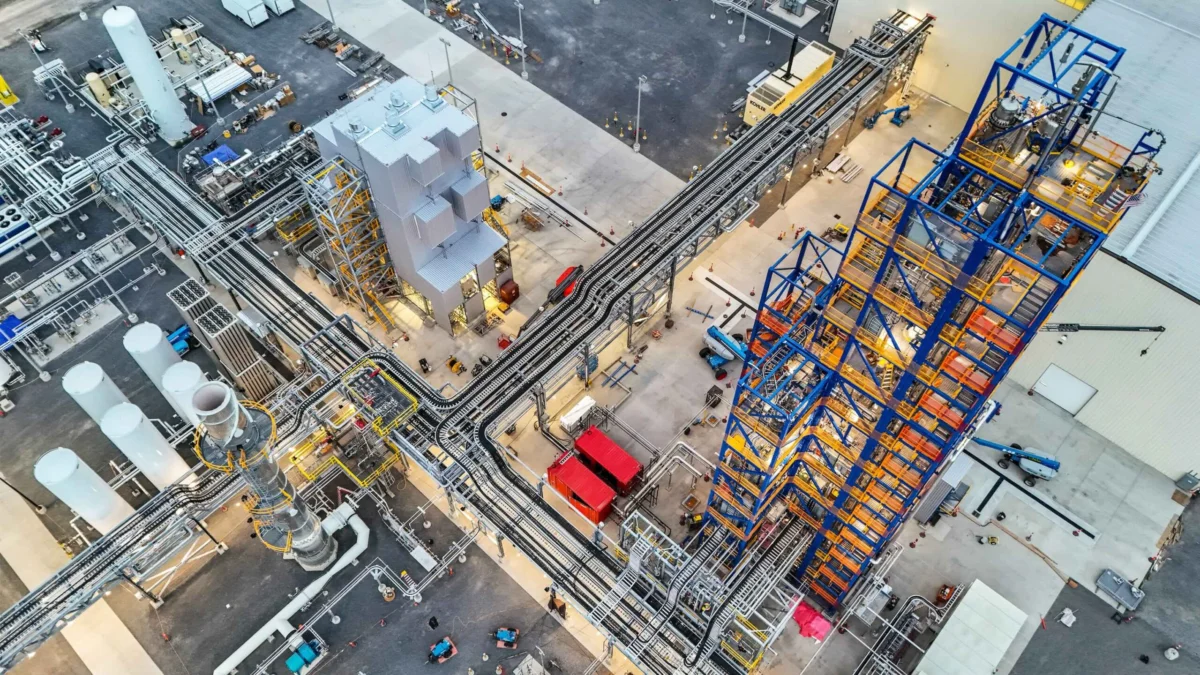
MOSES LAKE, Washington — Sila, a leading developer of next-generation battery materials, has announced a successful $300 million private funding round. This capital injection is earmarked to accelerate the expansion of its gigascale manufacturing facility in Moses Lake, Washington. The expansion is designed to scale the production of Sila’s proprietary silicon-carbon anode material, providing enough capacity to power more than 100,000 electric vehicles (EVs) annually and positioning the company as a key player in the Western hemisphere’s bid for battery supply chain independence.
This funding milestone arrives at a critical juncture for both the domestic energy transition and global trade relations. As the United States navigates a complex regulatory environment and shifting consumer demand, Sila’s domestic production capabilities offer a crucial alternative to the Eastern-dominated battery supply chain.
Main Facts: The $300 Million Capital Injection
The $300 million funding round was led by prominent investment firms Atreides Management and Sutter Hill Ventures. The round also saw significant participation from a consortium of new and returning investors, including 8VC, Bessemer Venture Partners, Matrix Partners, and various funds and accounts advised by T. Rowe Price Associates, Inc.
Prior to this round, Sila had secured approximately $1.3 billion in equity funding, bringing its total capital raised to date to roughly $1.6 billion. This substantial war chest reflects deep investor confidence in Sila’s proprietary technology and its commercial viability at scale.
The primary objective of this latest capital raise is to transition the Moses Lake plant from its initial production phase to true "gigascale" manufacturing. The facility, which officially commenced operations in September 2025, is currently capable of producing up to 2 gigawatt-hours (GWh) of silicon-carbon anode material. The newly funded expansion will elevate the plant’s output to tens of gigawatt-hours per year. This volume is sufficient to displace traditional graphite anodes in hundreds of thousands of electric vehicles, consumer electronics, and grid-scale storage systems annually.
Chronology: Sila’s 15-Year Journey to Gigascale
Sila’s rise to prominence is the result of a deliberate, fifteen-year development cycle aimed at solving one of the most stubborn challenges in electrochemistry: the commercialization of silicon anodes.
+-----------------------------------------------------------------+
| 2011: Sila founded by Gene Berdichevsky (Tesla Employee #7)     |
+-----------------------------------------------------------------+
                                |
                                v
+-----------------------------------------------------------------+
| 2011–2021: Ten years of intensive R&D on silicon-carbon anodes  |
+-----------------------------------------------------------------+
                                |
                                v
+-----------------------------------------------------------------+
| 2021: First commercial launch in Whoop 4.0 fitness tracker      |
+-----------------------------------------------------------------+
                                |
                                v
+-----------------------------------------------------------------+
| 2022–2023: Supply agreements signed with Mercedes-Benz & Panasonic|
+-----------------------------------------------------------------+
                                |
                                v
+-----------------------------------------------------------------+
| Sept 2025: Moses Lake, WA factory opens (Initial 2 GWh capacity)|
+-----------------------------------------------------------------+
                                |
                                v
+-----------------------------------------------------------------+
| July 2026: Secures $300M to expand Moses Lake to Gigascale      |
+-----------------------------------------------------------------+
The Early Years and R&D Focus
Sila was co-founded in 2011 by Gene Berdichevsky, who famously served as the seventh employee at Tesla, where he was the lead engineer on the Roadster’s battery pack. Recognizing that incremental improvements to traditional lithium-ion chemistry would eventually plateau, Berdichevsky and his team spent more than a decade in stealth and R&D modes, perfecting a silicon-carbon composite that could withstand the physical stresses of battery cycling.
Commercial Proof of Concept
By 2021, Sila achieved its first commercial milestone when its material, branded as Titan Silicon, was integrated into the Whoop 4.0 fitness tracker. This marked the first time a next-generation silicon anode was successfully commercialized in a consumer device, proving that the material could deliver superior energy density in real-world applications.
Strategic Partnerships and Scale
Following the success in consumer electronics, Sila secured landmark supply agreements with global automotive and technology giants. In 2022, Mercedes-Benz announced it would use Sila’s silicon-anode chemistry in its upcoming electric G-Class SUV to extend driving range. In late 2023, Panasonic—a primary battery supplier for Tesla and other major automakers—signed a supply agreement with Sila to integrate the material into its next-generation EV cells.
Manufacturing Milestones
In September 2025, Sila officially opened the doors of its Moses Lake, Washington plant. The facility represented the first commercial-scale silicon anode factory in the United States. The announcement in July 2026 of a $300 million expansion represents the final phase of transitioning Sila from a boutique materials provider to a high-volume, gigascale industrial powerhouse.
Supporting Data: Silicon Chemistry vs. Traditional Graphite
The driving force behind Sila’s commercial appeal is the stark performance contrast between its silicon-carbon composite and traditional graphite anodes.
| Performance Metric | Traditional Graphite Anode | Sila Silicon-Carbon Anode | Net Performance Impact |
|---|---|---|---|
| Energy Density Increase | Baseline (approx. 372 mAh/g) | Up to 40% higher volumetric density | Significantly longer range/run-time per charge |
| Charging Time (10% to 80%) | ~20–30 minutes | Under 10 minutes | Drastic reduction in charge-anxiety |
| Supply Chain Concentration | ~75% controlled by China | Made in USA (Moses Lake, WA) | Protection from tariffs & trade disruptions |
| Physical Characteristics | Stable, low expansion | Engineered to resist swelling | Maintains cell longevity over thousands of cycles |
For the past three decades, the anode of almost every lithium-ion battery has been made of graphite. While graphite is stable and reliable, it has reached its theoretical physical limit for energy storage. Silicon, by contrast, can hold up to ten times more lithium ions by weight than graphite.
Historically, the obstacle to using silicon was that it swells up to 300% when fully charged, causing the battery cell to fracture, degrade, and fail rapidly. Sila’s technological breakthrough lies in its engineered silicon-carbon scaffold, which accommodates the swelling of silicon on a microscopic level, preventing macroscopic expansion and ensuring the battery remains stable over thousands of charge-discharge cycles.
Official Responses: Aligning Capital with Technology Sovereignty
The successful funding round has drawn optimistic responses from Sila’s leadership team and its financial backers, who view the expansion not just as a business success, but as a geopolitical necessity.
Statement from Sila Leadership
Gene Berdichevsky, Co-founder and CEO of Sila, emphasized the strategic importance of domestic manufacturing:
"To secure America’s technology sovereignty and meet the demands of the transition to clean energy, we must manufacture critical battery components here at home. This $300 million investment allows us to scale up our Moses Lake facility much faster, ensuring that our automotive partners like Mercedes-Benz and Panasonic have access to the highest-performing, domestically sourced materials. We are no longer just proving the science; we are scaling the industrial engine that will power the next generation of transportation."
Investor Perspectives
Representatives from the lead investment groups echoed this sentiment, highlighting Sila’s rare position as a market-ready alternative to foreign supply chains. A spokesperson from Sutter Hill Ventures commented:
"Sila has systematically de-risked its technology over fifteen years, proving its performance first in consumer devices and now in rigorous automotive validation tests. Our continued investment reflects our belief that Sila is the only company positioned to deliver true gigascale quantities of advanced anode materials to Western markets in the immediate term."
Implications: Geopolitics, Market Divergence, and the Rise of AI
The scaling of Sila’s manufacturing facility carries profound implications across multiple sectors, ranging from international trade policy to the rapidly changing demands of artificial intelligence infrastructure.
1. Geopolitical Decoupling and Supply Chain Security
Currently, Chinese enterprises control roughly 75% of the global graphite anode supply chain. This near-monopoly has left Western automakers highly vulnerable to export restrictions, geopolitical tensions, and shifting tariff structures.
By establishing a robust, domestic source of high-performance silicon-carbon anodes in Washington State, Sila provides automakers with a viable path to comply with the stringent sourcing requirements of the U.S. Inflation Reduction Act (IRA) and avoid costly import tariffs. This domestic production is a cornerstone in the broader effort to build a self-sustaining North American battery ecosystem.
       [Traditional Supply Chain]                [Sila Domestic Supply Chain]

          +-------------------+                     +-------------------+
          |  China Graphite   |                     | Sila Moses Lake WA|
          |  (75% of Supply)  |                     |  Silicon Anodes   |
          +---------+---------+                     +---------+---------+
                    |                                         |
         (Tariffs / Export Risks)                    (IRA Compliant / Local)
                    |                                         |
                    v                                         v
          +-------------------+                     +-------------------+
          | Global Battery    |                     | North American    |
          | Manufacturers     |                     | Battery Ecosystem |
          +-------------------+                     +-------------------+
2. The Divergent EV Market
Sila’s expansion comes during a complex period for the U.S. electric vehicle market. Domestic EV demand has experienced a temporary softening, influenced by policy shifts from the Trump administration aimed at reducing federal subsidies and modifying fuel economy standards. U.S. sales in 2026 have remained somewhat depressed compared to the high-water marks of 2025, which saw a surge in buying ahead of the sunsetting of key consumer tax credits.
However, the global picture tells a very different story. According to data from Benchmark Minerals Intelligence, global EV sales grew by 27% year-over-year, reaching 2.0 million units in June 2026 alone. Markets in Europe, Asia, and emerging economies continue to adopt electric mobility at a rapid pace. Sila’s dual-track approach—supplying domestic markets while fulfilling international contracts with companies like Panasonic and Mercedes-Benz—insulates the startup from localized policy fluctuations in the United States.
3. The AI and Grid-Scale Energy Storage Revolution
While electric passenger vehicles remain the largest consumer of lithium-ion batteries, a new and massive demand vector has emerged: grid-scale Energy Storage Systems (ESS).
The rapid proliferation of AI-focused data centers has created unprecedented demand on local electrical grids. These data centers require enormous amounts of continuous power. Tech companies and utilities are increasingly purchasing grid-scale battery packs to:
- Act as mission-critical backup power sources.
- Mitigate peak demand charges by storing cheap electricity during off-peak hours.
- Enable the 24/7 utilization of intermittent renewable energy sources, such as solar and wind power.
Because Sila’s silicon-carbon anodes offer 40% higher energy density, grid storage operators can store significantly more power in a smaller physical footprint. This footprint reduction is highly valuable for data centers located in urban or space-constrained environments, ensuring that Sila’s market opportunity extends far beyond the automotive sector and deep into the infrastructure supporting the global artificial intelligence boom.
