





Main Facts
In an era where Silicon Valley’s aerospace sector is heavily saturated with flashy, capital-intensive concepts like electric vertical takeoff and landing (eVTOL) aircraft and hydrogen propulsion, Poseidon Aerospace is taking a decidedly contrarian approach. The Alameda, California-based startup has secured $60 million in a Series A funding round, positioning itself to disrupt the regional air cargo market not through novel propulsion, but through pragmatic, autonomous design.
The Series A round was led by early-stage venture capital firm TQ Ventures. It also attracted new investments from Hanwha Asset Management, G Squared, and JAWS, alongside continued participation from existing backers Starship Ventures, Draper Associates, and Drover Ventures. This substantial capital injection follows an $11 million seed round raised last year, bringing Poseidon’s total disclosed funding to over $71 million.
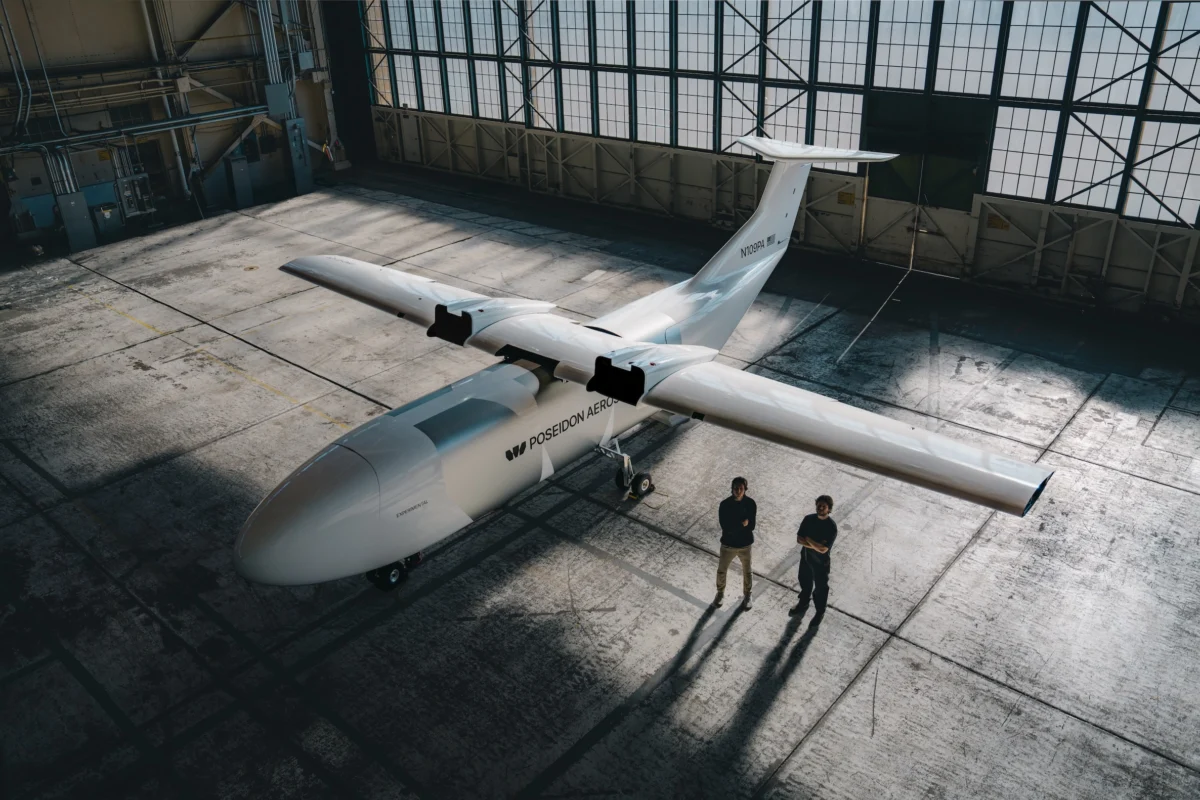
The fresh capital will fund the completion and upcoming maiden flight of "Egret," Poseidon’s flagship uncrewed cargo plane, which is scheduled for its first test flight by the end of this year. Additionally, the funding will support the development of "Heron," a seaplane variant designed for marine and coastal logistics, and fuel a significant hiring expansion at the company’s new headquarters—a historic, spacious former U.S. Navy hangar in Alameda, California.
Unlike its competitors, Poseidon is rejecting the complex engineering requirements of VTOL systems and alternative powertrains. Instead, the company is building fixed-wing, autonomous aircraft powered by traditional internal combustion engines. By eliminating the cockpit, life support systems, and the pilot, Poseidon aims to slash the operating costs of regional air logistics, targeting both defense applications and commercial regional cargo networks.
+-------------------------------------------------------------------------+
|                       POSEIDON AEROSPACE AT A GLANCE                    |
+-------------------------------------------------------------------------+
| Founders:          David Zagaynov (CEO) & Parker Tenney                 |
| Total Funding:     $71 Million ($11M Seed + $60M Series A)              |
| Lead Investor:     TQ Ventures                                          |
| Flagship Aircraft: Egret (Uncrewed Cargo), Heron (Seaplane Variant)     |
| Propulsion:        Liquid Hydrocarbon Combustion Engines                |
| Core Facility:     Former U.S. Navy Hangar, Alameda, California         |
+-------------------------------------------------------------------------+
Chronology
The genesis of Poseidon Aerospace lies in the intersection of corporate logistics and defense-grade aerospace engineering. The company’s trajectory highlights a rapid transition from conceptual design to full-scale hardware manufacturing.
2024: The Ideation Phase
While managing logistics operations at Amazon, David Zagaynov found himself analyzing the systemic bottlenecks of regional shipping. Simultaneously, co-founder Parker Tenney was working at Lockheed Martin, observing the defense sector’s growing demand for resilient, low-cost supply chains. The two repeatedly discussed the rise of advanced air mobility (AAM) startups. They realized that while the industry was flooded with capital, most players were focused on complex, passenger-carrying eVTOL designs that faced steep regulatory and technological barriers. Zagaynov and Tenney saw an underserved opportunity: optimizing air cargo through a ruthlessly simplified, uncrewed, combustion-powered platform.
Late 2024: Seed Funding and "Seagull" Prototype
To validate their thesis, the founders established Poseidon Aerospace and secured an $11 million seed funding round. With this initial capital, the team designed, manufactured, and successfully flight-tested the "Seagull," a quarter-scale prototype of their autonomous aircraft. The flight tests proved the aerodynamic viability of their airframe and the reliability of their proprietary autonomous flight control software.
Mid-2025: Series A and Facility Expansion
Building on the success of the Seagull prototype, Poseidon raised a $60 million Series A round. To accommodate the manufacturing of their full-scale, 50-foot-wingspan aircraft, the company relocated its operations to a historic Navy hangar in Alameda, California. This facility provides the physical clearance and industrial infrastructure required to assemble multiple full-sized aircraft simultaneously.
Late 2025 (Projected): The Egret’s Maiden Flight
With manufacturing underway in Alameda, Poseidon is on track to execute the first test flight of the full-scale Egret uncrewed cargo plane before the end of the year. This milestone will kickstart the company’s flight envelope expansion and regulatory certification pathways.
Supporting Data and Technical Specifications
Poseidon’s business model is built on the cold math of payload-to-weight ratios, energy density, and asset utilization.
The Energy Density Reality
While electric aviation startups struggle with the weight of modern lithium-ion batteries, Poseidon relies on traditional liquid hydrocarbon fuels.
- Energy Density Comparison: Jet-A fuel and high-octane aviation gasoline yield approximately 12,000 Watt-hours per kilogram (Wh/kg). In contrast, state-of-the-art commercial batteries struggle to exceed 250 to 300 Wh/kg.
- Payload Implications: By utilizing combustion engines, Poseidon’s aircraft do not have to carry thousands of pounds of dead battery weight on return trips. As fuel burns, the aircraft becomes lighter, increasing cruise efficiency and reducing structural stress.
The Structural Dividend of Autonomy
Removing human pilots yields major design advantages. Traditional aircraft designs must dedicate significant weight, volume, and electrical power to keep a human pilot safe and comfortable. By designing an uncrewed system from scratch, Poseidon eliminates:
- The physical cockpit and windshields (reducing aerodynamic drag).
- Heavy flight instruments, manual controls, and pilot seats.
- Life support systems, including cabin pressurization, heating, oxygen tanks, and air conditioning.
This design choice triggers a positive engineering feedback loop:
$$textReduced Structural Weight longrightarrow textSmaller, Lighter Engines Required longrightarrow textLower Fuel Consumption longrightarrow textIncreased Payload Capacity$$
Traditional Piloted Regional Cargo Plane vs. Poseidon Egret Design:

+-----------------------------------------+      +-----------------------------------------+
|  [Cockpit] [Life Support] [Instruments] |      |                                         |
|  [     Crew Payload Capacity: 60%     ] |      |  [        Cargo Payload Capacity: 85% ] |
|  [      Structural Weight: High       ] |      |  [        Structural Weight: Low      ] |
+-----------------------------------------+      +-----------------------------------------+
       Piloted Regional Aircraft                         Poseidon Egret Uncrewed Cargo
Operational Economics and Asset Utilization
In regional logistics, the hub-and-spoke model dominates because traditional aircraft are expensive to run and bound by crew availability. Poseidon aims to shift this to a point-to-point model.
- Pilot Hour Limitations: Under FAA regulations, commercial pilots are restricted to strict flight-time limitations (typically 8 hours of flight time in a 24-hour lookback period). This leads to expensive overnight stays, crew swaps, and grounded aircraft.
- Asset Utilization: Because Poseidon’s aircraft are autonomously operated and monitored by remote pilots, they can operate continuously, stopping only for refueling, cargo loading, and routine maintenance.
- Point-to-Point Routing: By eliminating pilot-related overnight costs and simplifying airport requirements, Poseidon can operate routes directly between secondary and tertiary airports. This bypasses congested hub airports and slashes shipping times.
Official Responses and Leadership Philosophy
Poseidon’s leadership emphasizes a pragmatic, market-first approach over technological novelty. In an exclusive interview, co-founder and CEO David Zagaynov detailed the company’s philosophy.
"Philosophically, we want to build the future of aerologistics," Zagaynov stated. "Not to be a hater, but I think a lot of people who start aerospace companies get nerd-sniped by very cool technology and then want to implement it into market. For us, we want to improve cargo."
Zagaynov expanded on his aversion to the "nerd-sniping" phenomenon—a term used in engineering circles to describe getting so distracted by an intellectually challenging problem that one loses sight of commercial viability.
"It’s really hard to beat the energy density of fuels of anything carbon-related," Zagaynov explained. "Can I make a really good box with wings to move things for super cheap? If you do that, then abstracting the tech away, we’re left with unmanned cargo-like planes that are able to operate on a much lower cost curve, and have much higher utilization."
Addressing the company’s go-to-market strategy, Zagaynov made it clear that Poseidon does not intend to be an aircraft OEM (Original Equipment Manufacturer) selling hardware to third parties. Instead, the company plans to build and operate its own logistics network.
"What’s very nice is, logistics is a commodity, and so if you sell a commodity and do it better, faster, cheaper, the demand is all yours," Zagaynov said. "When you have a pilot, they have a maximum amount of hours that they can fly. So if they fly a five-hour leg in one direction, they’re not able to come back home. And unless you have a relief pilot, then you have to pay for them to spend the night somewhere. The plane is like a very expensive asset that spends most of its life just waiting."
Implications
The successful scaling of Poseidon Aerospace carries significant implications for the defense sector, the commercial logistics industry, and the broader aerospace regulatory environment.
+---------------------------------------------------------------------------------+
|                              POTENTIAL IMPACT AREAS                             |
+---------------------------------------------------------------------------------+
| Defense & National Security   | Resilient, decentralized logistics for contested|
|                               | environments; direct counter to foreign drone   |
|                               | supply-chain capabilities.                      |
+---------------------------------------------------------------------------------+
| Commercial Air Cargo          | Transition from hub-and-spoke to direct point-  |
|                               | to-point middle-mile delivery; lower shipping   |
|                               | costs for regional communities.                 |
+---------------------------------------------------------------------------------+
| Regulatory Frameworks         | Accelerated cargo-only autonomous certification |
|                               | pathways; validation of uncrewed commercial     |
|                               | operations over remote and maritime routes.     |
+---------------------------------------------------------------------------------+
Defense and National Security: Contested Logistics
In modern warfare, logistics is a critical vulnerability. The U.S. Department of Defense is increasingly focused on "contested logistics"—the challenge of keeping forces supplied in environments where adversaries can disrupt traditional transport hubs and deep-water ports.
Poseidon’s aircraft are well-suited for these environments. By designing planes that can operate from short, degraded, or nonexistent runways—and, in the case of the Heron seaplane variant, directly from water—Poseidon offers a decentralized supply chain.
This capability reduces reliance on large, vulnerable airbases. The strategic urgency is heightened by geopolitical competition; China has actively developed and tested heavy cargo drones to establish its own resilient, uncrewed logistics networks across the Indo-Pacific. Poseidon provides a Western counterweight to these capabilities.
Commercial Logistics: Disrupting the Middle Mile
In the commercial sector, Poseidon is targeting the "middle mile" of logistics. Currently, companies like FedEx, UPS, and DHL rely on feeder airlines operating fleets of older, piloted turboprops (such as the Cessna Caravan or ATR 42) to move packages from major sorting hubs to regional airports.
By bypassing the hub-and-spoke model entirely, Poseidon can offer direct, point-to-point regional cargo flights. This strategy mirrors the business models of low-cost, point-to-point passenger airlines like Breeze Airways or Avelo Airlines, but applies it to freight.
Because Poseidon operates its own fleet, it can integrate directly with existing ground-logistics providers. This setup allows them to offer same-day or overnight regional deliveries at a fraction of the cost of current air cargo services.
Regulatory and Certification Pathways
While passenger-carrying eVTOL startups face a long, complex path to certify experimental aircraft for urban operations, Poseidon benefits from a simpler regulatory environment.
- Lower Risk Profile: Cargo-only operations over sparsely populated or maritime routes carry far lower safety risks than passenger flights over dense cities. Consequently, aviation regulators like the Federal Aviation Administration (FAA) can apply more streamlined certification pathways.
- Regulatory Momentum: The FAA has shown an increased willingness to support aviation innovation. Programs originally designed to accommodate advanced air mobility and eVTOL platforms have established regulatory precedents that Poseidon can use to certify its autonomous flight systems.
- The Path to Autonomy: By starting with remote piloting and gradually transitioning to higher levels of autonomy, Poseidon can build a solid safety record. This stepwise approach makes it easier to secure commercial operating certificates under FAA Part 135 regulations.
By combining proven combustion propulsion with autonomous design, Poseidon Aerospace is taking a highly practical path to market. If the upcoming test flight of the Egret succeeds, the company will be well-positioned to prove that in the race to modernize aviation, simplicity and cost-efficiency often win out over complex, unproven technologies.
