




By [Your Name/Journalist Desk]
Melbourne-based medical technology innovator Navi Medical Technologies has successfully closed a $6.8 million funding round, a pivotal milestone that will accelerate the commercial rollout of its groundbreaking pediatric catheter technology across the United States. This capital injection marks a significant turning point for the startup, which is poised to transform the standard of care for critically ill newborns in neonatal intensive care units (NICUs) worldwide.
The funding round was spearheaded by a $4 million investment from ANZ healthcare venture capital firm KP Rx. Existing investors, including Innovation Victoria (formerly Breakthrough Victoria) and Pacific Chan, also contributed, underscoring strong confidence in the company’s clinical roadmap and its recently acquired regulatory achievements.
The Problem: Navigating the Most Fragile Patients
In the high-stakes environment of a pediatric intensive care unit, every second counts. One of the most common yet notoriously difficult procedures performed on critically ill infants is the insertion of a central venous catheter. These devices are essential for delivering life-saving medications, nutrition, and fluids to newborns who are often born prematurely or with complex health conditions.
However, the placement of these catheters is fraught with risk. Traditionally, clinicians rely on tactile feedback, anatomical landmarks, and post-procedural X-rays to verify that the catheter tip is correctly positioned in the major vein near the heart. Misplacement can lead to severe, life-threatening complications, including cardiac tamponade, vessel perforation, and arrhythmias.
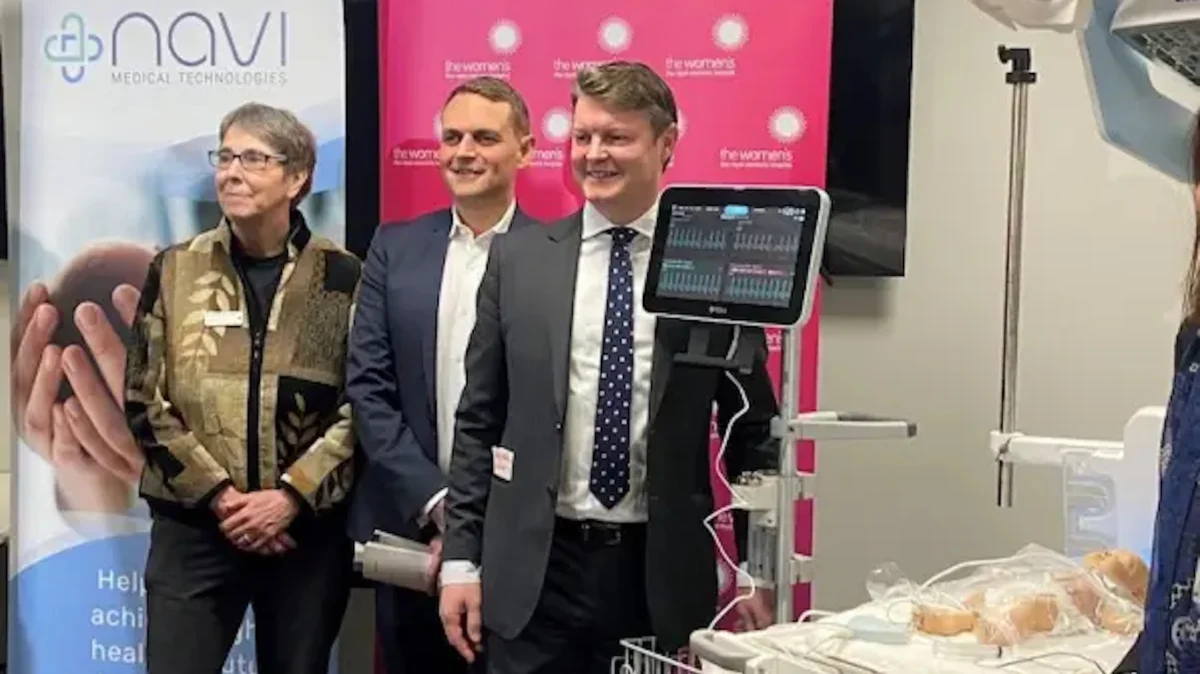
Navi Medical Technologies, co-founded by CEO Alex Newton and neonatologist Dr. Christiane Theda, sought to solve this persistent clinical challenge. Their flagship device, Neonav, provides real-time, precise guidance for clinicians, significantly reducing the margin of error and the reliance on radiation-heavy imaging.
A Chronology of Innovation: From Melbourne to Boston
The journey of Navi Medical Technologies is a testament to the robust medical research ecosystem in Australia. The startup’s trajectory reflects a deliberate, evidence-based approach to medtech development.
- 2017-2018: Concept and Early Validation: Following the identification of a significant clinical gap in pediatric care, the founders began the research and development phase, focusing on creating a device that could integrate seamlessly into existing hospital workflows.
- 2021: Strategic Growth: The company began to expand its footprint, establishing a presence in Boston, Massachusetts—a global hub for biotechnology and clinical research—to position itself for the rigors of the U.S. healthcare market.
- Mid-2023: Early Funding Success: Navi secured $2.4 million in a seed round supported by Medtech Actuator, Artesian VC, and the Victorian government’s investment arm, Breakthrough Victoria. This funding allowed for the refinement of the Neonav device and the initiation of formal regulatory processes.
- 2024-2025: Regulatory Milestones: After rigorous testing and clinical evaluation trials at two leading U.S. pediatric hospitals, the company successfully navigated the complex FDA approval process, granting them the legal authorization to market and sell the device in the U.S.
- July 2026: Scaling Operations: With the latest $6.8 million in funding, the company is moving from a clinical research focus to a commercial expansion phase, aiming to place Neonav in hospitals across the U.S.
The Science Behind the Success
The Neonav system is designed to provide clinicians with accurate, real-time feedback during catheter insertion. By utilizing proprietary sensor technology, the device alerts the operator to the position of the catheter tip in relation to the heart.
"The accurate placement and management of central venous access devices used to deliver nutrition, fluids, and medications is one of the most challenging procedures in intensive care for infants," said Alex Newton, co-founder and CEO of Navi. "Our technology is designed to eliminate the guesswork. When you are dealing with the most vulnerable patients, you cannot afford uncertainty."
Clinical data from the two U.S. hospitals that participated in the evaluation trials indicated that the device significantly improves the success rate of initial placement. By minimizing the need for multiple attempts and reducing the frequency of follow-up X-rays, Neonav not only improves patient safety but also streamlines hospital efficiency—a crucial metric for administrators looking to optimize resource allocation in strained ICU departments.
The Investment Landscape: Why Investors Are Betting on Navi
The $6.8 million investment, led by KP Rx, highlights a growing trend of institutional interest in "precision pediatrics." While much of the medtech world focuses on aging populations and chronic disease management for adults, pediatric innovation has historically been underserved due to smaller market sizes and higher regulatory hurdles.
"Navi represents the intersection of high-impact patient outcomes and scalable technology," said a spokesperson from the investment group. "The fact that they have already secured FDA approval and demonstrated success in U.S. clinical environments de-risks the investment significantly. They have moved past the ‘idea’ stage and into the ‘execution’ stage."
The backing of Innovation Victoria further underscores the state’s commitment to nurturing local medtech talent. By providing both financial support and policy advocacy, the Victorian government has enabled Navi to maintain its R&D base in Melbourne while simultaneously capturing market share abroad.
Implications for the Healthcare Sector
The entry of Neonav into the U.S. market has broader implications for how hospitals approach neonatology.
1. Reduced Exposure to Radiation: By reducing the need for confirmatory X-rays, infants are spared unnecessary radiation exposure, which is a significant concern in long-term neonatal care.
2. Improved Workflow Efficiency: NICU teams are often overworked and under immense pressure. Technologies that simplify complex procedures allow staff to focus on other critical aspects of patient care, reducing burnout and improving the quality of the work environment.
3. Economic Impact: While the upfront cost of the device is a factor, the reduction in complications and the associated costs of treating those complications (such as extended hospital stays or emergency surgical interventions) present a compelling value proposition for hospital CFOs.
Challenges Ahead: The Road to Widespread Adoption
Despite the momentum, the path to universal adoption is not without its hurdles. The U.S. healthcare system is notoriously fragmented, and getting a new device into the hands of clinicians requires navigating complex procurement processes, hospital board approvals, and insurance reimbursement frameworks.
Navi will need to leverage its Boston base to build strong relationships with key opinion leaders in pediatric medicine. As the company scales, it must also continue to collect real-world evidence (RWE) to satisfy the demands of hospital value-analysis committees, which determine which new technologies get purchased and which are relegated to the sidelines.
Furthermore, competition remains a consideration. While Navi holds a unique position, larger medical device manufacturers are constantly exploring ways to integrate real-time monitoring into their existing catheter portfolios. Maintaining its "first-mover" advantage through continued innovation and clinical evidence will be paramount for Newton and her team.
Looking Toward the Future
With this latest round of funding, Navi Medical Technologies has the capital to build out its sales and marketing teams, expand its clinical support infrastructure in the U.S., and potentially pursue additional indications for the Neonav technology.
As the company prepares for this next chapter, the focus remains firmly on the goal that started it all: ensuring that every infant, regardless of their condition at birth, has the best possible start to life. By removing the technical risks associated with one of the most common medical procedures, Navi is not just selling a device; it is setting a new standard for pediatric excellence.
For a startup that began in a Melbourne laboratory, the journey to the heart of the U.S. healthcare system is a milestone worth celebrating. As the first units begin to ship and find their place in NICUs across America, the true success of Navi will be measured in the quiet, steady recovery of the infants it serves—a metric that, for the team at Navi, is the only one that truly matters.
