




While corporate tax rates often dominate political headlines, a quieter but far more consequential factor dictates the health of national economies: capital allowances. These tax provisions, which determine how businesses account for the cost of investments in machinery, technology, and infrastructure, are the bedrock of capital formation. As European nations navigate a period of sluggish growth and shifting global competition, the way they structure these allowances is becoming a primary battleground for economic competitiveness.
The Mechanics of Capital Recovery: Why Timing Matters
At its core, a business calculates its taxable profit by subtracting operational expenses—such as wages, rent, and raw materials—from total revenue. However, capital investments are treated differently. Governments generally do not allow businesses to deduct the full cost of a new factory or a fleet of machines in the year they are purchased. Instead, they mandate "depreciation schedules," which spread the cost of an asset over its "useful life."
From an accounting perspective, this seems logical. From an economic perspective, however, it is a significant hurdle to growth. The practice fails to account for the time value of money and the erosive effects of inflation. If a firm invests €10,000 in equipment today, the ability to deduct €1,000 annually over the next decade is worth significantly less in "real" terms than a full deduction at the moment of purchase.
By failing to offer full, immediate expensing, tax codes effectively inflate the tax base. This increases the "cost of capital," a phenomenon that discourages investment, hampers the adoption of new, more efficient technology, and ultimately stagnates productivity and wage growth.
A Comparative Landscape: Europe vs. The Global Stage
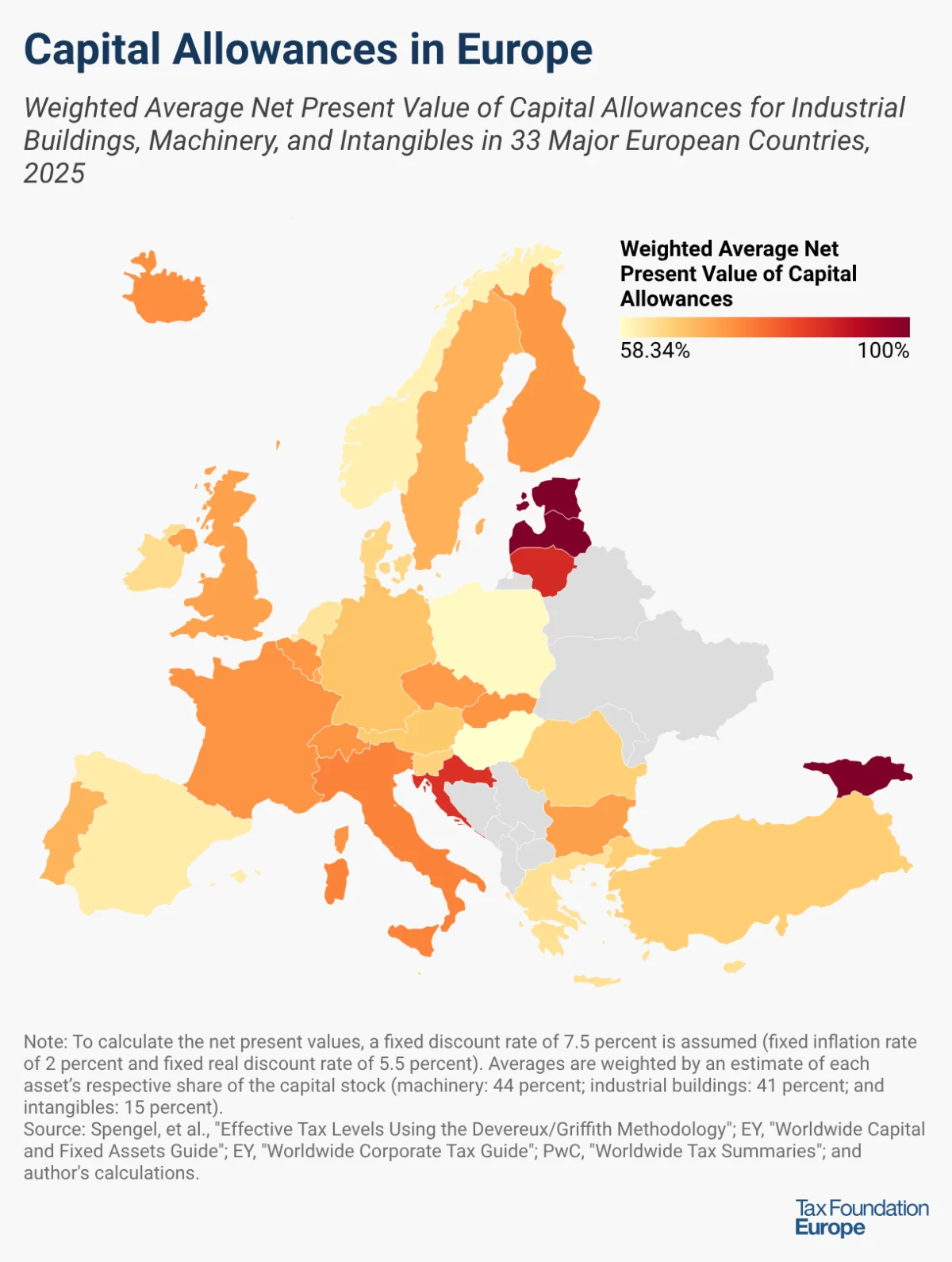
The current European landscape for capital allowances is a patchwork of disparate policies, leading to vastly different incentives for business expansion. In 2025, the average European business can recover roughly 72.1 percent of the present value cost of its investments. This figure is calculated by weighting the treatment of three primary asset classes: machinery (44 percent of capital stock), industrial buildings (41 percent), and intangibles like patents (15 percent).
The disparity between nations is stark. At the top of the spectrum are Estonia, Georgia, and Latvia. These nations have adopted distribution-based tax systems, where reinvested earnings remain untaxed. This effectively permits 100 percent of the present value of capital investment to be written off, placing them at the vanguard of European tax efficiency.
Conversely, countries such as Norway (60.7 percent), Poland (59.3 percent), and Hungary (58.3 percent) offer some of the least attractive cost-recovery environments on the continent. These nations essentially penalize businesses for modernizing, as the tax code forces them to wait years to fully recover the costs of their productive assets.
When measured against the United States, which has recently leaned into aggressive cost-recovery policies, many European nations find themselves at a disadvantage. In 2025, the U.S. implemented permanent full expensing for qualifying investments, allowing for a 94.5 percent recovery rate on average—a move explicitly designed to stimulate domestic manufacturing and technological adoption.
Chronology of Reform: A Movement Toward Permanence
The last five years have seen a frantic, albeit necessary, evolution in tax policy as European governments realized that temporary fixes were no longer sufficient to maintain competitive momentum.
- 2020–2022: In the wake of pandemic-induced economic uncertainty, nations like Finland and Germany introduced accelerated depreciation schedules for machinery. These were intended as short-term stimuli.
- 2023: A pivot toward permanence began. The United Kingdom, recognizing that the "wait-and-see" approach of temporary tax relief was failing to spur long-term capital projects, implemented permanent full expensing for machinery and equipment.
- 2024: Germany, having seen its initial accelerated depreciation policies expire, opted for a partial renewal and expanded the scope to include dwellings, signaling a recognition that infrastructure investment requires long-term policy certainty.
- 2026 (Forthcoming): Lithuania is set to join the ranks of the most competitive jurisdictions by implementing permanent full expensing for machinery, equipment, and software, a move expected to bolster its tech sector significantly.
This timeline reflects a broader, tectonic shift: policymakers are moving away from "tax-and-spend" cycles toward "invest-and-grow" frameworks.
Supporting Data: The Cost of Inaction
The data clearly demonstrates that asset-specific treatment is critical to industrial output. Machinery, the backbone of the manufacturing sector, receives the highest capital allowance rates in Europe (87 percent on average). Intangibles, which drive the digital economy, follow at 82.6 percent. However, industrial buildings languish at a 52.3 percent recovery rate.
This creates a systemic bias. When buildings are harder to write off than machines, businesses are incentivized to upgrade their technology but discouraged from expanding their physical footprints. In a global economy where space-efficient, high-tech manufacturing hubs are the goal, this tax bias acts as a bottleneck for industrial scaling.
Furthermore, the "cost of capital" is not merely an academic concern. High costs of capital lead to lower investment ratios. When the tax code treats an investment as a "gain" rather than a "cost," firms defer projects. Over a ten-year horizon, this results in a compound effect: the equipment not purchased today is the productivity gain not realized tomorrow, leading to stagnant real wages for the workforce.
Official Responses and Policy Shifts
The consensus among economic analysts and various governmental advisory boards is increasingly unified: the tax code must become neutral.
The German government, in its latest draft law to boost investment, explicitly linked its extension of accelerated depreciation to the need for a "modernization of the industrial core." By extending schedules into 2027, Berlin is attempting to provide the long-term visibility that corporate boards require to approve multi-year capital expenditure (CAPEX) budgets.
Similarly, the United Kingdom’s decision to make full expensing permanent—despite increasing the headline corporate tax rate from 19 to 25 percent—was a calculated trade-off. By pairing a higher tax rate with a much broader tax base (through full expensing), the U.K. has attempted to create a system that is "neutral"—meaning the tax code does not interfere with the business decision of whether to invest or wait.
Economic Implications: The Path Forward
The implications of these policies are profound. For a continent facing demographic headwinds and intense competition from North American and Asian markets, capital allowances are the most potent lever available to boost productivity without increasing public spending.
The Case for Neutrality
To compete globally, European policymakers should adopt three core principles:
- Immediate Expensing: Moving toward a system where 100 percent of the cost of machinery and equipment can be deducted in the first year removes the "tax-bias" against investment.
- Inflation Adjustments: For long-term assets like buildings, where immediate expensing may be fiscally difficult, governments should allow for indexation of depreciation to account for inflation, ensuring the real value of the deduction is preserved.
- Policy Certainty: The era of "temporary" incentives must end. Business investment is a long-term game; a policy that is set to expire in two years is often ignored by corporate planners. Permanence is the ultimate catalyst for capital formation.
Conclusion
Capital allowances are the unsung heroes of economic policy. While they lack the visibility of income tax cuts or public infrastructure projects, they provide the internal incentives that drive private-sector growth. As the European Union and its neighbors look to revitalize their industrial bases, the message from the data is clear: the countries that allow businesses to recover the full cost of their investments today will be the ones that own the technological and industrial leadership of tomorrow.
The path to a more prosperous Europe is not necessarily through more spending, but through smarter, more neutral taxation that rewards those who build, invent, and expand. By refining capital allowances, Europe can ensure that its tax systems serve as a bridge to growth rather than a wall blocking it.
