




By Editorial Staff | August 17, 2026
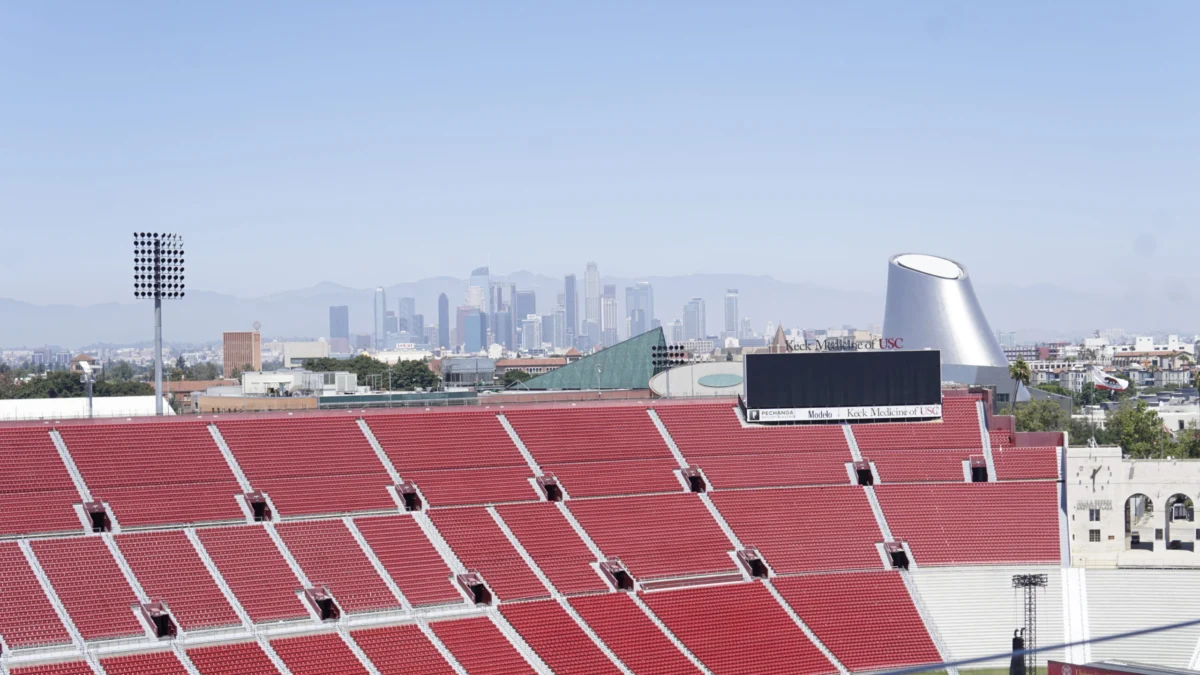
The Los Angeles Memorial Coliseum stands as a monumental pillar of American sporting history. Since its dedication in 1923, the “Grand Old Lady” has hosted two Olympic Games, two Super Bowls, and countless cultural milestones. Yet, as the world navigates the midpoint of a volatile decade, the venue faces an adversary far more formidable than any opposing team: the shifting, punishing reality of a changing climate.
While the Coliseum has garnered international acclaim for its pioneering waste-reduction initiatives—often cited as the gold standard for sustainable stadium operations in the United States—the physical infrastructure of the century-old bowl was engineered for a climate that no longer exists. Today, as Los Angeles grapples with record-breaking heat domes and shifting seasonal patterns, the venue finds itself at the intersection of heritage conservation and climate adaptation.
Main Facts: The Sustainability Paradox
The Los Angeles Memorial Coliseum operates under a complex duality. On one hand, it is a model of environmental stewardship. Its “zero-waste” programs, which divert over 90% of game-day refuse from landfills through rigorous composting and recycling streams, have set a benchmark for the NFL and collegiate athletics.
However, the stadium’s structural integrity and functionality are increasingly compromised by extreme weather. Designed nearly 100 years ago, the bowl’s open-air concrete architecture relies on passive airflow and moderate Mediterranean temperatures—conditions that are rapidly being replaced by prolonged, intense heat waves. The challenge for stadium operators is no longer just about managing trash; it is about managing the safety of the spectators and the longevity of a historic monument in an era of climatic instability.
Chronology: A Century of Resilience Tested
The history of the Coliseum is a timeline of adaptation, but the pace of change has accelerated drastically in the last decade.
- 1923: The Coliseum is completed. Its design emphasizes natural ventilation and stone-heavy thermal mass, perfect for the mild Los Angeles climate of the early 20th century.
- 1984: The stadium hosts the Summer Olympics. Environmental concerns are largely focused on urban smog and local waste management.
- 2019: Completion of a $315 million renovation. While focused on modernizing seating and technology, engineers begin identifying the need for “climate-resilient” upgrades, though the full extent of the heat crisis is yet to be realized.
- 2023–2025: A series of unprecedented heat waves in Southern California forces the postponement of early-season games and highlights the danger of heat stress for fans in the open-air bowl.
- August 2026: Current status. The Coliseum is now the focal point of a feasibility study on structural cooling, shading, and the potential for a “living stadium” concept to mitigate urban heat island effects.
Supporting Data: The Rising Mercury
The environmental data surrounding the Coliseum paints a sobering picture. Meteorological records for the Los Angeles Basin indicate that the number of days exceeding 95°F (35°C) has increased by nearly 30% since the turn of the century.
- Heat Stress Indices: During the 2025 season, internal heat sensors placed throughout the upper tiers of the Coliseum recorded temperatures 12 degrees higher than ambient city air, due to the concrete’s heat-retention properties.
- Water Consumption: Despite its green credentials, the stadium has seen a 15% uptick in water usage for misting systems and turf maintenance, even as local municipal water restrictions become more stringent.
- Energy Loads: The cooling requirements for the stadium’s back-of-house operations, including massive cooling arrays for broadcast equipment and locker room environments, have surged, placing additional strain on the regional power grid during peak afternoon hours.
Official Responses: Navigating the Future
Stadium management, in collaboration with city planners and environmental consultants, is currently evaluating a multi-pronged response.
"We are in the business of preserving history, but history is not a static concept," says a spokesperson for the venue’s management team. "To keep the Coliseum open for another century, we must acknowledge that the environment we serve is no longer the one our predecessors built for. We are currently looking at retrofitting the upper canopy with solar-reflective materials and integrating advanced ventilation systems that mimic traditional wind-tunnel effects without relying solely on mechanical cooling."
Local government officials have expressed support, noting that the Coliseum serves as a microcosm for the broader challenges facing Los Angeles. "If we can make the Coliseum climate-resilient, we can apply those lessons to the rest of the city’s aging infrastructure," a representative from the LA Mayor’s Office stated. "The goal is to move from reactive measures—like handing out water bottles and opening cooling stations—to proactive design that makes the venue inherently cooler."
Implications: The High Cost of Preservation
The implications of these findings extend far beyond Los Angeles. The “Coliseum Problem” is one shared by thousands of historic venues globally.
1. The Heritage vs. Efficiency Conflict
Many of these stadiums are protected by historic preservation laws. Adding massive shading structures or modern cooling vents can alter the aesthetic integrity of these monuments. Finding the balance between architectural preservation and the immediate health needs of spectators is a growing legal and design challenge.
2. The Economic Burden
The capital expenditure required to “climate-proof” a venue is astronomical. As stadiums look to install high-tech reflective surfaces, automated misting systems, and improved HVAC infrastructure, the cost of ticket prices will inevitably rise. This raises questions about equity: who gets to enjoy these historic venues in a warming world?
3. The New Standard for Sports
Professional sports leagues are beginning to realize that the traditional “open-air” experience is becoming a liability. We are seeing a shift in the sporting calendar, with games being moved to evening slots or, in extreme cases, relocated to cooler regions. The Coliseum is currently a testing ground for whether it is possible to maintain the traditional daytime outdoor experience in a region where the heat is becoming untenable.
4. Urban Heat Island Effects
The Coliseum is not just a building; it is a massive thermal sink located in the heart of a densely populated urban area. By integrating green roofing or vertical gardens into the stadium’s design, planners hope to lower the local ambient temperature, turning the stadium from a heat-generating burden on the neighborhood into a cooling hub.
Conclusion: A Race Against Time
The Los Angeles Memorial Coliseum remains an architectural triumph, a testament to human engineering and community spirit. However, the 2026 landscape serves as a stark reminder that human history is inextricably linked to the natural world.
As the stadium embarks on its next phase of evolution, it does so with the eyes of the world upon it. If the Coliseum can successfully adapt to the brutal realities of the 21st-century climate, it will cement its legacy not just as a site of athletic glory, but as a pioneer in the struggle for environmental survival. If it fails, it risks becoming a relic of a bygone era—a beautiful, massive, and ultimately unusable monument to a world that could not adapt fast enough to the heat.
The clock is ticking. For the athletes, the fans, and the historians who cherish the Coliseum, the next decade will be the most critical in the venue’s long and storied life. It is no longer just about the score on the field; it is about the resilience of the stage itself.
This report was produced using data from the Clean Energy Wire. All content is available under a Creative Commons Attribution 4.0 International Licence (CC BY 4.0).
