




This post was sponsored by Trendos. The opinions expressed in this article are the sponsor’s own.
In the rapidly evolving landscape of search, the traditional "blue link" model is being rapidly supplanted by AI-generated answers. When a user asks a question, modern AI engines do not merely list websites; they synthesize information from a curated, shifting set of sources to provide a definitive answer. For marketers, the stakes have never been higher: if your brand isn’t in the source set, you don’t exist in the answer.
Understanding which sources make the cut is no longer a matter of guesswork. It is a strategic imperative. A new analysis of 107 million AI-generated answers across four major engines—ChatGPT, Perplexity, Gemini, and Google AI Overviews—reveals that the "winning" sources vary significantly by industry. To capture the attention of AI, brands must move beyond generalized SEO and start engineering their presence where the algorithms are actually looking.
The Anatomy of an AI Answer: Industry-Specific Trends
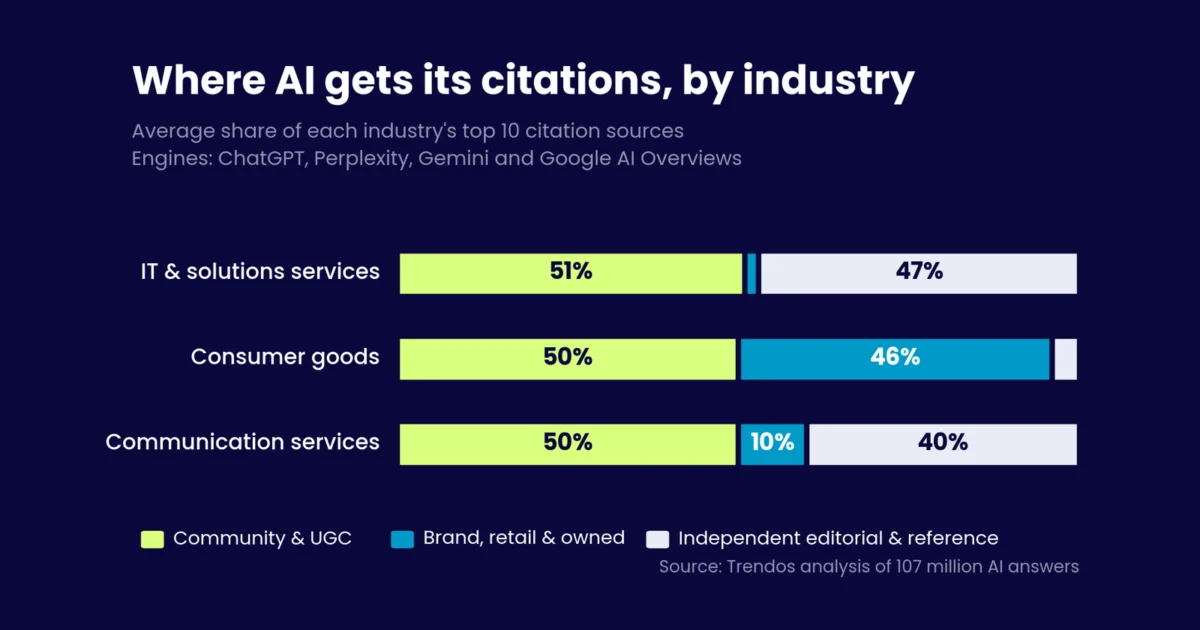
To decode the "black box" of AI citations, researchers categorized domains into three distinct groups: Community and User-Generated Content (UGC) (e.g., Reddit, YouTube, forums), Brand and Retail (e.g., Amazon, corporate sites, product pages), and Independent Editorial and Reference (e.g., media outlets, Wikipedia, B2B directories).
The data reveals a striking truth: there is no "one-size-fits-all" strategy. While community-led content serves as a baseline, the secondary sources required to build authority change depending on whether a company operates in IT services, consumer goods, or communication services.
Current Breakdown Of AI Citation Sources, By Industry
| Industry | Community & UGC | Brand, Retail & Owned | Independent Editorial |
|---|---|---|---|
| IT & Solutions | 51% | 2% | 47% |
| Consumer Goods | 50% | 46% | 4% |
| Communication | 50% | 10% | 40% |
Across all categories, community content acts as the bedrock, accounting for roughly 50% of citations. However, the remaining 50% represents the battleground where brands either secure their recommendation or lose out to competitors.
B2B Software & IT Services: The Era of Independent Validation
In the IT and solutions sector, the corporate homepage has lost its power as a primary citation source, plummeting to a mere 2% share. When an executive or technical lead asks an AI for software recommendations, the engine ignores the vendor’s own marketing copy, favoring "proof of work" from third-party ecosystems.
The Power of Third-Party Directories
For B2B brands, the AI-driven search experience is fueled by platforms like G2, Clutch, Gartner, and Slashdot. These directories act as the "social proof" that AI engines trust to validate vendor claims.
- Actionable Strategy: Brands must claim and complete their profiles on these platforms. An incomplete profile is a signal of obsolescence to an AI.
- Review Velocity: It is not enough to have a profile; you must earn current, verified reviews. AI engines prioritize freshness, and a static directory listing will eventually be passed over in favor of a competitor with active, recent user feedback.
Pursuing Trade Media Coverage
Independent editorial and trade media outlets (like TechRadar or PCMag) fill the remaining void in the IT services sector. Securing coverage in these outlets is no longer just about public relations; it is a critical component of your technical SEO strategy.
E-Commerce & Consumer Goods: Controlling the Digital Shelf
Consumer goods represent the industry outlier. In this space, independent editorial media almost entirely vanishes, accounting for only 4% of citations. Instead, the AI relies heavily on the "Brand, Retail, and Owned" category, which captures 46% of the citation share.
Marketplace Dominance
For consumer products, the AI is looking for product descriptions, technical specs, and customer reviews directly on the storefront.
- The Marketplace Audit: Your Amazon and marketplace listings must be treated as "answer copy." Titles, bullet points, and features should be optimized not just for human conversion, but for machine-readable clarity.
- Closing the Review Gap: Because AI summarizes reviews to provide product context, a lack of volume or sentiment depth on your own site or Amazon listing effectively silences your product in AI responses.
The Secondary Front: YouTube and Reddit
While brand pages carry the weight, the remaining half of the consumer goods equation is managed by YouTube and Reddit. Product demonstrations on YouTube and community sentiment on Reddit serve as the "human" vetting layer for the AI. If your brand is absent from these platforms, you are effectively missing from the conversation the AI is having with your potential customers.
Communication Services: The Public Reputation Game
For telecom and media brands, the strategy shifts toward "earned" reputation. With community content at 51% and editorial/reference at 40%, the focus must remain on high-authority, encyclopedic, and journalistic sources.
The Role of Wikipedia
Wikipedia is often the primary source for factual queries regarding large service providers. Maintaining an accurate, well-sourced, and neutral Wikipedia entry is one of the most effective ways to ensure the AI has a reliable "truth" to reference when asked about your company.
Investing in Earned Media
Telecom brands should pivot budget away from landing pages—which the AI often ignores—and toward trade and consumer press. Consistent mentions in authoritative media outlets build a "reputation profile" that the AI cross-references to determine which providers are worth recommending.
Understanding the Engine-Specific Playbooks
Not all AI engines are created equal. Their citation behavior is a reflection of their underlying training and purpose:
- Google AI Overviews: The most social-heavy engine. It leans heavily on Reddit and YouTube, often sourcing up to 80% of its answers from these platforms.
- Perplexity: A hybrid model that values community content for sentiment but looks to professional review directories and media for technical validation.
- ChatGPT: The most editorial-focused. It prioritizes Wikipedia, trade media, and established reference sites.
- Gemini: Highly context-dependent. It mirrors the industry: it will pull from trade press for services but prioritize retail/vendor sites for physical goods.
The "Reddit Factor": The Universal Constant
Across every industry and every engine, one source remains an omnipresent force: Reddit. It is consistently found in the top three citation sources, and in many cases, it is the primary source.
For brands, this is a call to action. You cannot "SEO" your way into a Reddit thread. Instead, you must monitor the conversation. Understand what the community says about your brand, address valid pain points, and ensure your presence is felt through authentic interaction rather than spam. When an AI cites a Reddit thread to answer a query, it is essentially asking the "wisdom of the crowd." If your brand is missing from the crowd, you are missing from the answer.
Implications for the Future
The shift toward AI-generated search requires a fundamental change in how marketing teams operate. The "rank-and-file" approach to traditional search engine optimization is becoming obsolete.
To succeed in this new environment, brands must:
- Map their own citations: Identify which sources appear for your specific industry prompts.
- Audit continuously: AI engines update their weighting algorithms frequently. A source that was dominant last month may be relegated to page two tomorrow.
- Adopt an "Answer-First" mindset: Stop creating content for search crawlers and start creating information that AI engines can easily synthesize, verify, and cite.
Tools like Trendos are emerging to automate this complex, manual process, allowing brands to track engine behavior in real-time. Whether you use specialized tools or manual audits, the message is clear: the brands that win in the era of AI are those that stop guessing and start watching. By aligning your digital footprint with the sources the engines actually trust, you ensure that when a customer asks a question, your brand is the answer.
