





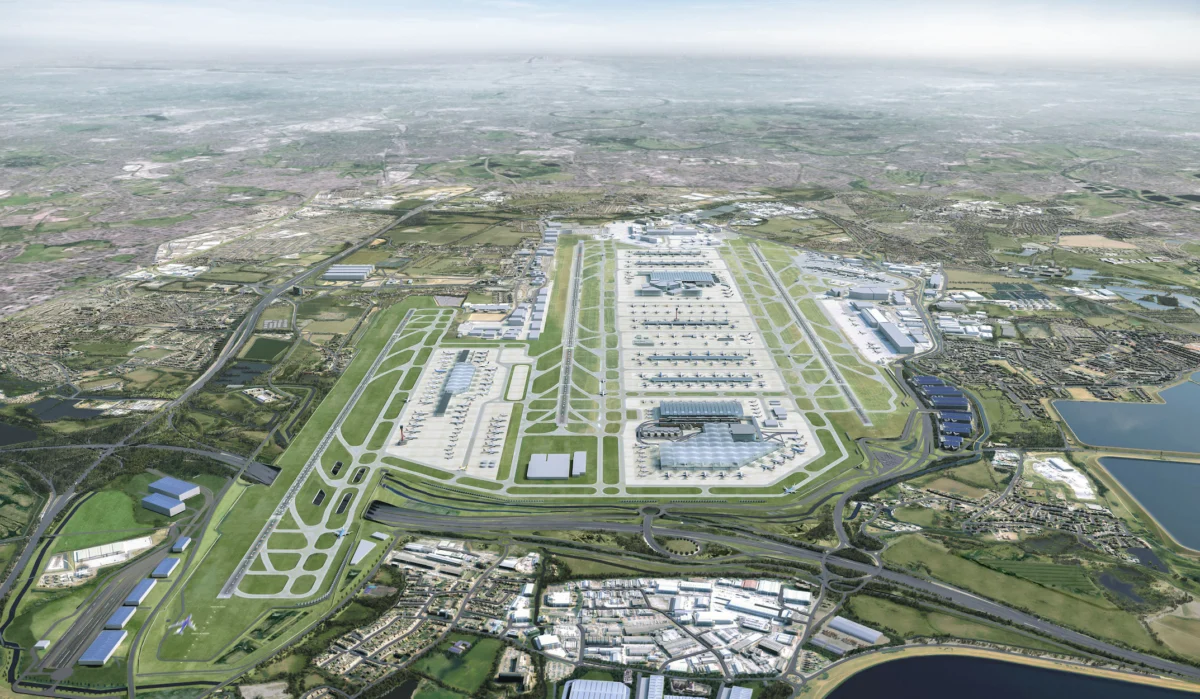
The debate over the expansion of London Heathrow—the United Kingdom’s busiest aviation hub—has reached a critical inflection point. As the airport pushes forward with visions of a third runway and increased capacity, a powerful coalition of climate scientists, policy advisors, and environmental advocates is sounding a cautionary alarm. The central contention is stark: the UK cannot simultaneously pursue a massive expansion of aviation infrastructure and meet its legally binding commitment to reach Net Zero carbon emissions by 2050.
The discourse has moved beyond mere local planning disputes; it now sits at the heart of the national climate strategy. As Nigel Topping, chair of the government’s Climate Change Committee (CCC), recently asserted, the current trajectory of the aviation sector is fundamentally incompatible with the UK’s climate goals.
Main Facts: The Infrastructure vs. Environment Paradox
At its core, the Heathrow expansion represents the classic tension between economic growth and environmental stewardship. The airport argues that a third runway is essential for maintaining the UK’s competitive edge in the global economy, facilitating trade, and ensuring that London remains a premier hub for international travel.
However, the climate reality is less forgiving. Aviation currently accounts for approximately 2.5% of global carbon emissions, a figure that is projected to rise as emerging economies increase their air travel and as long-haul flights become more accessible. In the UK context, the aviation sector is one of the most difficult to decarbonize. Unlike the energy grid, which is rapidly shifting toward wind and solar, or the automotive industry, which is pivoting toward electric vehicles, aviation remains heavily reliant on fossil-fuel-derived kerosene.
The proposition from critics is radical yet logical: if the technology to fly carbon-neutrally does not exist at scale, the only lever remaining to curb emissions is the throttling of passenger demand. This would mean placing a ceiling on flight numbers, effectively capping the growth that a new runway is intended to accommodate.
Chronology: A History of Stalled Ambition
The Heathrow expansion has been a political hot potato for over two decades. The chronology of the project illustrates the friction between political will and environmental reality.
- 2003: The UK government publishes a White Paper on the Future of Air Transport, which first floated the idea of a third runway at Heathrow.
- 2010: The newly formed Coalition government cancels plans for the third runway, citing concerns over noise, air quality, and climate impact.
- 2015: The Airports Commission, chaired by Sir Howard Davies, recommends Heathrow for expansion over Gatwick, arguing it provides the greatest economic benefit.
- 2018: Parliament votes overwhelmingly in favor of the expansion, a move seen as a major victory for the aviation industry and the government’s post-Brexit economic strategy.
- 2020: The Court of Appeal rules the expansion plans unlawful because the government failed to consider the Paris Agreement on climate change when setting the National Policy Statement.
- 2020 (December): The Supreme Court overturns the Court of Appeal’s ruling, allowing the expansion project to proceed in principle, provided it meets strict environmental requirements.
- 2024: The Climate Change Committee and various independent experts escalate their warnings, stating that the conditions set in 2020 are no longer being met due to the lack of a credible decarbonization plan.
Supporting Data: The Emissions Gap
To understand the severity of the challenge, one must look at the data. Even without the expansion of Heathrow, the UK’s aviation emissions are projected to rise. The growth in demand for air travel is currently outstripping the marginal efficiency gains achieved through better air traffic management or more fuel-efficient aircraft.
The Decarbonization Gap
- Aviation’s Carbon Footprint: While 2.5% of global emissions seems small, aviation’s impact is magnified by the high altitude at which emissions are released, which causes additional warming effects through contrails and nitrogen oxides.
- The "Credible Plan" Failure: The CCC has repeatedly noted that the government lacks a "credible plan" to manage aviation emissions. Policies like Sustainable Aviation Fuel (SAF) are in their infancy, with production levels nowhere near the scale required to offset a significant increase in flight volumes.
- Demand Management: Studies from environmental think tanks suggest that to keep aviation within a carbon budget consistent with the Paris Agreement, demand growth must be curtailed to near-zero for the next two decades, or until carbon-neutral technologies are fully mature.
Official Responses: The Battle of Narratives
The friction between the aviation industry and climate regulators has created a fractured landscape of policy and intent.
The Climate Change Committee’s Stance
Nigel Topping has been vocal about the systemic failure of the aviation sector to accept accountability. "Government needs to ensure that the aviation industry takes responsibility for the emissions it creates and bears the costs of decarbonization," Topping stated. His position is clear: unless the aviation industry can prove it can grow without adding to the total carbon budget, expansion is effectively a violation of the UK’s climate targets.
Heathrow Airport’s Position
Heathrow maintains that expansion is "Net Zero compatible." The airport’s management argues that through a combination of operational efficiencies, the use of SAF, and future investments in hydrogen-powered aircraft, the expansion can be achieved without increasing the net carbon footprint of the airport. They often point to "offsetting" as a key tool, though this is heavily criticized by scientists who argue that offsets do not equate to actual emission reductions.
Government Policy
The government finds itself in a precarious position. It is committed to Net Zero, yet it is also committed to "Global Britain." Officials argue that the UK must remain an aviation powerhouse to ensure economic prosperity. This duality has led to what critics call "policy schizophrenia," where the government encourages greener aviation in rhetoric while approving infrastructure that encourages higher carbon throughput.
Implications: The Future of Travel and Trade
The outcome of the Heathrow expansion debate will set a precedent not only for the UK but for the global aviation industry.
For the Aviation Industry
If Heathrow is forced to limit capacity, the aviation industry faces a fundamental shift in business models. Airlines would have to pivot away from high-volume, low-cost growth models toward a "high-value" model. This could mean higher ticket prices, which would naturally dampen demand but also make air travel a luxury reserved for the affluent—a shift that raises significant socio-economic questions about the "right to fly."
For the UK Climate Strategy
If the expansion goes ahead without strict, enforced limits on emissions, the UK risks missing its 2050 Net Zero target. This would damage the nation’s reputation as a climate leader and could trigger legal challenges from environmental groups, creating a cycle of litigation that could delay the project for years to come.
The Role of Technology
The entire debate hinges on the assumption that technology will save us. If the aviation industry fails to scale hydrogen or synthetic fuels, the infrastructure built today will become a "stranded asset"—a massive, multi-billion-pound concrete project that cannot be used to its full potential without violating the laws of physics and the requirements of the climate.
Conclusion: A Turning Point for Infrastructure Policy
The Heathrow expansion is no longer just about where a runway is placed or how much noise it creates for local communities. It is a fundamental litmus test for the UK’s commitment to its climate promises. The warnings from the Climate Change Committee are not merely technical advice; they are a stark reminder that physical infrastructure has a long shelf life.
By continuing to prioritize airport expansion while failing to demonstrate a clear path to net-zero aviation, the UK government is gambling with its environmental credibility. As the world watches, the choice is clear: either the aviation industry must undergo a radical, immediate transformation, or the growth that Heathrow represents must be sacrificed to ensure a habitable climate for future generations. The era of "growth at any cost" in the aviation sector is coming to an end; the era of accountability, however, has only just begun.
