



By Financial News Desk
The Turkish financial landscape is reeling this week as a sweeping, state-led investigation into market manipulation has reached the highest echelons of the insurance sector. Turkiye Sigorta AS, the nation’s largest state-backed insurer, has seen its market valuation evaporate following the arrest of its top leadership. The fallout, which has sent shares to a two-year low, represents one of the most significant corporate governance scandals in recent Turkish history, threatening to destabilize investor confidence in state-managed assets.
The Core of the Crisis: Executives Under Arrest
The turbulence surrounding Turkiye Sigorta reached a fever pitch following confirmation that Chief Executive Officer Taha Cakmak and his deputy, Gurol Sami Ozer, were detained by authorities earlier this month. The arrests are part of a broader, aggressive judicial crackdown on alleged market manipulation involving investment funds that have been accused of inflating the values of obscure, thinly-traded companies.
According to reports from state-run news outlet Anadolu Agency and broadcaster NTV, the investigation focuses on allegations that Turkiye Sigorta—a firm majority-owned by the Turkish Sovereign Wealth Fund—funneled significant capital into investment vehicles managed by Tera Portfoy Yonetimi. This brokerage firm is widely considered the epicenter of the current fund crisis.
The allegations suggest a sophisticated scheme wherein capital from the insurance giant was used to artificially boost the share prices of specific firms within the investment funds, effectively "pumping" the value of these assets before potentially offloading them at inflated prices.
A Chronology of the Collapse
The disintegration of Turkiye Sigorta’s reputation and market standing did not happen overnight. The following timeline tracks the rapid descent of the insurance giant:
- 2020: Turkiye Sigorta is established through the strategic merger of various insurance subsidiaries belonging to Turkey’s state-owned banks, positioning itself as a dominant market leader.
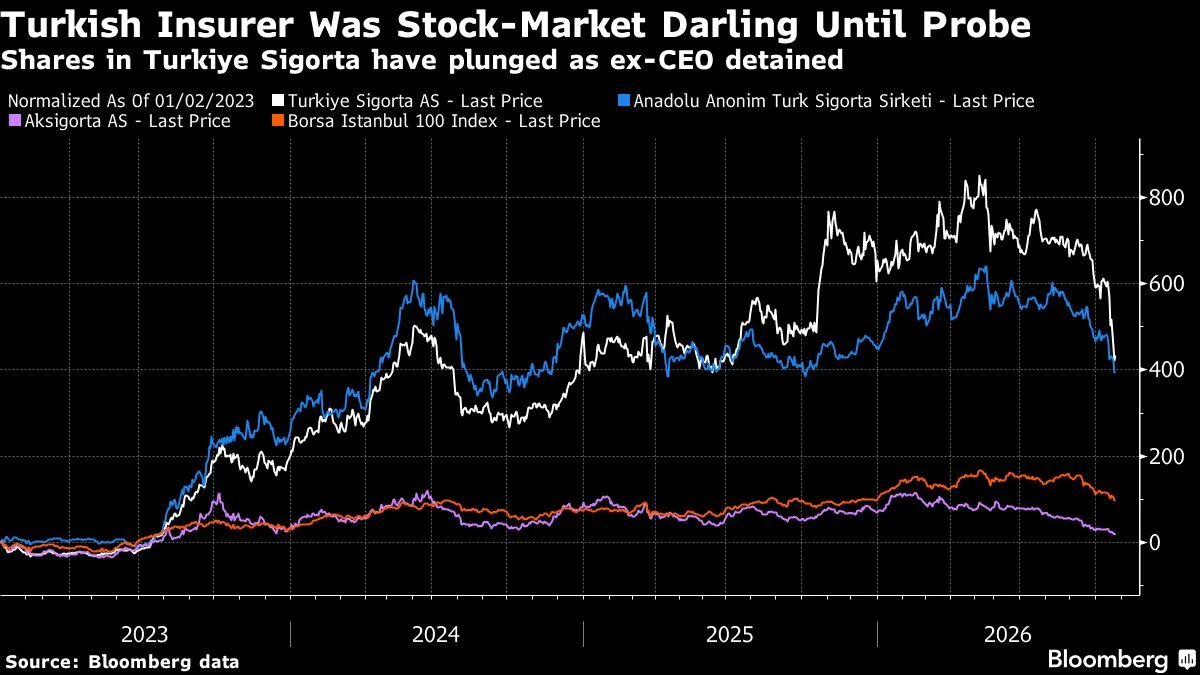
- 2023: Taha Cakmak, a former central bank deputy governor and seasoned financial regulator, is appointed CEO. Under his tenure, the company enjoys a meteoric rise, with its stock soaring over 500% by May 2026, vastly outperforming the Borsa Istanbul 100 Index.
- September 2026: The stock begins an abrupt, sustained decline. Market participants note unusual volatility, sparking early rumors of regulatory scrutiny.
- October 15, 2026: Turkiye Sigorta formally announces the resignation of Taha Cakmak, citing "personal reasons." The move raises immediate alarms among institutional investors.
- October 19, 2026: The company abruptly postpones its third-quarter earnings release, fueling speculation of accounting irregularities or impending legal action.
- Late October 2026: Local media confirms the detention of both Cakmak and Ozer. The company subsequently announces the formal firing of Ozer.
- October 27, 2026: Shares of Turkiye Sigorta plummet 18% in just two days, marking a cumulative loss of 40% in market value since September and hitting a two-year floor.
Supporting Data: The Rise and Fall of a Market Darling
For years, Turkiye Sigorta was held up as a flagship success story of the Turkish Sovereign Wealth Fund (TWF). With the TWF holding a 76% stake in the insurer—and with President Recep Tayyip Erdogan serving as the chairman of that sovereign wealth fund—the company was viewed by many as a "safe harbor" investment.
The "Cakmak Effect"
Taha Cakmak’s tenure was characterized by aggressive growth strategies that resonated with retail investors. By leveraging his background as a former bank regulator, he cultivated an image of stability and fiscal prudence. During the peak of the rally in May, the company’s market capitalization reached levels that analysts now describe as "detached from fundamental reality."
The Tera Portfoy Connection
The investigation centers on the intersection of Turkiye Sigorta’s capital and the investment funds managed by Tera Yatirim Menkul Degerler AS. Financial filings indicate that these funds were significant shareholders in the insurance company, acquiring portions of their stake as recently as August 2026. This creates a circular investment loop that regulators are now dissecting to determine whether it constituted an illegal mechanism for share price manipulation.
Official Responses and Legal Stances
The legal pressure is mounting rapidly. Justice Minister Akin Gurlek recently confirmed via social media that the investigation is not limited to Turkiye Sigorta. According to the Minister, authorities have apprehended 88 suspects across various financial institutions as part of this "vast scandal."

The defense has been swift but limited. Ersin Yucel, legal counsel for Taha Cakmak, has categorically denied all allegations of wrongdoing on behalf of his client. Yucel stated that the defense team is currently preparing a formal appeal against the detention order, maintaining that Cakmak’s actions were conducted in accordance with standard corporate governance and investment protocols.
Meanwhile, Turkiye Sigorta has remained largely silent. Despite multiple inquiries from international media and financial analysts, the company has declined to comment on the specific charges, the status of its internal audits, or its plans for leadership succession. The silence has only served to exacerbate investor anxiety, as shareholders are left without a clear explanation regarding the postponement of the third-quarter results.
Wider Implications for the Turkish Financial Sector
The arrest of such high-profile figures within a state-backed entity sends a jarring signal to international markets.
1. The Question of Sovereign Governance
Because the Turkish Sovereign Wealth Fund owns a controlling interest in Turkiye Sigorta, the scandal creates a political headache for the government. It raises difficult questions regarding the oversight of state-run enterprises and whether political appointments in the financial sector have compromised institutional integrity.
2. Market Volatility
The broader "fund crisis" mentioned by prosecutors has already begun to affect the liquidity of smaller Turkish stocks. As investigators probe how local funds used "obscure companies" to manipulate valuations, many retail investors are fleeing the market, fearing that other, as-yet-unnamed companies may be involved in similar schemes.
3. Regulatory Overhaul
Analysts suggest that this scandal will likely trigger a massive regulatory overhaul in the Borsa Istanbul. The Securities and Exchange Commission of Turkey (SPK) is under immense pressure to tighten rules regarding fund disclosures and the cross-ownership of shares between insurers, banks, and investment firms.
4. Investor Trust
For foreign investors, who have already been cautious regarding the Turkish economy, this event represents a significant "trust deficit." When the management of a national champion is accused of market manipulation, it challenges the narrative of a maturing, transparent capital market.
Conclusion: A Turning Point for Borsa Istanbul
The case of Turkiye Sigorta is a cautionary tale of how quickly market sentiment can turn when corporate governance fails. What was once the "darling" of the Borsa Istanbul is now the epicenter of a national financial scandal.
As the legal proceedings against Taha Cakmak and Gurol Sami Ozer unfold, the focus will shift to the company’s ability to recover. Will the firm be able to stabilize its operations, or will the investigation reveal even deeper rot within its portfolio? For now, the market is voting with its feet, and the long-term ramifications for Turkey’s state-backed financial sector remain profoundly uncertain. The investigation serves as a stark reminder to market participants: in an environment where capital flows are opaque, even the largest and most protected institutions are not immune to the consequences of systemic integrity failures.
