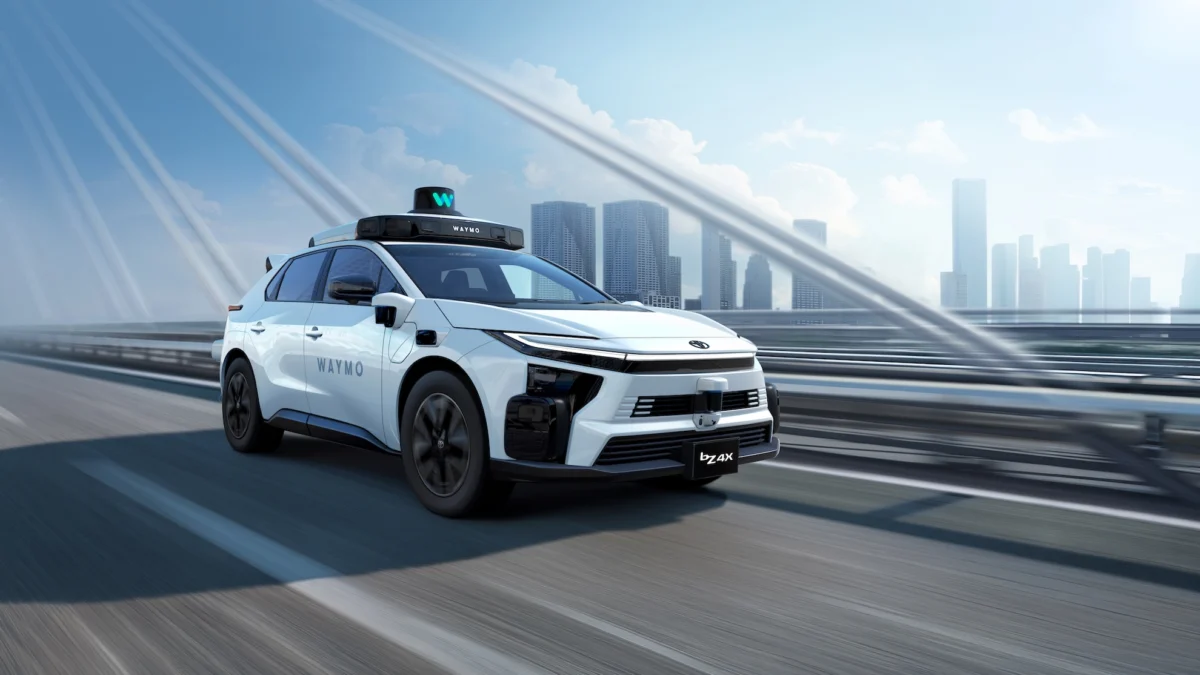



TOKYO & MOUNTAIN VIEW, Calif. — Alphabet’s autonomous driving unit, Waymo, and Japanese automotive giant Toyota Motor Corporation have formally expanded their strategic partnership. Under a new agreement announced Friday, Toyota will manufacture purpose-built, autonomous versions of its bZ4X electric vehicle (EV), integrating Waymo’s self-driving technology directly on assembly lines in Japan.
The initiative marks a significant step forward in Waymo’s global expansion plans, establishing a dedicated pipeline for right-hand drive (RHD) autonomous vehicles. Public road testing of the self-driving Toyota bZ4X is scheduled to begin in Japan next year, with subsequent deployments targeted for international markets, including the United Kingdom.
Main Facts: Factory-Integrated Autonomous Vehicles for Global Operations
The core of the expanded partnership centers on mass manufacturing and international market penetration. Rather than retrofitting existing production vehicles after they leave the dealership lot, Toyota will integrate Waymo’s autonomous hardware and software suite—known as the Waymo Driver—directly during the manufacturing process at its historic Takaoka plant in Aichi Prefecture, Japan.
+-------------------------------------------------------------------+
|                  Waymo & Toyota Partnership Key Features          |
+-------------------------------------------------------------------+
| Primary Vehicle Model  | Toyota bZ4X EV (bZ in North America)     |
| Assembly Location      | Takaoka Plant, Aichi Prefecture, Japan   |
| Initial Test Market    | Japan (Commencing 2027)                  |
| Planned Expansion      | United Kingdom & other RHD markets       |
| Hardware Integration   | Factory-level Waymo Driver integration   |
| Strategic Scope        | Commercial Robotaxis & Personal AV tech  |
+-------------------------------------------------------------------+
Key operational and technical details of the collaboration include:
- Vehicle Architecture: The autonomous fleet will be built on the 2027 model year Toyota bZ4X battery-electric crossover (sold simply as the "bZ" in North America).
- Right-Hand Drive Focus: By engineering the autonomous bZ4X natively in right-hand drive configurations, Waymo resolves a major technical hurdle for international scaling, enabling rapid entry into countries with left-side traffic flow.
- Dual-Track Deployment Strategy: While initial public testing will take place in Japan to lay the groundwork for a future commercial ride-hailing service, these vehicles are explicitly destined for international markets. Top priority is given to the U.K., where Waymo has already spent months conducting road tests with customized Jaguar I-Pace vehicles in London ahead of planned commercial operations.
- Beyond Commercial Fleets: In addition to public robotaxi networks, both companies confirmed they are exploring avenues to bring Waymo’s self-driving capabilities to consumer-owned, personal Toyota vehicles in the long term.
Chronology: From Preliminary Handshake to Industrial Execution
The agreement represents the maturation of an ongoing dialogue between two of the automotive and tech industries’ heaviest hitters. The timeline of their evolving relationship highlights a deliberate move from tentative evaluation to concrete industrial manufacturing:
Timeline of Waymo-Toyota Strategic Alignment:
========================================================================================
[April 2025]   --> Signing of preliminary non-binding memorandum of understanding (MOU)
[Late 2025]    --> Joint engineering feasibility studies & hardware-software mapping
[October 2026] --> Formal announcement of manufacturing partnership & bZ4X integration
[Next Year]    --> On-road autonomous testing begins in Japan
[Future Target]--> Commercial deployment of bZ4X robotaxis in Japan and the U.K.
========================================================================================
April 2025: The Exploratory Memorandum
Eighteen months prior to this announcement, Waymo and Toyota signed a non-binding memorandum of understanding to explore potential synergies between Waymo’s autonomous stack and Toyota’s vehicle platforms. At the time, industry analysts characterized the deal as an exploratory exercise, with broad language that left open whether it would lead to a commercial product or remain an R&D experiment.
Mid-2025 to Mid-2026: Technical Validation
Over the subsequent year and a half, engineering teams from Mountain View and Toyota City worked to evaluate redundant vehicle architecture, power distribution requirements for autonomous compute systems, and assembly-line logistics at Toyota’s Takaoka facility.
October 2026: Commercial Industrialization Agreement
The definitive partnership announced on October 30, 2026, transitions the relationship into an operational supplier and co-development agreement. Toyota officially added Waymo-enabled vehicles to its manufacturing roadmap for the 2027 model year, formalizing the production of specialized bZ4X units for commercial robotaxi networks worldwide.
Supporting Data: Scaling Robotaxi Economics and Fleet Diversity
Waymo’s decision to onboard Toyota’s bZ4X aligns with a broader industry trend toward expanding vehicle platform options while reducing sensor and manufacturing costs.
Fleet Diversification and Supply Chain Resilience
Historically, Waymo relied heavily on modified Chrysler Pacifica minivans and, more recently, all-electric Jaguar I-Pace crossovers. However, scaling commercial driverless operations across major metropolitan areas requires a broader, lower-cost vehicle portfolio.
Waymo Vehicle Platform Portfolio Expansion
-----------------------------------------------------------------------
Platform             Type       Target Regions     Status
-----------------------------------------------------------------------
Chrysler Pacifica    Minivan    US (Various)       Phased / Legacy
Jaguar I-Pace        EV CUV     US / UK            Active Operational
Zeekr / Geely AV     EV Van     US / Global        In Testing
Hyundai Ioniq 5      EV CUV     US                 In Development
Toyota bZ4X / bZ     EV CUV     Japan / UK / Int'l Testing Next Year
-----------------------------------------------------------------------
By adding Toyota to a roster of vehicle partners that also includes Geely (Zeekr) and Hyundai Motor Group (Ioniq 5), Waymo mitigates single-supplier risk, diversifies its vehicle form factors, and gains access to Toyota’s global manufacturing footprint and supply chain network.
Market Drivers for International Expansion
- The Right-Hand Drive Imperative: Right-hand drive jurisdictions represent approximately 30% of the world’s population and roughly a quarter of global road mileage, including key affluent markets such as Japan, the United Kingdom, Australia, India, and Singapore.
- Commercial Scalability: Assembly-line integration at Toyota’s Takaoka plant significantly reduces the upfitting costs per vehicle compared to retrofitting finished cars, directly improving unit economics for commercial autonomous ride-hailing services.
Official Responses and Strategic Perspectives
Executive commentary from both organizations emphasizes the combined scope of the venture, highlighting not only driverless ride-hailing services, but also road safety enhancements and smart-city infrastructure integration.
Hiroki Nakajima, Executive Vice President and Board Member of Toyota Motor Corporation, outlined the company’s vision for the partnership:
"This collaboration will help scale that technology and bring it to customers in Japan and beyond through Waymo’s ride-hailing service, and in parallel, Toyota will continue to explore how integrating vehicles with traffic infrastructure can make those roads safer still."
The statement points toward joint research into Vehicle-to-Everything (V2X) communication, where autonomous vehicles communicate directly with traffic signals, roadside sensors, and central traffic management systems to improve congestion flow and prevent accidents.
                       +---------------------------------------+
                       |       Waymo-Toyota Synergy Stack      |
                       +---------------------------------------+
                                           |
           +-------------------------------+-------------------------------+
           |                                                               |
           v                                                               v
+-----------------------+                                       +-----------------------+
|    Waymo Driver AI    |                                       |   Toyota Production   |
|                       |                                       |                       |
| • 6th-Gen Sensor Suite|                                       | • Takaoka Factory     |
| • Level 4 Autonomy    |                                       | • e-TNGA Platform     |
| • Operational Data    |                                       | • Global Scale        |
+-----------------------+                                       +-----------------------+
           |                                                               |
           +-------------------------------+-------------------------------+
                                           |
                                           v
                       +---------------------------------------+
                       |          Target Outcomes              |
                       |                                       |
                       | 1. Global RHD Robotaxi Fleets         |
                       | 2. Enhanced Road Safety via V2X       |
                       | 3. Personal Autonomous Ownership      |
                       +---------------------------------------+
Industry analysts note that for Toyota, which has historically taken a cautious, multi-pathway approach to pure battery electric vehicles and full driverless automation, partnering with Waymo provides immediate access to market-tested Level 4 autonomous software without bearing the sole burden of full-stack software development.
Strategic Implications: Industry Impact and Future Outlook
The expanded alliance between the world’s largest automaker by volume and the leading commercial autonomous ride-hailing operator has far-reaching implications across the transportation landscape.
1. Shift Toward OEM Factory Integration
For years, autonomous vehicle developers operated primarily by buying standard internal combustion or electric vehicles and spending hundreds of thousands of dollars retrofitting them with exterior sensor pods, custom wiring harnesses, and trunk-mounted compute units. The Waymo-Toyota bZ4X project reflects a transition toward factory-installed self-driving hardware. Designing body panels, sensor mounts, and redundant steering/braking control loops natively on the assembly line ensures higher quality control, lower production costs, and streamlined regulatory homologation.
2. Regulatory Acceleration in Europe and Asia
Deploying driverless fleets in Japan and the U.K. requires navigating complex regulatory environments that differ markedly from the U.S. state-by-state patchwork.
- United Kingdom: The U.K.’s Automated and Electric Vehicles legislation and ongoing regulatory frameworks provide a clear path to commercialization. Waymo’s ongoing trials in London, combined with RHD bZ4X supply, position the company to launch one of Europe’s first commercial driverless taxi networks once final permits are granted.
- Japan: Japan has actively updated its Road Traffic Act to permit Level 4 autonomous driving under specific conditions as part of a national effort to address severe public transit labor shortages and an aging population in regional centers.
3. The Personal Autonomous Vehicle Horizon
Perhaps the most intriguing long-term component of the announcement is the explicit intent to explore bringing Waymo’s self-driving technology to personally owned Toyota vehicles.
While commercial robotaxi networks generate immediate recurring revenue, the consumer market for advanced driver assistance systems (ADAS) and full self-driving features represents a massive commercial opportunity. A future consumer-facing Toyota equipped with factory-integrated Waymo technology could redefine private vehicle ownership, positioning Waymo as a primary software tier-1 supplier alongside its driverless ride-hailing business.
4. Competitive Pressure on Global Rivals
The partnership intensifies competitive pressure across the autonomous mobility ecosystem:
- In North America: Competitors like General Motors’ Cruise, Amazon’s Zoox, and Tesla (with its proposed Cybercab vision) face a rival that is aggressively diversifying both its vehicle platforms and geographic footprint.
- In Asia and Europe: International players, including Baidu’s Apollo fleet in China and European transit consortiums, will soon face a consolidated partnership combining Toyota’s global brand trust and production capacity with Waymo’s proven operational safety record.
As public testing of the autonomous bZ4X begins in Japan next year, the automotive industry will be watching closely to see if this alliance can bridge the gap between low-volume prototype fleets and truly global commercial scale.
