




For decades, the “site:” search operator has been the bread and butter of Search Engine Optimization (SEO) professionals. Whether troubleshooting indexing issues or verifying that a new piece of content has finally hit the SERPs, the simplicity of typing site:domain.com/url into Google or Bing has remained the industry’s most reliable, low-barrier diagnostic tool. It is the digital equivalent of checking the pulse of a website.
However, as the search landscape shifts from traditional blue links to AI-driven generative answers and large language model (LLM) retrieval systems, the old ways of verifying presence are being tested. When you lack access to Google Search Console (GSC) or Bing Webmaster Tools (BWT), how do you confirm that your content is actually being ingested by modern AI search models?
This guide explores a new, robust methodology for verifying retrieval—and introduces a workflow tool designed to make the process as seamless as the legacy techniques we’ve left behind.
The Evolution of Search Discovery: From Indexing to Retrieval
To understand why traditional methods are changing, we must first distinguish between "indexing" and "retrieval." In traditional search, a crawler finds a page, renders it, and adds it to an index. In the AI era, specifically with models like ChatGPT with Search or Perplexity, the process involves a two-step dance: the model must first find the content via a search index, and then it must be able to "retrieve" that information and synthesize it into an answer.
The Proven Method: Snippet Testing
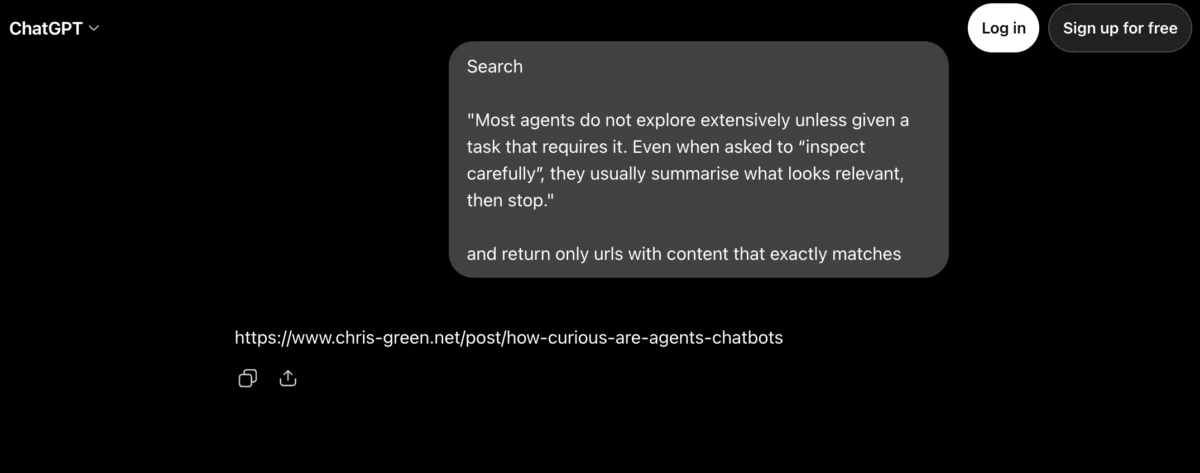
If you want to know if a specific page is part of an AI’s knowledge base, you don’t need complex API access. You can leverage the "snippet test." By taking a unique, high-value sentence or paragraph from your page and searching it in quotation marks, you can force the AI to look for that exact string.
If the AI returns your URL as a citation, you have verified two things:
- The content has been crawled and indexed by the underlying search engine.
- The model has successfully retrieved that content and considers it relevant enough to include in its output.
Chronology: Why Modern SEOs Need New Tools
The transition from legacy search to AI-assisted search hasn’t happened overnight, but the requirements for visibility have changed drastically.
- 2000s–2010s: SEOs relied heavily on site operators and log file analysis. If a URL wasn’t in the index, it was a technical error (robots.txt, canonicalization, or crawl budget).
- 2020–2023: The rise of GSC and BWT provided granular data, but as AI search features (SGE, ChatGPT Search) began to dominate, SEOs realized that being "indexed" in Google didn’t always mean being "retrieved" by an AI.
- 2024–Present: The industry is now grappling with the "black box" of LLM citations. Many sites appear in standard search results but are ignored by AI models. This has led to a need for a "vibe-check" approach to AI retrieval.
Supporting Data: Troubleshooting Retrieval Failures
If your content fails the snippet test, it doesn’t necessarily mean your site is broken. It means your content is currently outside the "retrieval set" of the AI model.
Common Reasons for Retrieval Failure:
- Discovery Latency: AI models may refresh their search data at different intervals than standard organic search crawlers. Your content might be indexed but not yet prioritized for generative synthesis.
- Lack of Semantic Distinctiveness: If the snippet you are testing is too generic, the AI may be pulling from a more authoritative source that says the same thing. Use highly specific, proprietary data points for your tests.
- Bot Blocking: While most AI crawlers respect
robots.txt, if your site is overly restrictive, you may be intentionally excluding yourself from the training or retrieval data sets. - Content Quality/Authority: AI models are weighted toward high-authority sources. If your content is thin or lacks unique insights, it may be deemed "retrievable" but not "worthy" of inclusion in a generative response.
Pro-Tip: If you are testing, perform the search four to five times. AI models pull from diverse sources; a single failed attempt might just be a limitation of that specific search session.
Implications: The "Exactly Matchy" Workflow
Because manual copy-pasting is inefficient, we’ve developed a conceptual workflow tool—Exactly Matchy—to bridge this gap.

How the Workflow Functions
Instead of manually navigating to ChatGPT or Perplexity and typing out commands, this workflow approach automates the "snippet-to-query" pipeline:
- Selection: Highlight a unique snippet on your webpage.
- Execution: Use an extension or a custom script to send that text to an LLM with the instruction: "Search for this specific snippet and return the source URL only if it matches exactly."
- Verification: Analyze the returned URL. If it matches your target page, you have confirmation of retrieval.
Note: This is currently an experimental approach. Users looking to implement this should review the code via GitHub (search for "Exactly Matchy") and run it in a development environment. Always exercise caution when installing browser extensions.
Official Responses and Industry Consensus
Search experts emphasize that this "workaround" is not a replacement for comprehensive technical SEO. While these methods provide immediate feedback, they are not "truth."
"AI chatbot responses are probabilistic, not deterministic," notes industry analyst Chris Green. "You should interpret these results as a barometer of your current visibility, not a definitive health report. A normal technical SEO approach—fixing crawling, indexing, and canonicalization—remains the foundation. If you aren’t visible in traditional search, you will almost certainly struggle to be visible in AI-driven search."
Strategic Implications: Beyond Retrieval
It is critical to distinguish between retrieval and ranking. Many webmasters reach out with the complaint: "My page is being returned in the snippet test, but I’m not getting traffic or AI mentions."
Retrieval is simply the first hurdle. If an AI can find your page but chooses not to cite it in a final answer, you are facing an authority or relevance issue, not a technical indexing issue. In this case, your strategy must pivot from technical SEO to content quality:
- Unique Value Proposition: Does your content offer data or insights that aren’t available on the top-ranking competitors?
- Structure: Is your content structured in a way that makes it easy for an AI to parse (e.g., clear headers, concise summaries, schema markup)?
- Citation Authority: Are you building the kind of brand presence that causes AI models to recognize you as a primary source?
Conclusion: The Path Forward
The "site:" operator is not dead, but it is no longer the sole arbiter of truth. As we move further into an era defined by AI search, SEO professionals must adopt a multi-layered approach to validation.
By combining the traditional, rigorous technical standards of site audits with new, experimental snippet-retrieval tests, you can maintain a clearer view of how your content exists in the modern search ecosystem. The goal is not just to be indexed—it is to be useful, discoverable, and, ultimately, the authoritative source that the AI chooses to trust.
Stay patient, keep testing, and continue to refine your technical foundations. The tools may change, but the core principle of providing clear, high-value information remains the surest way to secure your place in the future of search.
