




As the initial wave of generative AI curiosity gives way to the hard realities of operational deployment, the corporate world has reached a critical juncture. The transition from “chatting with a chatbot” to deploying autonomous, agentic AI represents one of the most significant shifts in enterprise architecture in the last two decades. While 80% of Fortune 500 companies have already begun experimenting with agentic AI, the path to meaningful, enterprise-scale integration remains fraught with friction.
For many organizations, the current state of affairs is characterized by "pilot purgatory"—a collection of isolated, fragmented AI experiments that fail to move the needle on top-line revenue or bottom-line efficiency. To bridge this gap, leaders must pivot from viewing AI as a collection of disjointed tools toward treating it as a cohesive, systemic workforce capable of reshaping the very foundations of business operations.
The Main Facts: Defining the Agentic Shift
At its core, agentic AI differs from standard generative AI by its capacity for autonomy. Rather than simply producing text or code, these agents are designed to navigate complex environments, utilize software tools, connect to databases, and execute multi-step workflows to achieve specific goals.
However, the ambition of autonomy is currently hitting a wall of complexity. Enterprises are discovering that agents are only as effective as the ecosystems they inhabit. If an agent lacks access to the right data, or if it is forced to operate within the constraints of an antiquated, inefficient workflow, its potential is severely diminished.
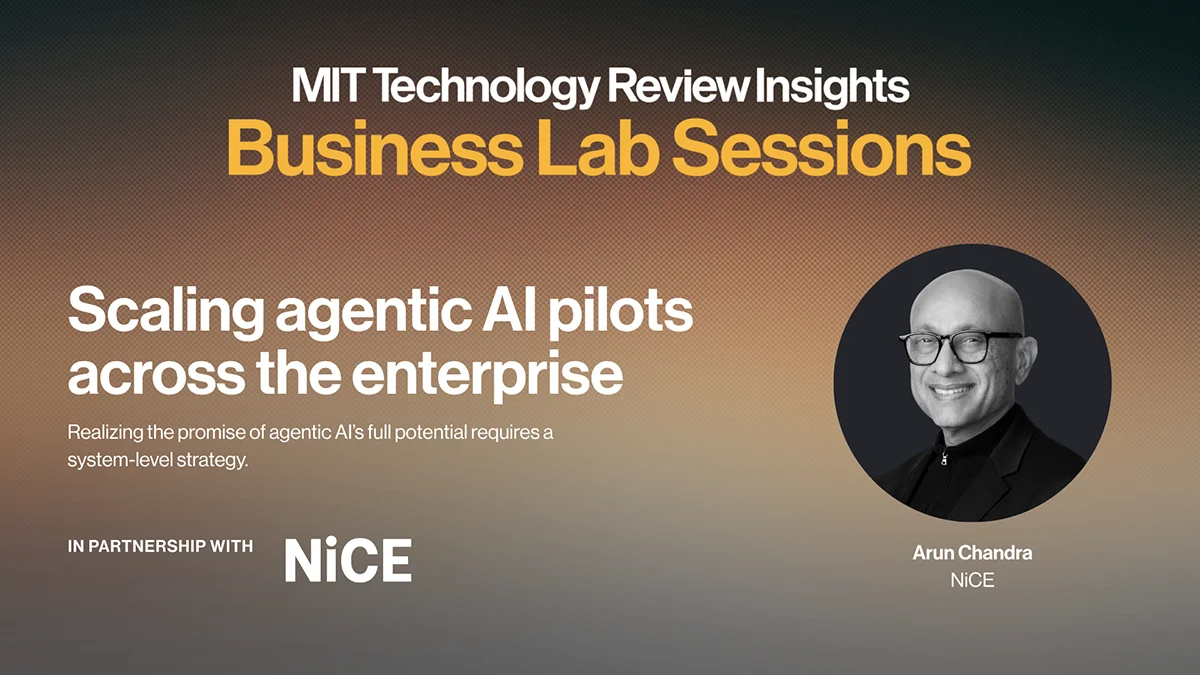
Arun Chandra, chief operating officer at NiCE, emphasizes that the primary failure point is a lack of strategic alignment. "Everybody’s trying to figure out what can we do with this technology?" Chandra observes. "But scaling requires a clearer connection to business strategy." The mandate for the C-suite is no longer about testing the technology; it is about defining the objective—whether that be aggressive revenue growth, radical cost reduction, or enhanced customer experience—and then building the agentic architecture to support that specific goal.
Chronology: The Evolution of Enterprise AI
To understand the current state of agentic AI, one must look at the rapid maturation of the technology over the last 24 months:
- Phase 1: The Exploration Era (2023): Organizations rushed to deploy simple Large Language Model (LLM) interfaces. The primary objective was familiarization, with internal "Copilots" being used for summarization and basic content drafting.
- Phase 2: The Fragmentation Era (Early 2024): As teams realized the limitations of simple prompts, they began creating standalone AI agents for specific tasks. This resulted in "shadow AI"—disjointed, siloed applications that existed outside of centralized governance.
- Phase 3: The Integration Mandate (Mid-2024–Present): Companies are now attempting to connect these agents to back-end enterprise systems (ERP, CRM, and custom databases). The focus has shifted from generative capacity to systemic orchestration.
- Phase 4: The Future—Agentic Ecosystems (2025 and beyond): The expected horizon involves multi-agent collaboration, where autonomous units communicate with one another to resolve complex customer journeys without human intervention.
Supporting Data and the "Pilot" Paradox
The discrepancy between adoption and impact is stark. While the 80% adoption figure for Fortune 500 firms suggests a technological revolution, the internal data tells a different story of uneven progress. Many of these firms are currently operating in a state of high-cost, low-impact experimentation.
The "pilot paradox" stems from a tendency to layer AI onto existing, broken processes. If an organization has a manual, error-prone procurement workflow, simply adding an AI agent to "assist" with that workflow often just accelerates the rate at which errors occur. Research indicates that successful scale-up requires a "clean-slate" approach to workflow design. Organizations that see the highest ROI are those that treat AI as a catalyst for business process re-engineering rather than a plug-and-play productivity booster.
Official Perspectives: The NiCE Philosophy
Arun Chandra and the leadership team at NiCE have been at the forefront of this shift. Their perspective is that the "efficacy of these AI agents is purely a function of the context, the knowledge, and the data they can ingest and use."
Rethinking Workflow Design
Chandra is adamant about the danger of digitizing inefficiency. "The last thing you want to do is to apply AI on an outdated or an inefficient workflow," he says. This requires a fundamental rethink of business processes before the code is even deployed. Organizations must perform a "workflow audit" to determine which segments are ripe for automation and which require human oversight.
The Contextual Requirement
Agents need more than just raw data; they need context. An agent tasked with resolving a customer support ticket is useless if it cannot access the customer’s purchase history, recent support interactions, and the current status of the supply chain. Providing this "knowledge graph" to the AI is the technical hurdle that separates the successful enterprise from the experimental one.
Organizational and Operational Implications
Scaling agentic AI is not just a technical challenge; it is a profound organizational transformation. As agents take on more consequential roles, the rules of governance must evolve.
The "Co-worker" Paradigm
Chandra suggests that we must stop thinking of AI as a tool and start thinking of it as a member of the workforce. If an AI agent is handling financial transactions or customer sensitive data, it should be held to the same standards of auditability, security, and privacy as a human employee. This means implementing "AI HR" policies—defining what an agent is allowed to do, establishing a chain of command for escalation, and creating a framework for performance monitoring.
The Risk of Siloed Intelligence
A significant danger in scaling is the creation of "digital silos." If the marketing department builds its own agentic stack and the logistics department builds another, the company may find itself with incompatible, non-communicating autonomous systems. Achieving scale requires a centralized, platform-based approach where agents can share data, context, and protocols across departments.
Security and Governance
As agents become autonomous, the "attack surface" of an organization expands. If an agent is given the power to trigger payments or change account settings, the security controls must be robust enough to handle autonomous error or malicious manipulation. Governance, therefore, must move from a reactive model (fixing problems after they happen) to a proactive model (embedding guardrails into the agent’s core architecture).
The Road Ahead: From "Boiling the Ocean" to Strategic Scaling
Looking toward the future, the goal is not total, immediate automation across the enterprise. Chandra warns against the temptation to "boil the ocean"—attempting to automate every process at once.
Instead, the most successful firms are focusing on "high-value use cases." These are workflows where the cost of human error is high, the volume of data is large, and the strategic impact on the bottom line is immediate. By building a connected strategy around these specific nodes, organizations can create a "proof of scale" that justifies further investment.
The Multi-Agent Future
The next iteration of enterprise AI will be the transition from single-task agents to collaborative multi-agent systems. Imagine a customer complaint arriving in a CRM:
- Agent A (Support) analyzes the sentiment and identifies the root cause.
- Agent B (Logistics) checks the delivery status.
- Agent C (Finance) calculates a refund based on company policy.
- Agent D (Communication) reaches out to the customer with a resolution.
This level of orchestration requires a high degree of "inter-agent" communication, which is only possible when the underlying data architecture is unified.
Conclusion: A New Strategic Mandate
The shift from experimental pilot programs to an integrated, agentic enterprise is the defining business challenge of the mid-2020s. It requires a move away from the excitement of "what can it do?" to the discipline of "what should it do for the business?"
As Arun Chandra and the experts at NiCE suggest, the path to scale is paved with intentionality. Organizations that survive and thrive in this era will be those that treat their AI agents not as isolated software utilities, but as a critical, governed, and integrated extension of their human workforce. The technology is no longer the bottleneck; the bottleneck is, and always has been, the strategy. By reimagining workflows, centralizing data context, and enforcing rigorous governance, enterprises can finally move beyond the pilot phase and unlock the true, scalable potential of agentic AI.
This article was produced by Insights, MIT Technology Review’s custom content arm, in partnership with NiCE. It was researched and written by humans, with any AI tools used limited to production processes under human oversight.
