





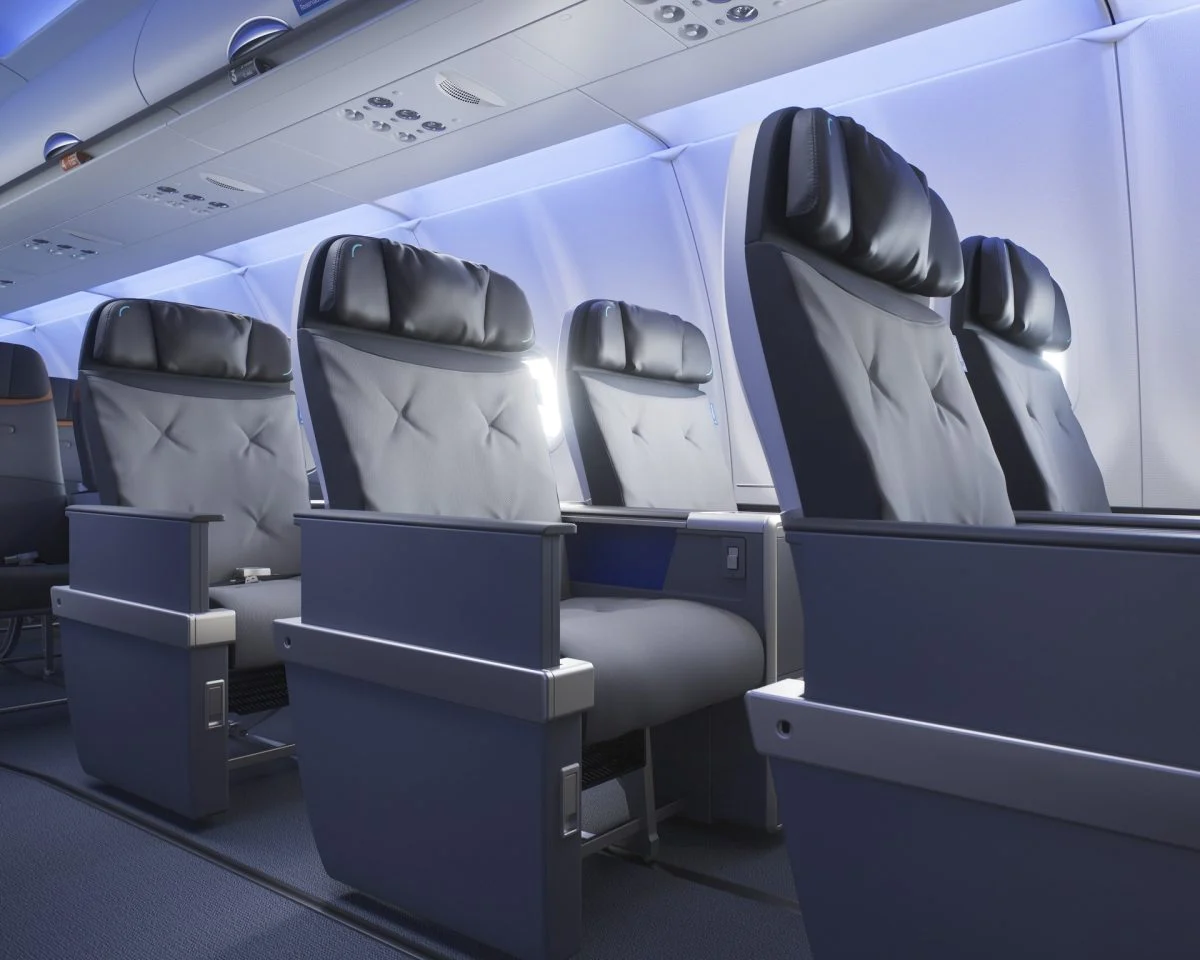
In an industry where premium travel has become the primary battleground for profitability, JetBlue Airways has finally laid its cards on the table. On Tuesday, the New York-based carrier unveiled "BlueFirst," a sophisticated domestic first-class product designed to redefine the airline’s standing in the premium market. After six consecutive years of financial losses, JetBlue is betting its future on the belief that passengers are willing to pay a premium for a superior domestic experience.
The launch of BlueFirst represents more than just a cabin upgrade; it is a fundamental shift in JetBlue’s business model. Long known as a hybrid carrier that championed the "best of both worlds"—combining low-cost efficiency with boutique amenities—JetBlue is now aggressively pivoting toward the high-margin corporate and premium leisure traveler.
Main Facts: Redefining the Domestic Premium Experience
The BlueFirst offering is not merely a reconfiguration of existing legroom; it is a total redesign of the onboard environment. Central to the offering is the hardware itself: seats engineered with specialized mattress-grade foam, designed to provide ergonomic support that surpasses the standard industry offerings.
Key Technical Specifications:
- Seating Configuration: The cabin will feature a 2×2 layout, prioritizing both space and intimacy.
- Dimensions: Passengers will benefit from seven additional inches of legroom compared to standard economy, paired with up to five inches of recline.
- Fleet Integration: JetBlue is retrofitting its Airbus A220 and A320 fleets to include 12 BlueFirst seats, while the larger Airbus A321s will feature 16.
- Technology & Comfort: Each seat is equipped with 13.3-inch high-definition seatback screens, integrated power outlets, and dedicated overhead bin space, addressing one of the most common passenger pain points.
Beyond the hardware, the service philosophy has been overhauled. First-class passengers will enjoy a bespoke culinary experience, including customized cocktails and curated meal services, all manageable through a seatback ordering system. The holistic "ground-to-air" experience includes priority boarding, dedicated check-in lanes, and access to expedited security lanes at over 30 airports nationwide.
Chronology: The Road to BlueFirst
The announcement of BlueFirst did not occur in a vacuum. It is the culmination of a multi-year effort to modernize the airline’s fleet and service standards.
- 2018–2021 (The Era of Uncertainty): Following several years of modest gains, JetBlue faced a perfect storm. The global pandemic halted travel, and the airline’s attempts to capture market share through partnerships, such as the Northeast Alliance with American Airlines, resulted in legal hurdles and significant regulatory scrutiny.
- 2022–2023 (The Search for Identity): As the industry recovered, JetBlue’s financial performance lagged behind legacy carriers like Delta and United, which successfully leaned into their premium "First/Business" cabins. During this period, JetBlue focused on its Mint transcontinental product, which won accolades but remained limited to select long-haul routes.
- Early 2024 (The Strategic Realignment): Under new leadership, JetBlue signaled a shift in focus. The airline began phasing out less profitable routes and signaling that a "Domestic First" product was in the development phase.
- Tuesday’s Unveiling: The official introduction of BlueFirst marks the start of the final implementation phase. Bookings are scheduled to open this fall, with the first aircraft retrofitted with the new cabins entering service before the end of the year.
Supporting Data: Why JetBlue Needs a Win
The necessity of the BlueFirst launch is underscored by the airline’s recent financial disclosures. For six straight years, JetBlue has grappled with profitability issues, a streak that has concerned investors and prompted activist shareholder pressure.
Financial Context
In the most recent fiscal quarters, while major competitors reported record-breaking premium revenue, JetBlue struggled with high operating costs and a brand perception that hovered somewhere between "discount carrier" and "full-service airline." Industry analysts note that domestic first-class tickets often carry profit margins three to four times higher than economy-class tickets. By dedicating 12 to 16 seats on its primary fleet to a premium product, JetBlue is aiming to capture a greater share of the "wallet" of the business traveler who was previously booking with legacy competitors.
Market Dynamics
The "premiumization" of the domestic cabin is a trend that began in earnest around 2015. Data shows that travelers are increasingly choosing airlines based on seat comfort and ancillary perks rather than just price. With the introduction of mattress-foam technology, JetBlue is attempting to differentiate itself from the "thin" seats common among low-cost competitors, aiming to position itself as a "boutique-premium" alternative.
Official Responses and Corporate Strategy
The leadership team at JetBlue has framed this move as a strategic necessity rather than a luxury vanity project. In statements released during Tuesday’s launch, executives emphasized that the product was developed based on extensive customer feedback.
"Our customers have consistently told us that they are looking for a more premium experience on our domestic network that mirrors the success we’ve seen with our Mint product," said a JetBlue spokesperson. "BlueFirst is the answer to that demand. We are not just selling a seat; we are selling a premium, end-to-end journey that restores the joy of flying for our most loyal customers."
Internal memos suggest that the airline’s internal research team spent months analyzing the "dwell time" of domestic passengers, concluding that even on flights of two to four hours, the demand for premium comfort—and the willingness to pay for it—is significantly higher than previously estimated. The carrier’s focus on mattress-foam technology is specifically intended to capture the "wellness-conscious" traveler, a demographic JetBlue is aggressively targeting.
Implications: Can BlueFirst Change the Narrative?
The introduction of BlueFirst carries significant implications for both the airline and the broader aviation market.
For JetBlue: The "Make or Break" Factor
If successful, BlueFirst will transform JetBlue’s balance sheet by increasing the average revenue per seat. However, the risk is significant. The capital expenditure required to retrofit the A220, A320, and A321 fleets is substantial. If the product fails to drive sufficient premium bookings, the airline risks locking itself into a high-cost operating structure without the corresponding revenue boost.
For the Aviation Market
The move signals a final departure from the "no-frills" era that defined the early 2010s. JetBlue’s entry into the formal "domestic first-class" category puts increased pressure on competitors like Southwest Airlines, which remains one of the few major U.S. carriers without a traditional premium cabin. It also forces Delta, United, and American to re-evaluate their own domestic offerings; if JetBlue succeeds in providing a superior experience at a competitive price, the "Big Three" may be forced to accelerate their own cabin refreshes.
For the Consumer
The passenger is the ultimate winner in this arms race. As JetBlue pushes the envelope with better seats, upgraded tech, and dedicated ground services, the baseline for "domestic comfort" is being raised across the industry. Travelers can expect more choices in the coming years, though likely at a higher price point as the industry continues to move away from low-cost "race to the bottom" pricing models.
Conclusion: A High-Stakes Transformation
JetBlue’s BlueFirst is a bold, necessary move for a carrier that has spent too long in the shadows of its more profitable peers. By blending the comfort of mattress-grade seating with the convenience of a modern, tech-forward service experience, JetBlue is attempting to carve out a new niche in the domestic market.
The challenge now lies in execution. Can JetBlue maintain its legendary customer service standards while managing the operational complexity of a premium cabin? Will the business traveler, who has been conditioned to look toward legacy carriers for premium domestic travel, be swayed by JetBlue’s boutique approach?
As the first BlueFirst aircraft takes to the skies later this year, the entire industry will be watching. For JetBlue, this is more than a product launch; it is an attempt to rewrite its corporate narrative, silence the critics of the past six years, and prove that there is still room for a "premium-hybrid" carrier in the modern skies. The success of this endeavor will determine whether JetBlue remains a contender in the domestic arena or continues to struggle under the weight of its own historical constraints. With the introduction of BlueFirst, the carrier has signaled that it is no longer willing to settle for second place.
