



In an era defined by fractured trade relations and the explosive, resource-hungry ascent of artificial intelligence, technology giant Lenovo is aggressively rewriting its operational playbook. By doubling down on a "global-local" manufacturing strategy, the company is attempting to insulate itself from the volatility of international trade while struggling to keep pace with an unprecedented surge in demand for high-performance computing hardware.
Benjamin Massie, Vice President of Global Supply Chain for Servers and Storage at Lenovo, recently detailed the company’s strategic shift in an interview with Supply Chain Dive. As Lenovo navigates a complex landscape of tariffs, regional conflicts, and component shortages, its focus has shifted toward building a decentralized, resilient manufacturing footprint that places production closer to the end consumer.
Main Facts: The "Global Local" Paradigm
Lenovo’s strategy is built upon the premise that a centralized, China-centric supply chain is no longer viable in a world of protectionist trade policies and geopolitical friction. Over the past 24 months, the company has invested heavily in regional manufacturing hubs designed to serve specific markets while remaining flexible enough to bypass trade barriers.
The core of this strategy involves a two-pronged approach: geographic diversification and deep integration with local partners. By establishing manufacturing nodes in strategic territories—such as the United States and Saudi Arabia—Lenovo is not merely shifting its logistics; it is fundamentally restructuring its ability to respond to market shifts.
The primary objective is the mitigation of "geopolitical risk." According to Massie, the company’s distributed manufacturing network allows it to pivot production between nodes, effectively dodging tariffs and regulatory hurdles that have crippled less agile competitors. This is supported by a hybrid model that utilizes both internal factories and partnerships with Original Design Manufacturers (ODMs) to ensure that, regardless of the crisis, the production lines remain active.
Chronology of Expansion and Disruption
The last two years have been a period of rapid development for Lenovo, marked by significant capital investment and unavoidable, external delays.
- 2022–2023: The Foundation of Regionalization: Lenovo began accelerating its "global local" model, moving away from a traditional export-heavy approach to one centered on localized assembly and production.
- December 2025: Lenovo officially commenced PC production at its new facility in Riyadh, Saudi Arabia. This plant represents a crown jewel in the company’s Middle East strategy, developed in collaboration with ALAT, a Saudi public investment fund.
- Early 2026: The planned full-scale opening of the Riyadh facility—which includes server production—faced delays. The instability caused by regional geopolitical tensions, specifically the conflict in Iran, forced a postponement of the facility’s full operational launch, which is now slated for the fall of 2026.
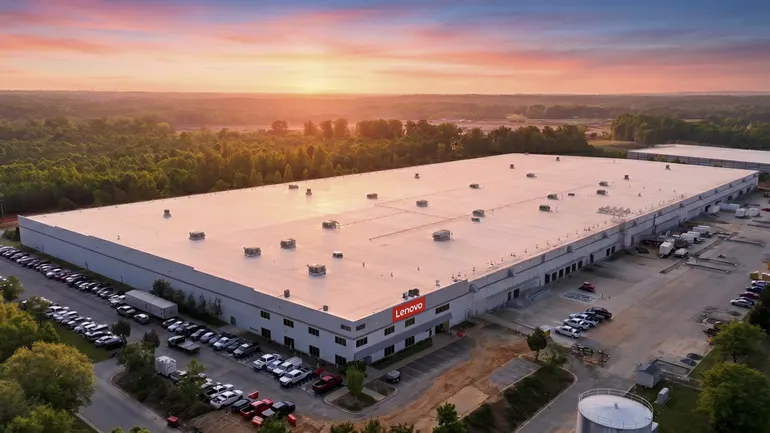
- Mid-2026: Lenovo finalized the expansion of its North Carolina plant in Whitsett. The project, which increased the facility’s footprint to 890,000 square feet, was a direct response to the ballooning demand for AI-ready server infrastructure in the North American market.
- Present Day: The company continues to navigate the "arms race" of AI infrastructure, balancing the expansion of these facilities against the realities of a global semiconductor shortage.
Supporting Data: The Cost of the AI Boom
The data surrounding Lenovo’s recent performance illustrates the double-edged sword of the AI revolution. While demand is surging, the underlying supply chain is straining under the weight of expectations.
The most striking figure is the growth of Lenovo’s AI server pipeline, which reached $54 billion last quarter, representing a staggering 157% increase quarter-over-quarter. This influx of orders is a testament to the company’s success in the data center market, yet it has created a massive backlog that the current supply chain is struggling to clear.
The bottleneck lies in semiconductors, specifically memory and high-end processors essential for AI workloads. According to industry analysis from TrendForce, lead times for critical server components have extended to nearly 12 months. This reality has forced Lenovo—and its rivals, such as Dell and HPE—to prioritize specific customer segments. Massie noted that Lenovo has implemented a tiered lead-time system, offering shorter delivery windows to long-term, strategic partners who engage in collaborative planning, while others face significantly longer wait times.
To manage this, Lenovo has turned to its proprietary AI-powered platform, iChain. This system provides granular visibility across the supply chain, monitoring the health and inventory levels of first-, second-, and third-tier suppliers to preemptively address potential shortages.
Official Responses and Strategic Rationale
When asked about the industry-wide shift toward regionalization, Massie noted that while many of Lenovo’s competitors have only "dipped a toe" into localized manufacturing, Lenovo has committed to the model entirely.
"We’ve been able to pivot between the different nodes we have around the world to be able to adjust for the different geopolitical rules and tariffs," Massie explained. He emphasizes that the "global local" strategy is not merely a temporary defensive measure but a permanent shift in corporate philosophy. By owning the regional nodes, Lenovo gains the flexibility to adjust to shifting trade rules—such as changes in US-China relations or new import levies—without needing to overhaul its entire global structure.
Regarding the current scarcity of components, the official stance is one of pragmatic management. Lenovo is increasing its baseline inventory levels to buffer against shocks, acknowledging that the "arms race" for AI capacity shows no signs of stabilization. "There seems to be an arms race a little bit," Massie admitted, "and we’re seeing that in our backlog, in our pipeline."
Implications: A New Era of Supply Chain Management
The implications of Lenovo’s strategy are profound for the broader technology sector.
1. The Death of Just-in-Time Manufacturing
The era of lean, "just-in-time" supply chains is being replaced by "just-in-case" logistics. The heavy investments in the Riyadh campus (an 11-building, 2.15 million-square-foot facility) and the North Carolina expansion signify that companies are now willing to carry the cost of massive excess capacity to ensure that they are never left without a production option.
2. Geopolitics as a Competitive Advantage
In the past, supply chain efficiency was measured by cost-per-unit. Today, it is measured by "resilience-per-region." Lenovo is betting that its ability to navigate tariffs will eventually provide a cost advantage over competitors who remain dependent on centralized production hubs that are vulnerable to sudden regulatory changes. By effectively being "local" in the markets where they sell, Lenovo turns potential liabilities into competitive assets.
3. The AI "Arms Race" as a Permanent State
The data suggests that the surge in server demand is not a temporary bubble. The $54 billion pipeline for AI servers suggests that global enterprises and governments are in the early stages of a massive infrastructure refresh. For manufacturers, this means that component scarcity—particularly in memory and advanced logic chips—is likely to persist for years, not months. The winners of the next decade will not necessarily be those with the cheapest products, but those with the most transparent and predictive supply chains.
4. The Human and Political Cost
Lenovo’s reliance on the Saudi public investment fund (ALAT) and the delays caused by regional conflicts highlight that a global supply chain is inextricably linked to international diplomacy. The decision to build in Saudi Arabia is a signal of the Middle East’s growing importance in the tech sector, but it also exposes the company to the inherent risks of that geography.
As Massie and his team look toward the future, the challenge remains clear: Lenovo must continue to scale its regional manufacturing footprint while simultaneously refining its AI-driven logistics tools. The "global local" model is an ambitious experiment in corporate agility, and as the company continues to battle a backlog of orders, its success will serve as a bellwether for the entire hardware industry.
In conclusion, Lenovo is effectively transforming from a traditional hardware manufacturer into a complex logistics engine that views geography as a variable to be managed rather than a constraint to be endured. Whether this strategy will be enough to satisfy the insatiable hunger of the AI market remains to be seen, but one thing is certain: the era of the simplified global supply chain is over, and the era of the regional, resilient, and AI-managed network has begun.
