




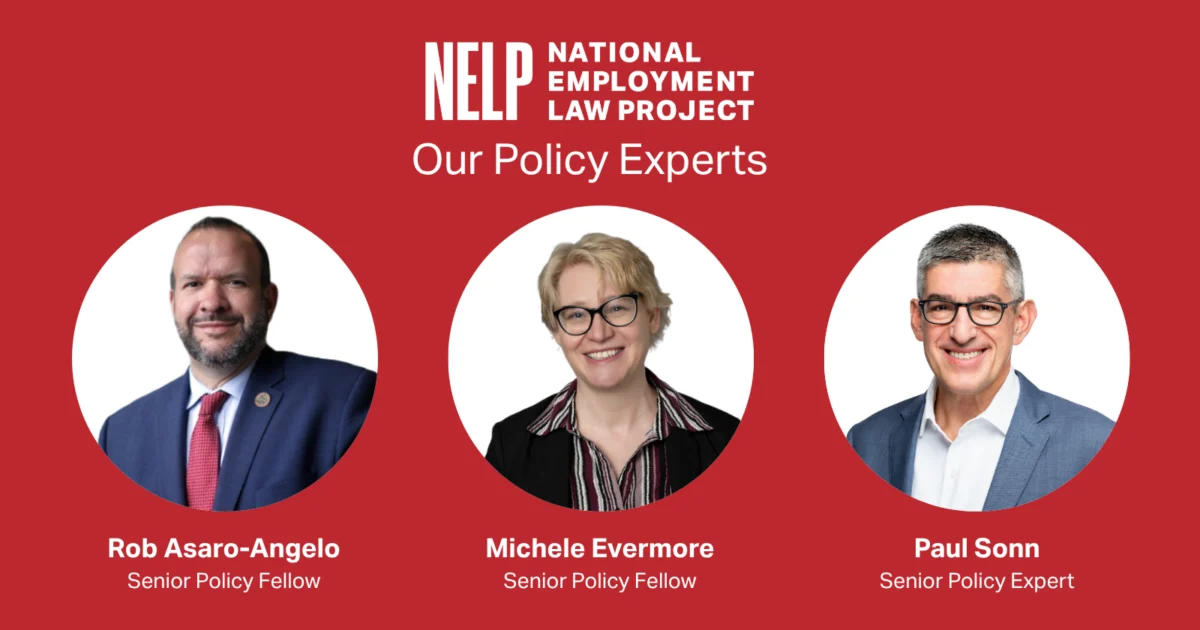
WASHINGTON, D.C. — July 30, 2026 — In a move designed to fortify the American labor landscape against the headwinds of rapid technological disruption and systemic economic inequality, the National Employment Law Project (NELP) announced today the appointment of three nationally recognized labor policy veterans to senior roles.
As the U.S. workforce faces a transformative era defined by the integration of artificial intelligence (AI), shifting employment models, and the need for more robust social safety nets, NELP is sharpening its strategic focus. The organization, a cornerstone of the workers’ rights movement since 1969, has tapped Rob Asaro-Angelo, Michele Evermore, and Paul Sonn to lead its research, advocacy, and policy innovation arms. These appointments signal a commitment to not only addressing the challenges of today’s gig-centric, tech-heavy economy but also architecting the protections required for the labor market of the 2030s.
The Strategic Shift: A New Nucleus for Worker Advocacy
The appointments come at a pivotal moment for labor policy. With the rise of algorithmic management, the automation of middle-skill jobs, and the persistent threat of wage stagnation, traditional labor protections are being tested as never before.
“We are thrilled to have such extraordinary leaders as Rob, Michele, and Paul taking on these significant new roles for NELP,” said Rebecca Dixon, NELP’s President & CEO. “Among the nation’s most renowned worker advocates, each is an accomplished architect of both visionary policies and winning campaigns. Together, they will be the nucleus of a team that advances transformative policies for workers across the country.”
The organization’s renewed focus centers on three pillars: strengthening enforcement mechanisms, modernizing social insurance (specifically Unemployment Insurance), and innovating wage and affordability policies.
Leadership Profiles: Architects of Modern Labor Policy
The three appointees bring a combined century of experience in the trenches of labor law and public policy, bridging the gap between academic research and on-the-ground legislative victory.
Rob Asaro-Angelo: Senior Policy Fellow for Worker-First Protections
Rob Asaro-Angelo joins NELP following a transformative eight-year tenure as Commissioner of the New Jersey Department of Labor and Workforce Development (NJDOL). Under Governor Phil Murphy, Asaro-Angelo oversaw a massive expansion of worker rights in the Garden State. His tenure was marked by the successful implementation of a $15 minimum wage, the passage of a pioneering temporary workers’ bill of rights, and the codification of domestic worker protections.
In his new role at NELP, Asaro-Angelo will focus on the "enforcement gap." As the labor market becomes more fragmented, state agencies often struggle to police wage theft and safety violations. Asaro-Angelo aims to develop practical, scalable innovations that allow state agencies to maximize their existing capacity, ensuring that laws on the books are actually felt in the paychecks of working families.
Michele Evermore: Senior Policy Fellow for Economic Security and Worker Transitions
Michele Evermore’s return to NELP represents a significant strengthening of the organization’s social safety net portfolio. A veteran of the U.S. Department of Labor under the Biden administration—where she served as Deputy Director for Policy in the Office of Unemployment Insurance Modernization—Evermore is widely regarded as one of the nation’s foremost experts on Unemployment Insurance (UI).
Her expertise is critical as the U.S. grapples with "job transition" volatility. As AI displaces certain roles, the need for a robust, responsive, and equitable UI system becomes paramount. Evermore’s work will focus on modernizing these systems to ensure they function as a bridge, rather than a barrier, for workers moving between industries. Her previous work with NELP during the COVID-19 pandemic, which resulted in historic expansions of unemployment assistance, provides the blueprint for her current agenda.
Paul Sonn: Senior Policy Expert for Wages and Affordability
A long-time stalwart of the organization, Paul Sonn transitions into his new role as Senior Policy Expert for Wages and Affordability. Sonn is a legendary figure in the minimum wage movement, having helped design and defend the first municipal minimum wage laws in the country.
Sonn’s portfolio will expand to include "next-generation" affordability solutions. This includes not only raising the floor on wages but also addressing the cost-of-living crisis through innovative local policy. Notably, Sonn has recently led the charge in developing "just cause" job protections, which safeguard workers from arbitrary termination, and establishing guardrails for the use of AI in the workplace—a frontier issue that is currently top-of-mind for labor regulators.
Chronology of Influence: NELP’s Path to 2026
To understand the weight of these appointments, one must look at the trajectory of NELP over the last two decades:
- 2000–2010: NELP pivots toward a state-level strategy, identifying that federal legislative gridlock requires local victories. This era sees the birth of the "living wage" movement in major U.S. cities.
- 2012–2015: The organization provides critical research and legal scaffolding for the "Fight for $15," changing the national conversation on what constitutes a fair wage.
- 2020–2022: The COVID-19 pandemic exposes the fragility of the U.S. unemployment system. NELP experts, including Michele Evermore, provide the data and policy guidance necessary for unprecedented federal stimulus and UI expansion.
- 2023–2025: The rapid adoption of generative AI creates a new class of "vulnerable workers." NELP shifts its focus toward algorithmic transparency and protection against digital wage theft.
- 2026: With the appointment of the new senior policy trio, NELP formalizes its structure to address the "Triple Threat" of the current decade: enforcement failure, social insurance decay, and the automation of the workplace.
Supporting Data: The Current Labor Environment
The urgency of these appointments is underscored by recent economic data:
- Wage Theft Estimates: According to data synthesized by NELP and partner organizations, wage theft costs American workers an estimated $50 billion annually, exceeding the cost of all other property crimes combined.
- UI Accessibility: Post-pandemic studies show that the UI system remains inaccessible to nearly 60% of unemployed workers in some states, due to archaic technology and restrictive eligibility requirements—a primary target for Michele Evermore’s upcoming work.
- Technological Displacement: A 2025 report suggests that up to 25% of current U.S. jobs will be significantly impacted by AI automation by 2030, necessitating the "job transition" policies that form the core of NELP’s new strategic mandate.
Implications: A New Era for Worker Advocacy
The implications of this restructuring are profound. By centralizing expertise in enforcement, social insurance, and wage affordability, NELP is positioning itself to be the primary intellectual and strategic hub for the labor movement.
The focus on AI and algorithmic management is particularly notable. While many organizations focus on the ethical implications of AI, NELP’s approach is grounded in labor law—treating AI not just as a technological challenge, but as a workplace management tool that requires new regulatory frameworks. By bringing Paul Sonn’s expertise in "just cause" protections to the AI conversation, NELP is signaling that it intends to lead the effort to ensure that technology serves workers rather than subjugating them.
Furthermore, the emphasis on state-level enforcement via Rob Asaro-Angelo suggests a shift away from relying solely on federal courts, which have become increasingly conservative. By empowering state agencies to act as the first line of defense for workers, NELP is building a more resilient, localized infrastructure for labor rights.
Conclusion: Building a Just Economy
Founded in 1969, the National Employment Law Project has spent over half a century evolving alongside the American worker. From the industrial age to the digital frontier, its mission remains constant: to build an economy where all workers have the power to thrive.
As the organization looks toward the remainder of the 2020s, the addition of Asaro-Angelo, Evermore, and Sonn provides the leadership depth required to turn high-level policy into tangible, life-changing results. For the 100 million workers whose lives have been impacted by NELP’s victories over the last decade, these appointments represent a promise: that even in an age of radical change, the rights of the worker will remain the bedrock of the American economy.
For more information on the organization’s current initiatives, research, and policy papers, visit www.nelp.org.
