




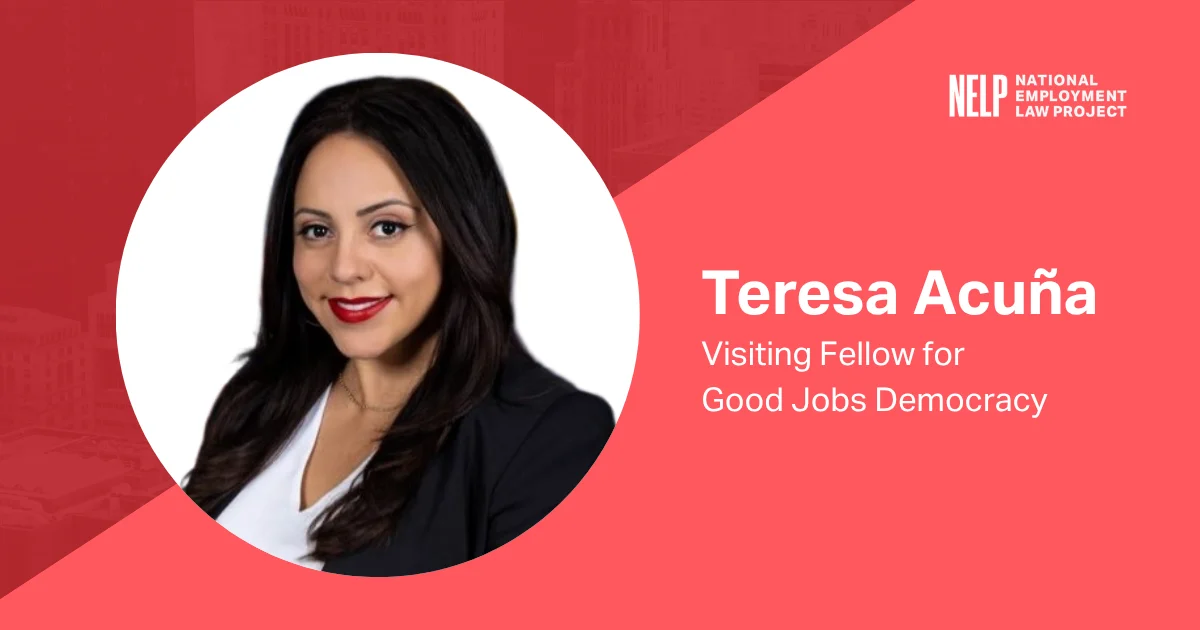
WASHINGTON, D.C. — The National Employment Law Project (NELP), a cornerstone of labor advocacy in the United States since 1969, announced on August 19, 2026, the appointment of Teresa Acuña as the organization’s new Visiting Fellow for Good Jobs Democracy. This strategic addition to NELP’s leadership ranks marks a significant step in the nonprofit’s ongoing mission to bridge the gap between high-level policy research and the grassroots advocacy required to secure economic equity for the American workforce.
As the labor landscape faces unprecedented shifts driven by technological transformation, climate initiatives, and changing industrial policy, Acuña’s role is designed to serve as a critical bridge. She will work in tandem with NELP’s existing senior policy fellows to translate complex research into actionable advocacy strategies, aiming to ensure that the promise of a "good job" is not merely a political talking point but a tangible reality for millions of workers.
The Core Mandate: Bridging Policy and Power
The "Good Jobs Democracy" fellowship is a newly articulated initiative within NELP’s broader framework. Its primary objective is to move beyond the traditional silos of policy analysis and enter the arena of proactive advocacy. In her new capacity, Acuña will leverage her extensive background in legislative affairs and federal implementation to guide how NELP engages with the modern labor market.
The fellowship focuses on the premise that economic stability is the bedrock of civic participation. By securing higher pay, safer working conditions, and robust benefits, the initiative seeks to foster an environment where workers are empowered to participate fully in the democratic process.
Chronology of a Career Dedicated to Labor
Teresa Acuña’s transition to NELP follows a distinguished career marked by high-level public service and a steadfast commitment to worker-centric policy development. Her trajectory reflects a deep understanding of how legislative intent translates into administrative reality.
- Early Legislative Advocacy: Acuña’s career began in the trenches of legislative offices, where she served as a legislative director for members of both the U.S. House of Representatives and the California State Legislature. These roles provided her with a foundational understanding of the friction between proposed legislation and its practical application on the ground.
- The Good Jobs Initiative: Most recently, Acuña served as the Director of the Good Jobs Initiative at the U.S. Department of Labor (DOL) under the Biden-Harris administration. During her tenure, she became a central architect of the federal government’s strategy to leverage massive investments in infrastructure, clean energy, and manufacturing into high-quality, union-backed career pathways.
- Transition to NELP (August 2026): Acuña joins NELP at a pivotal time, as the organization seeks to scale its impact following a decade of advocacy that has demonstrably improved the lives of an estimated 100 million workers through wage growth, expanded benefits, and safety protections.
Supporting Data: The Need for "Good Jobs"
The urgency of Acuña’s new role is underscored by the current economic climate. While the U.S. has seen significant investment in infrastructure and green technology, the quality of jobs generated by these investments remains a central point of contention.
Defining the "Good Job"
According to internal NELP research and broader economic analysis, a "good job" in the 21st century must include:
- Living Wages: Compensation that keeps pace with inflation and supports family stability.
- Worker Agency: The right to organize, bargain collectively, and have a voice in workplace conditions.
- Security and Benefits: Access to comprehensive healthcare, paid leave, and retirement security.
- Career Pathways: Opportunities for upward mobility and skills training, ensuring that the "jobs of the future" are accessible to marginalized communities.
Data from the Bureau of Labor Statistics and independent economic think tanks suggest that while job creation figures remain robust, a significant portion of new employment opportunities lack the traditional benefits of the middle class. Acuña’s work will focus on closing this "quality gap," ensuring that federal dollars—particularly those earmarked for industrial policy—are tied to strict accountability measures for employers.
Official Responses and Strategic Vision
The announcement has been met with broad support from the labor advocacy community, which views Acuña as a rare talent capable of navigating both the bureaucratic corridors of Washington and the activist spirit of local labor movements.
Statement from Rebecca Dixon, CEO of NELP
"Teresa’s experience in translating policy ideas into tangible wins for workers and their communities is critical to advancing NELP’s vision of an inclusive democracy where all workers have the economic foundation to contribute to and share in progress," said NELP CEO Rebecca Dixon. "Good jobs enable people to be active citizens. When workers are struggling just to survive, their ability to engage with their communities and their government is inherently compromised. Teresa understands that the fight for labor rights is, at its core, a fight for a healthier democracy."
The Strategic Alignment
Acuña’s appointment signals a pivot toward a more aggressive, holistic advocacy model for NELP. By focusing on "Good Jobs Democracy," the organization is essentially making the case that economic inequality is a systemic risk to the American political project. In her upcoming work, Acuña is expected to focus on:
- Implementation Oversight: Ensuring that the labor standards promised in federal grant programs are actually enforced at the project level.
- Coalition Building: Connecting local labor organizations with federal policy stakeholders to ensure that community needs are reflected in national policy.
- Counter-Narrative Development: Challenging the assumption that job quantity should be prioritized over job quality, particularly in the manufacturing and construction sectors.
Implications for the Future of Work
The implications of this appointment extend far beyond the organizational structure of NELP. As the United States navigates the "green transition" and the ongoing integration of artificial intelligence into the workplace, the definition of a "good job" is being rewritten in real-time.
Strengthening Industrial Policy
Acuña’s previous work at the Department of Labor gave her firsthand experience with the Good Jobs Initiative—a program designed to provide resources to workers, employers, and government agencies to improve job quality. Her move to NELP suggests that the nonprofit sector is positioning itself to be the primary watchdog for these initiatives. As federal funding continues to flow into domestic manufacturing, Acuña will play a key role in ensuring these investments do not result in a "race to the bottom" regarding wage suppression or safety deregulation.
The Intersection of Democracy and Labor
Perhaps the most ambitious aspect of the fellowship is its focus on the intersection of labor and democracy. Political scientists have long documented the decline in union density and its correlation with rising political polarization and the erosion of civic institutions. By framing "good jobs" as an essential component of "good democracy," NELP is shifting the focus of labor advocacy.
The implication is clear: you cannot have a robust democracy if the working class is economically disenfranchised. By providing the financial security necessary for workers to attend town halls, participate in school boards, and engage in civic activism, NELP aims to demonstrate that labor rights are, in fact, human and civil rights.
Conclusion: A New Chapter for NELP
As NELP looks toward the future, the appointment of Teresa Acuña serves as a clear indicator of its strategic priorities. With over half a century of experience, the organization remains a formidable force in the legal and policy landscape. By adding an expert of Acuña’s caliber, NELP is not only reinforcing its commitment to its historic mission but also adapting to the challenges of an increasingly complex economic environment.
For the American worker, this means that the fight for fair pay, safe conditions, and a voice on the job is receiving a renewed, high-level focus. Whether through influencing federal agency rules or supporting local legislative battles, Acuña’s tenure as Visiting Fellow for Good Jobs Democracy promises to keep the needs of the working class at the forefront of the national conversation.
As the organization continues its work into late 2026 and beyond, the focus will remain steadfast: building a just and inclusive economy where all workers have the expansive rights and opportunities they need to thrive. For more information on the fellowship and the ongoing projects at the National Employment Law Project, stakeholders and the public are encouraged to visit www.nelp.org.
