




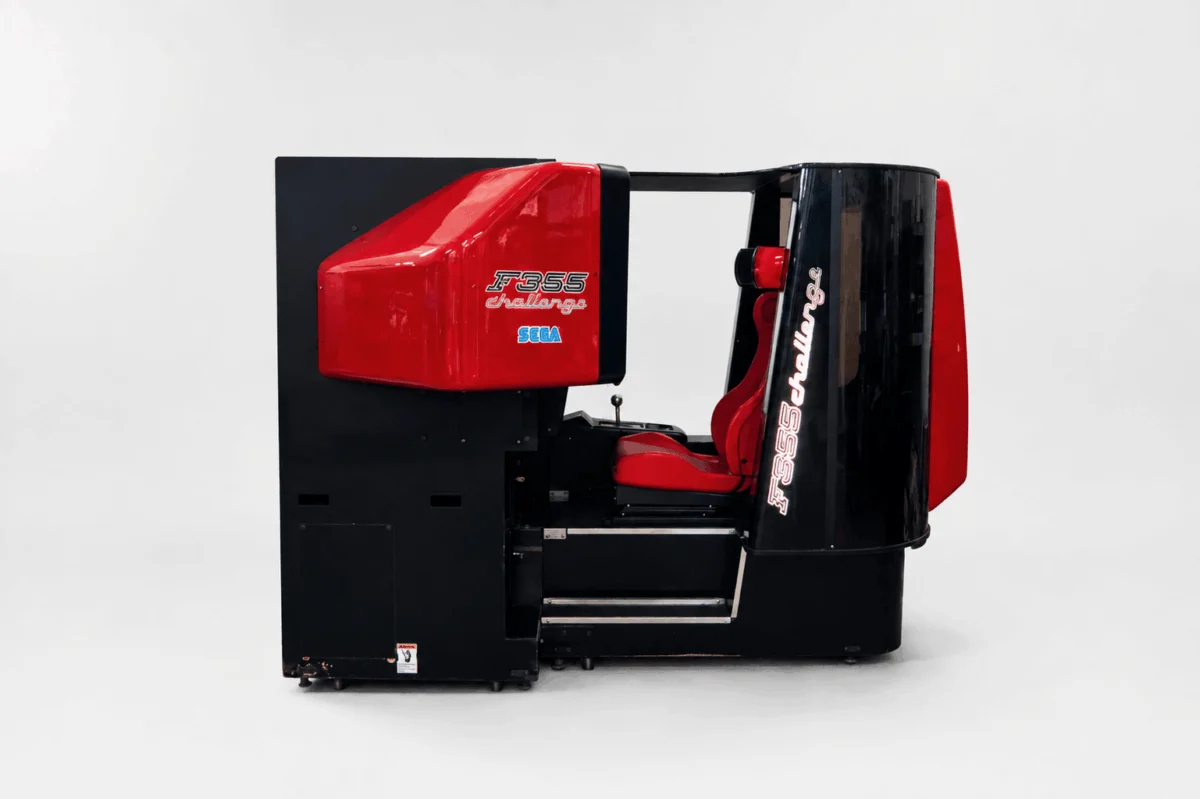
In the world of high-end automotive auctions, the digital and the physical rarely cross paths. Usually, the platform Bring a Trailer is the domain of concours-quality Ferraris, vintage Porsches, and rare rally homologation specials. However, earlier this month, a listing appeared that briefly shifted the focus from the open road to the glowing CRT monitors of the late 1990s: a pristine, triple-screen Ferrari F355 Challenge arcade cabinet.
The machine sold for a staggering $18,000. To the uninitiated, paying the price of a used economy sedan for a 27-year-old video game might seem like an act of madness. But to those who remember the arcade golden age, this wasn’t just a purchase—it was the acquisition of a piece of motorsport history.

The Genesis of an Arcade Icon
To understand why this cabinet commands such a premium, one must look at the pedigree behind the hardware. The game was directed by Yu Suzuki, the legendary Sega game designer whose resume reads like a history book of arcade gaming: Out Run, Space Harrier, After Burner, and Hang-On. By 1999, Suzuki wasn’t just a game designer; he was a driving enthusiast with a genuine Ferrari F355 in his personal garage.
Suzuki’s vision for F355 Challenge was singular: he wanted to bridge the chasm between "arcade game" and "professional simulator." At the time, most racing titles were arcade-style "twitch" experiences. Suzuki pushed for a level of realism that demanded actual driving technique, such as proper braking points and throttle modulation. He famously invited professional drivers to consult on the game’s physics, ensuring that the sensation of speed and the consequences of a missed apex felt authentic.

A Chronology of Simulation Excellence
The development of F355 Challenge was inextricably linked to the hardware of the era. Built on Sega’s NAOMI (New Arcade Operation Machine Idea) board, the game utilized architecture nearly identical to the Sega Dreamcast home console. This was a technological marvel for 1999. While other arcade games were running on proprietary hardware that could never be replicated at home, F355 Challenge brought the exact arcade experience into the living room—provided you had the Dreamcast hardware and the patience to master the game’s unforgiving physics.
However, the arcade cabinet remained the definitive experience. Specifically, the triple-screen "deluxe" model, like the one recently auctioned, was the pinnacle of the format.

- 1999: Sega releases Ferrari F355 Challenge to arcades worldwide, featuring a triple-screen setup, a true clutch pedal, and the option to use authentic paddle shifters—a feature that was still a cutting-edge novelty in road-going Ferraris of the time.
- 2000: The game receives critical acclaim for its sophisticated tire physics and track accuracy, setting a new benchmark for racing titles.
- 2003: Formula 1 icons Michael Schumacher and Rubens Barrichello are frequently photographed interacting with the cabinet, cementing its status as the preferred training tool for the Scuderia Ferrari team.
- 2026: A well-maintained unit fetches $18,000 at auction, highlighting a massive resurgence in interest for "analog" era digital hardware.
The Technical Marvel: Why It Still Matters
The triple-screen cabinet was a feat of engineering. Each screen was driven by its own dedicated NAOMI board, effectively synchronizing three separate computers to create a seamless, panoramic field of vision. This eliminated the claustrophobia of single-screen gaming and allowed the player to look through the corner—a fundamental tenet of performance driving.
Furthermore, the game’s tactile feedback was ahead of its time. The steering wheel, heavy with force feedback, communicated the grip levels of the tires in a way that felt intuitive rather than scripted. While modern sim racers like iRacing or Assetto Corsa Competizione possess vastly more complex tire models, they often lack the "soul" of the F355 cabinet. In the original Sega title, the lack of grip off the track was absolute; if you put a wheel on the grass, you were going to spin. There were no assists, no rewind buttons, and no modern hand-holding. It was a brutal, honest simulation of a mid-engine Italian sports car.

Official Responses and Industry Context
While Sega has long since pivoted away from the arcade hardware market, the legacy of the F355 project continues to be studied by game developers. Representatives from the retro-gaming community often note that the F355 cabinet represents a "closed loop" of design. Unlike modern games, which require massive day-one patches, server connections, and persistent internet access to function, the F355 cabinet is a self-contained ecosystem.
"When you buy this machine," says one prominent arcade restoration specialist, "you are buying a time capsule. It doesn’t care about your Wi-Fi connection, it doesn’t have a subscription fee, and it doesn’t need a firmware update to function. It is a piece of hardware that works exactly as intended, every time you flip the power switch."

This "no-strings-attached" nature is becoming increasingly rare in the gaming industry. As major publishers push toward digital-only ecosystems and "games as a service" models, the F355 cabinet stands as a defiant monument to the era of physical ownership.
The Implications: A Shift in Gaming Culture
The $18,000 price tag isn’t just about the scarcity of the hardware—though, given the fragile nature of 27-year-old CRT monitors, these cabinets are becoming increasingly rare. It represents a fundamental shift in how enthusiasts view their hobbies.

In an era of subscription fatigue, where users are effectively "renting" their gaming experience, there is a growing, wealthy demographic looking to "own" their entertainment. This mirrors the classic car market. Just as collectors are moving away from modern, computer-heavy supercars in favor of simpler, gated-manual Ferraris from the 1990s, the gaming community is beginning to treat high-end arcade hardware as a tangible asset.
The F355 cabinet also serves as a bridge between the automotive and gaming worlds. It is perhaps the only "video game" that a vintage car collector would feel comfortable displaying in their garage next to their actual Ferrari. It is, quite literally, a piece of automotive art.

The Future of the "Analog" Sim
As we look forward, the gap between the "sim" and the "game" continues to widen. Modern rigs are undeniably more accurate, but they are also increasingly utilitarian, composed of aluminum extrusions, direct-drive motors, and screens that look like office equipment. The F355 Challenge cabinet, with its bright yellow Ferrari branding, iconic gated shifter, and booming sound system, offers a theatrical experience that a home office setup simply cannot replicate.
The $18,000 sale on Bring a Trailer is a signal that the nostalgia market for 1990s technology is reaching a fever pitch. It is a reminder that the best gaming experiences were not necessarily the ones with the most polygons, but the ones that felt the most immersive, the most tactile, and the most permanent.

Whether the new owner of this cabinet plans to use it to chase lap times or simply to admire it as a centerpiece of their collection, one thing is certain: they have purchased a rare, uncorrupted slice of gaming history. In a world of fleeting digital licenses and vanishing software, the Ferrari F355 Challenge remains, quite literally, a solid, immovable object. And in the world of high-end collectibles, that is exactly what people are willing to pay for.
