





In the fast-evolving landscape of Generative Engine Optimization (GEO), the SEO community has been swept up in a wave of enthusiasm for llms.txt—a simple text file intended to guide AI models through a website’s content. Proponents have hailed it as the "missing link" for AI search discovery. However, beneath the surface of this technical trend lies a troubling reliance on anecdotal evidence and flawed logic.
To expose the precarious nature of these claims, digital strategist Mark Williams-Cook launched a controlled experiment: cats.txt. By creating a fake technical standard for documenting office cats, complete with "PurrLevel" metrics, Williams-Cook demonstrated that the very "proofs" used to validate llms.txt—crawling, indexing, and LLM endorsement—are, in fact, meaningless.
The Anatomy of an Industry Myth
The impetus for this experiment was simple irritation. For months, SEO professionals had been circulating a quartet of observations as evidence that llms.txt was a revolutionary tool for AI search. These four pillars—that the bots crawl it, Google indexes it, LLMs repeat its contents, and ChatGPT "recommends" it—became the foundation for client pitches and strategic decks.

Williams-Cook recognized these observations for what they were: common behaviors for any text file on the open web. To prove that these actions do not constitute a "standard" or a "ranking signal," he invented cats.txt. He drafted a professional-sounding specification, published it on his blog, and seeded it on LinkedIn with the earnest, jargon-heavy tone characteristic of modern tech thought-leadership. The result was a masterclass in exposing the absurdity of current industry benchmarks.
Chronology of a Viral Satire
The timeline of the cats.txt phenomenon is a reflection of how easily misinformation—or, in this case, harmless satire—can be legitimized by the digital ecosystem.
- The Inception: Williams-Cook publishes the
cats.txtspecification, which formally requires site owners to list their cats, their job titles, and a "PurrLevel" score out of 10. - The Seed: A LinkedIn post is published, framed as an urgent "must-adopt" standard for SEO and GEO. The post leverages the industry’s obsession with "AI-readiness" to gain traction.
- The Adoption: Technical SEO peers, recognizing the irony, begin adding
cats.txtfiles to their own domains. A third party eventually launchescatstxt.org, creating a more polished version of the joke than the original. - The Verification: Williams-Cook subjects
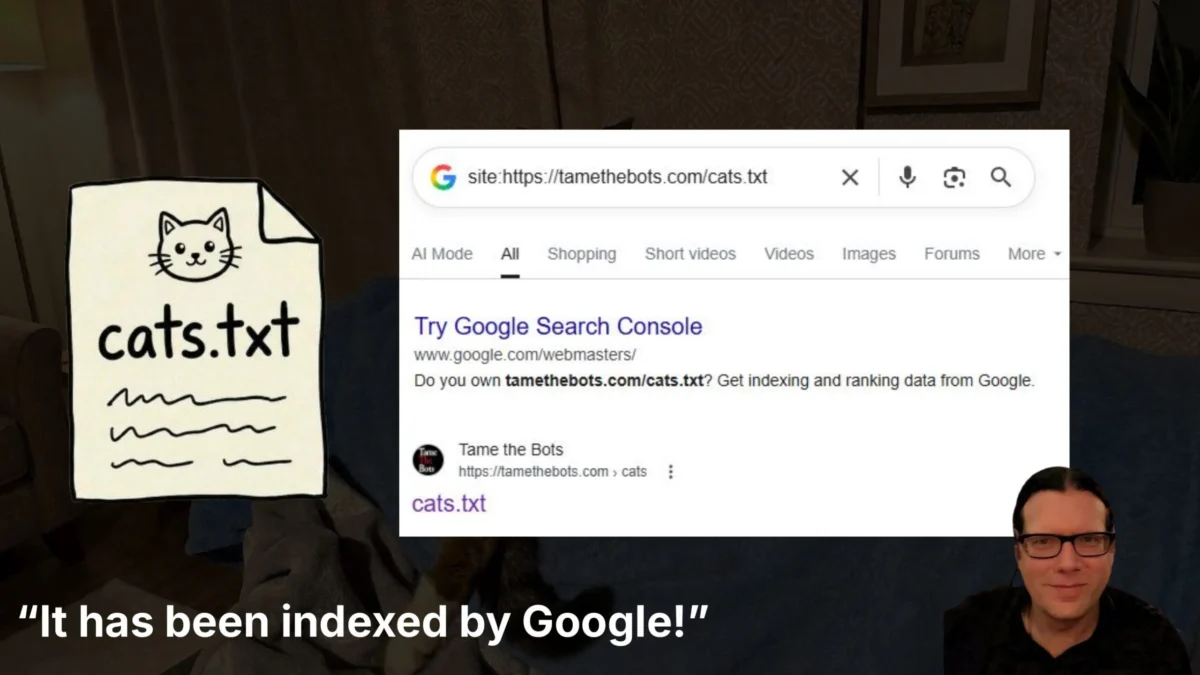
cats.txtto the four "proofs" cited by thellms.txtcommunity. The file is crawled by every major AI bot, indexed by Google, summarized by LLMs as a valid SEO tactic, and endorsed by ChatGPT as a tool for improved visibility.
The joke was successful precisely because it was transparent, yet it still moved through the gears of the internet’s algorithms with the same momentum as a "serious" proposal.

Dissecting the Four Pillars of "Proof"
The core of the issue lies in the faulty chain of inference used to justify new GEO tactics. Williams-Cook systematically dismantled the four arguments commonly used to validate llms.txt, showing how they apply equally to his satirical cat file.
1. The "Crawling" Fallacy
Proponents argue that because AI bots like GPTBot or ClaudeBot visit the llms.txt file, they are "using" it. This is a misunderstanding of how crawlers function. Crawlers are designed to fetch almost everything they find; a bot hitting a URL is a routine administrative event, not a value judgment. The fact that cats.txt was crawled with the same frequency as llms.txt proves that crawling is a neutral act, not an endorsement of the file’s content.
2. The Indexing Myth
Google has indexed plain-text files since the early days of the web. Being indexed simply means the URL exists and contains text. The fact that Google Search Console might offer to track "ranking data" for a file describing a British Shorthair’s "GUI Purrfectionist" skills does not mean Google values that data—it simply means Google is doing its job as an indexing engine.

3. The Retrieval-Augmented Generation (RAG) Misconception
The most persuasive argument for llms.txt is that an LLM can "read" the file and return the information inside it. However, this is just standard RAG behavior. If an LLM searches the web and finds a page (any page), it will synthesize that information. If a user asks about a cat on a site that has a cats.txt file, the model finds the file and reports the information. This does not mean the model has "recognized" a standard; it means the model has performed a basic retrieval task.
4. The "ChatGPT Endorsement" Trap
Finally, there is the belief that if ChatGPT says a tactic is good, it must be so. This ignores how LLMs work. They are trained on a massive corpus of human text. If enough people write that llms.txt is a good idea, the model will echo that consensus. When users began writing about cats.txt, the model simply converged on the existing discourse and echoed it back, confirming the satire as if it were a legitimate technical recommendation.
Official Stances and Empirical Reality
While the SEO community continues to debate the efficacy of llms.txt, industry leaders have been clear. Google’s John Mueller has been blunt, stating that no AI system currently uses llms.txt for search or discovery. Furthermore, large-scale studies conducted by Ahrefs and other SEO researchers have found no measurable citation advantage for sites that implement these files.

The disconnect between the "standard" as it is sold and the "standard" as it functions in the wild is profound. The evidence suggests that while these files are harmless to include, they are not currently functioning as the high-impact SEO levers that consultants are billing for.
Implications for the Future of GEO
The cats.txt experiment serves as a cautionary tale for the SEO industry. The "convergence problem"—where LLMs simply mirror the loudest voices in the room—means that consensus is no longer a proxy for truth.
For digital marketers, the implications are twofold:

- Verification is Mandatory: SEO professionals must move away from "proof by observation." Just because a change is crawled or indexed does not mean it is optimized.
- The Cost of Rituals: Every hour spent implementing "vanity standards" is an hour lost on verifiable, data-backed optimizations. The industry’s focus should remain on the "O" in SEO: actual optimization of performance and user experience.
As Williams-Cook noted during his presentation at Athens SEO, the industry needs to be more skeptical of "new standards" that lack documented support from AI providers. While adding an llms.txt file may be a low-risk "future-proofing" exercise, treating it as a proven ranking strategy is a failure of analytical rigor.
Ultimately, the lesson of cats.txt is that in an era of AI-driven search, the tools themselves are often the least reliable sources of truth. Whether it is a legitimate technical file or a satirical list of a cat’s favorite napping spots, the algorithms will treat them with the same robotic, uncritical efficiency. It is the responsibility of the human practitioner to discern the difference between a functional signal and a digital echo.
