






As the United States grapples with a crumbling transportation network and the rapid transition to electric vehicles (EVs), the traditional method of funding roads—the motor fuel tax—is effectively running out of gas. In its place, policymakers are increasingly looking toward a Vehicle Miles Traveled (VMT) tax. However, while economists argue that a VMT tax is the most principled and efficient way to ensure sustainable infrastructure, it faces a formidable hurdle: deep-seated, well-founded public anxiety regarding government surveillance.
The Fiscal Impasse: Why the Gas Tax is Failing
For decades, the federal Highway Trust Fund and state-level road programs have relied on excise taxes on gasoline and diesel. This "user fee" model functioned effectively when vehicles were relatively uniform in their fuel consumption. Today, that model is collapsing.
The rise of fuel-efficient hybrids and, more significantly, the mass adoption of electric vehicles, has created a widening gap between road usage and revenue collection. EV drivers utilize the same highways and local roads as gas-powered vehicle owners but contribute significantly less—or nothing at all—to the maintenance of that infrastructure through fuel taxes. As the vehicle fleet continues to electrify, the gas tax is destined to become an obsolete relic of the 20th century.
Policymakers are left with a fundamental question: how do we charge for the use of a public good without relying on an increasingly irrelevant metric? The answer, according to the Tax Foundation and other policy experts, is the VMT tax. By shifting the charge from the fuel consumed to the distance traveled, governments can create a stable, future-proof revenue stream that remains neutral regardless of engine technology.
A Chronology of the VMT Evolution
The journey toward a VMT tax has been long and marked by a tension between technological potential and political caution.
- 2000s – The Early Conceptualization: As fuel efficiency improved, transportation researchers began identifying the long-term instability of the gas tax. Academic white papers began proposing "road usage charges" (RUC) as a more direct proxy for road wear and tear.
- 2010s – The Pilot Phase: States like Oregon, Washington, and California began launching small-scale pilot programs. These tests aimed to prove that mileage could be tracked, reported, and taxed without creating a dystopian surveillance state.
- 2021 – The Infrastructure Investment and Jobs Act: While the federal government did not implement a national VMT tax, the landmark legislation signaled a shift toward examining new revenue models, even as it simultaneously introduced controversial provisions regarding vehicle "kill switches" and monitoring technologies, which inadvertently fanned the flames of privacy concerns.
- 2026 – The Current Stand-off: As state coffers dwindle, the debate has moved from the laboratory to the front pages of national news. Prominent political figures have begun using the VMT tax as a lightning rod for broader concerns about government overreach.
Supporting Data: Efficiency and Neutrality
The core economic argument for a VMT tax is rooted in the "user fee" principle. When a government provides a service—in this case, roads—it is most efficient to charge the individuals who derive the most benefit from that service.
Unlike retail delivery fees or rental car taxes, which target specific sectors of the economy, a VMT tax is broad-based and neutral. By adjusting the rate based on vehicle weight—since heavier vehicles cause significantly more pavement damage than lighter passenger cars—a VMT tax creates a direct link between the cost of the infrastructure and the cost to the user.

Furthermore, the current system is opaque. Many drivers are unaware that their gas taxes are often diverted to fund environmental programs or public transit subsidies, rather than the specific road they are driving on. A VMT tax would, in theory, restore transparency: the price of a mile is the price of the road.
Official Responses and the "Privacy Wall"
Despite the economic clarity of the VMT model, the political opposition is fierce. The primary, and often sole, argument against implementation is the fear of an unconstitutional surveillance state.
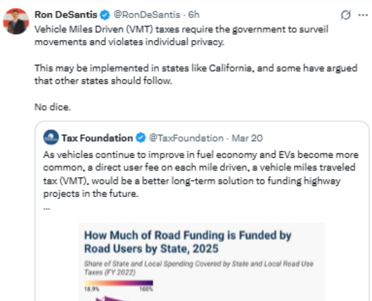
This sentiment was distilled in a recent social media post by Florida Governor Ron DeSantis, who sharply criticized the concept of VMT taxes. His opposition reflects a broader populist skepticism toward any government policy that involves the digital tracking of citizen movement. When the government discusses tracking miles, the public immediately hears "tracking location."
This fear is not unfounded. The modern driver is already subject to a web of surveillance that would have been unimaginable twenty years ago. Automated License Plate Readers (ALPRs) now blanket major intersections and toll roads across the country. According to the mapping project DeFlock, nearly 100,000 such cameras are currently active in the United States. In Florida alone, more than 5,000 ALPRs are deployed to support "Toll-By-Plate" systems, creating searchable databases of vehicle movements that can be accessed by law enforcement.
When a government that is already engaged in mass, warrantless license plate tracking proposes a new tax based on mileage, the public’s instinctual rejection is a rational response to an existing pattern of overreach.
Privacy-Conscious Design: The Path Forward
If a VMT tax is both fiscally necessary and politically radioactive, how do we bridge the gap? The answer lies in decoupling mileage reporting from location tracking.
Technologically, a VMT tax does not require knowing where a car went, when it got there, or how long it stayed. It requires only a single data point: the total number of miles driven on public roads within a specific jurisdiction.
1. Odometer Reporting
As demonstrated by the Washington state pilot program, the most privacy-conscious method of collecting a VMT tax is the simple odometer reading. Drivers can report their mileage manually, perhaps verified by a smartphone photo taken at a state-approved inspection site. This method is offline, requires no GPS, and maintains the traditional relationship between the taxpayer and the tax authority without any real-time tracking.
2. Third-Party Commercial Account Managers (CAMs)
For those who prefer a more automated experience, governments can utilize third-party intermediaries. Similar to how millions of Americans voluntarily share driving data with insurance companies to receive "safe driver" discounts, CAMs could collect mileage data and report only the final, aggregated total to the government. By utilizing strong, legally mandated data anonymization and encryption, the government would receive the tax revenue without ever seeing the raw data associated with a specific driver’s movements.
3. The "Choice" Framework
Privacy-conscious design mandates that location-based tracking never be mandatory. While some drivers might choose to use GPS-enabled apps to automatically calculate their travel on private vs. public roads (to save money on non-taxable miles), that must remain an opt-in feature. The baseline must be a non-intrusive, location-blind reporting system.
Implications for the Future of Infrastructure
The choice before American policymakers is clear: they can continue to rely on a broken gas tax model that penalizes efficiency and creates a fiscal cliff, or they can adopt a modern, neutral, and efficient VMT tax.
However, the success of a VMT tax will depend entirely on the ability of the state to earn the public’s trust. If lawmakers treat the VMT tax as a pretext for building a new, more granular surveillance apparatus, they will face, and likely deserve, a total political failure. Conversely, if they treat the VMT tax as a transparent, limited, and privacy-first user fee, they can secure the funding necessary to maintain the backbone of the American economy.
The transition to a VMT tax is not merely a tax policy question; it is a constitutional one. By stripping away the surveillance elements and focusing on the core mission of revenue collection, government leaders have the opportunity to prove that they can provide modern infrastructure without sacrificing the digital privacy of the citizens who use it. Failure to address these privacy concerns head-on will ensure that our roads remain underfunded, and our relationship with the state remains defined by mistrust.
