





Skift Take
Google’s agentic hotel booking is finally launching in AI Mode, nine months after it was first teased. While skeptics may view this as a digital redux of the shuttered "Book on Google" tool, the tech giant is positioning this iteration as a fundamental shift in how consumers interact with travel ecosystems. By leveraging advanced large language models (LLMs) to facilitate end-to-end transactions, Google is betting that the friction of traditional booking funnels is finally a thing of the past.
Main Facts: The New Frontier of AI-Assisted Travel
After months of anticipation and industry speculation, Google has officially pulled the curtain back on its agentic hotel booking capabilities within its AI-powered search interface. Starting Thursday, travelers across the United States can move beyond mere information gathering to executing full lodging transactions directly within Google’s AI chat environment.
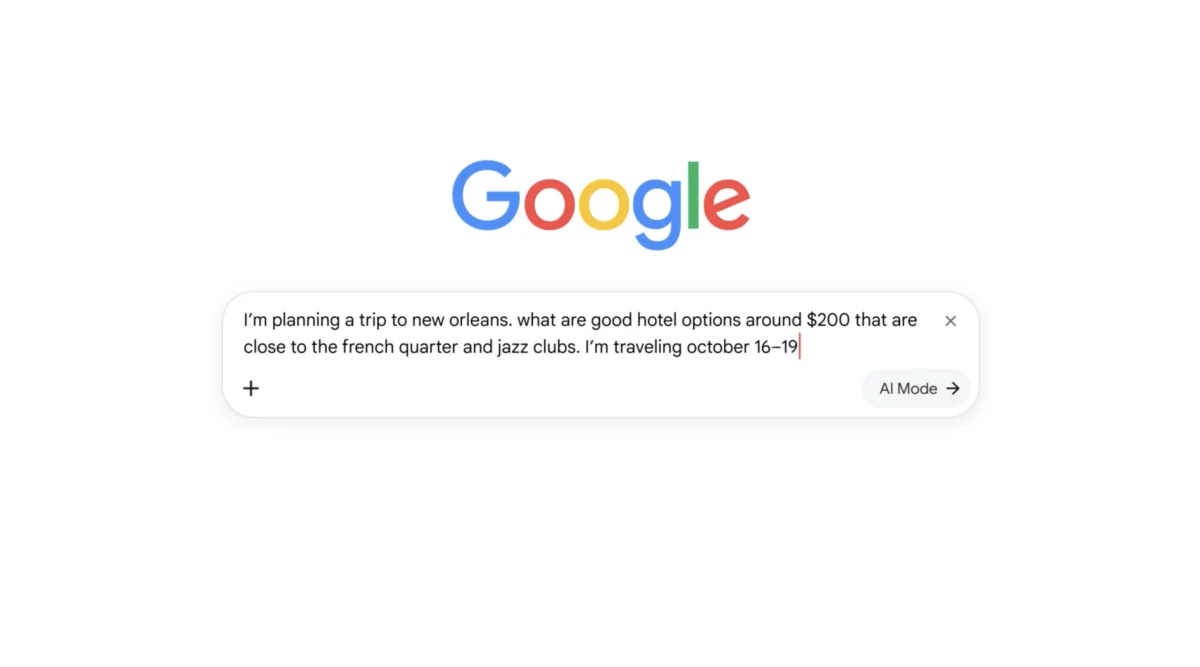
This integration represents a pivot from Google’s traditional role as a high-traffic referral engine—sending users to third-party sites—to an active participant in the conversion process. When a user queries, "Find me a boutique hotel in downtown Chicago for under $300 a night with a pool," the AI does not just provide a list of links. It now facilitates a conversational workflow where users can compare room types, scrutinize cancellation policies, and finalize payments via Google Pay without ever navigating away from the search result page.
Despite the "agentic" label, Google is careful to clarify the boundaries of its AI. The system does not act as a rogue autonomous agent; rather, it functions as a highly sophisticated interface that mediates between the user and the travel provider. The hotel or Online Travel Agency (OTA) remains the merchant of record, maintaining responsibility for charging the credit card, issuing confirmation emails, and providing customer support.
The launch is bolstered by an impressive roster of industry titans, signaling broad buy-in from the sector. Launch partners include global hospitality giants and dominant OTAs, such as Booking.com, Choice Hotels, Expedia, Hilton, Hotels.com, IHG, Marriott, Priceline, Trip.com, and Wyndham.
Chronology: From Concept to Commerce
The road to this launch has been marked by a deliberate, iterative approach that reflects Google’s cautious optimism regarding generative AI.
- November 2023: Google first teased the concept of "agentic" travel capabilities during its annual developer and product showcases. At the time, the focus was largely on the promise of AI agents that could handle complex, multi-step tasks across the web.
- Early 2024: The industry braced for impact, with many analysts questioning whether Google would repeat the mistakes of the now-defunct "Book on Google" tool—a product that faced significant regulatory scrutiny and pushback from travel partners who feared Google was monopolizing the user interface.
- Spring/Summer 2024: Throughout the mid-year months, Google began integrating AI summaries into Search, slowly acclimating users to the idea of AI-generated travel itineraries. During this time, the company worked closely with major hotel brands and OTAs to refine the backend infrastructure, ensuring that booking data could be seamlessly passed through Google’s interface.
- August 2024: The formal rollout begins. The shift from "search-to-book" marks the most significant change to the travel search landscape since the introduction of Google Flights and Google Hotels modules years ago.
Supporting Data: The Scale of the Ecosystem
The significance of this launch is best understood through the lens of Google’s massive travel footprint. As the primary gateway for millions of travel queries daily, Google holds a disproportionate amount of power in the conversion funnel.
While Google has not released internal metrics regarding the conversion rates expected from this new AI-integrated flow, market research suggests that the "conversational commerce" model could significantly reduce abandonment rates. According to industry data, the average hotel booking process involves multiple site visits and significant comparison friction. By consolidating this into a single chat window, Google aims to minimize the cognitive load on the user.
The roster of partners involved represents a substantial portion of the global hotel supply. By partnering with both major chains (like Marriott and Hilton) and aggregators (like Expedia and Booking.com), Google is positioning its AI as a neutral aggregator that prioritizes the user’s specific constraints—be it price, amenities, or loyalty program eligibility—over a single brand’s inventory.
Official Responses and Strategic Positioning
Google has framed this development not as a replacement for travel brands, but as an evolution of the user experience. A company spokesperson noted that the goal is to "help users make decisions faster by surfacing the most relevant information and providing a frictionless path to purchase."
The industry response, while cautious, has been largely collaborative. Unlike the launch of "Book on Google," where some partners felt sidelined by a lack of control over the user experience, this iteration is being presented as a partnership. By allowing the hotels and OTAs to remain the merchant of record, Google is effectively acting as a high-tech intermediary rather than a competitor.
"The AI acts as a concierge," one industry analyst observed. "It aggregates, summarizes, and facilitates. But it doesn’t try to be the hotelier. That distinction is crucial for maintaining the trust of the supply partners who are the backbone of this ecosystem."
However, the "agentic" terminology remains a point of debate. Google defines its agentic capabilities as the system’s ability to "chain" tasks together—finding, comparing, and booking—in a way that feels seamless to the user. Critics argue that the term "agentic" should be reserved for systems that can negotiate on a user’s behalf, such as finding a better rate or securing an upgrade, which this system currently does not do.
Implications: The Future of Travel Search
The implications of Google’s move are vast, affecting everything from SEO strategies to the future of hotel loyalty programs.
1. The Death of the Traditional Funnel?
For years, the travel industry has relied on the "search-click-convert" model. Google’s AI integration suggests a move toward "search-chat-convert." If successful, this could reduce the necessity for users to visit individual brand websites during the discovery phase. Hotels will need to optimize their content not just for search engines, but for Large Language Models that prioritize concise, high-utility answers.
2. The Power of "Merchant of Record"
By keeping the hotel or OTA as the merchant of record, Google is sidestepping some of the most complex regulatory and operational hurdles of the travel industry, such as customer service disputes and refund processing. This is a strategic masterstroke, as it allows Google to capture the conversion revenue without taking on the liability of the travel experience itself.
3. The Loyalty Program Conundrum
One of the most persistent questions is how loyalty programs will function within an AI-chat interface. Travelers often book directly with chains to earn points or enjoy status perks. Google’s system must prove that it can respect these loyalty parameters. If the AI cannot effectively surface a user’s "Marriott Bonvoy" status or "Hilton Honors" points to secure a member rate, the system may struggle to gain traction among frequent business travelers.
4. Regulatory Scrutiny
Google remains under the microscope of antitrust regulators worldwide. The integration of booking tools directly into Search results has historically been a flashpoint for competition concerns. By incorporating a wide range of partners—from Marriott to Trip.com—Google is likely attempting to present this as an open, competitive marketplace rather than an exclusionary one.
Conclusion: A New Era of Travel Planning
Google’s foray into agentic hotel booking is a clear signal that the company intends to dominate the top-of-funnel travel experience. By combining the conversational capabilities of its Gemini-powered AI with the deep inventory of the world’s largest travel brands, Google is creating a "super-app" experience within the search bar.
Whether this tool will truly revolutionize travel remains to be seen. The success of the feature will depend on the AI’s ability to handle edge cases—such as complex multi-room bookings, group travel, or nuanced customer support requests—without frustrating the user.
For now, the industry is watching closely. If Google succeeds in making the booking process as simple as sending a text message, it will mark a fundamental shift in the travel landscape, cementing the search engine’s role not just as a librarian of the web, but as a digital travel agent for the AI era. The technology is here, the partners are on board, and the next chapter of travel search has officially begun.
