





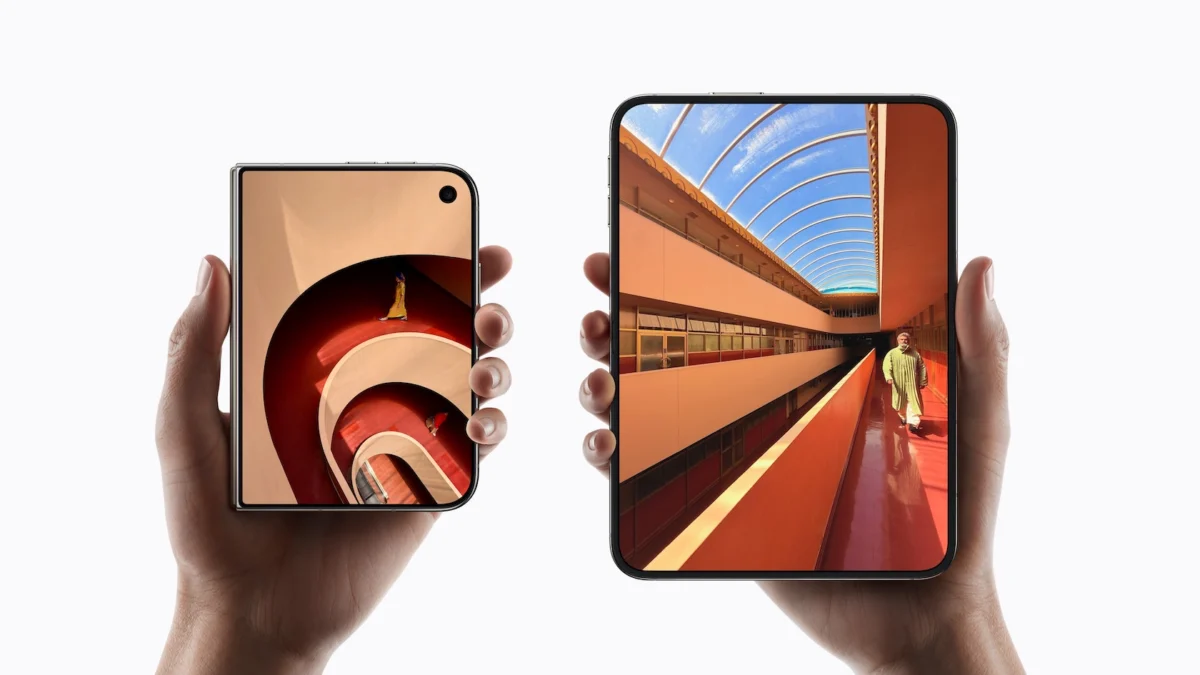
The atmosphere at Apple’s California headquarters during the latest annual product launch was thick with the kind of anticipation usually reserved for historical events. As the stage lights dimmed and the screens flickered to life, it became clear that the era of the "standard" slab smartphone is officially on the defensive. Under the stewardship of new CEO John Ternus—who assumed the mantle following Tim Cook’s storied tenure—the $6.2 trillion tech behemoth has unveiled its most ambitious hardware play to date: the iPhone Duo.
At a staggering price point of $3,499, the device is more than a phone; it is a statement. Designed to fold open with the tactile elegance of a passport, the Duo represents Apple’s long-awaited foray into the foldable market. Yet, as analysts and enthusiasts alike pore over the specifications, one burning question remains: in an era of global economic belt-tightening, is this hyper-premium productivity tool a necessary evolution, or is it simply a "flex" for the ultra-wealthy?
The Main Facts: A New Paradigm in Hardware
The iPhone Duo is not merely an iPhone that bends; it is an engineering overhaul. Marketed as the "thinnest iPhone ever" despite its complex hinge architecture, the device features a display that, when unfolded, is 50% larger than the flagship iPhone 18 Pro Max.
This massive canvas is aimed squarely at the power-user demographic—creative professionals, high-level executives, and tech enthusiasts who require a tablet-like experience that fits into a pocket. Beyond the foldable screen, the Duo utilizes a proprietary "Liquid-Flex" OLED panel designed to eliminate the notorious "crease" that has plagued competitors for years. It runs on the new A20 Bionic chip, optimized specifically for the split-screen multitasking capabilities that the device’s form factor demands.
Alongside the Duo, Apple refreshed its core lineup:
- iPhone 18: The standard iteration, focusing on incremental AI-driven photography improvements.
- AirPods 5: Featuring advanced spatial audio and adaptive noise cancellation that reacts to the user’s environment in real-time.
- Apple Watch Series 12: A refinement of the health-tracking ecosystem, now capable of more precise non-invasive glucose monitoring.
Chronology: The Road to the Duo
Apple’s journey to the foldable market has been one of deliberate, almost cautious, pacing. While Samsung and Motorola sprinted into the foldable space in the early 2020s, Apple remained famously sidelined, waiting for display technology to mature.
- 2023-2024: Rumors of a "foldable iPhone" began to gain traction, with industry insiders noting Apple’s aggressive patent filings for "seamless hinge mechanisms" and "self-healing display polymers."
- Early 2025: Following the transition of leadership from Tim Cook to John Ternus, internal reports suggested a shift in strategy. Ternus, a hardware veteran, prioritized the "Duo" project as the signature product to define his early tenure.
- September 2026 (Launch Night): In a tightly choreographed keynote, Apple officially unveiled the device. The presentation emphasized the "Duo" as the convergence of the iPhone and the iPad, effectively attempting to bridge the gap between portability and professional-grade screen real estate.
Supporting Data: The Economics of Niche Luxury
To understand the $3,499 price tag, one must look at the macro-economic environment of the tech sector. Apple’s market capitalization sits at an eye-watering $6.2 trillion, a figure that gives them the luxury to experiment with "Veblen goods"—products where demand increases as the price rises because they serve as status symbols.
Market data suggests that while the mid-range smartphone market has become commoditized, the "ultra-premium" tier (phones priced above $2,000) has seen a 14% year-over-year growth rate. This segment is driven by users who do not view their phone as a communication device, but as a primary computer.
"The Duo is not designed for the masses," says lead industry analyst Sarah Jenkins. "It is designed for the 1% of the user base that spends six hours a day on their mobile device. For them, a $3,499 investment, when amortized over three years, is a negligible cost for a productivity tool that replaces a laptop on the go."
However, the cost to Apple is also significant. The specialized manufacturing processes required to create the "thinnest hinge in the industry" mean that margins on the Duo are tighter than on the standard iPhone 18. This is a gamble on volume versus prestige; Apple is betting that the Duo will "halo" the rest of their lineup, making the standard iPhone 18 feel more attainable by comparison.
Official Responses and Strategic Positioning
During the post-launch press briefing, CEO John Ternus was quick to frame the Duo as a "productivity revolution."
"We didn’t want to build a foldable just to say we did it," Ternus stated. "We waited until we could build a device that didn’t compromise on the Apple experience. The Duo isn’t about the folding—it’s about the expanding. When you open this device, you aren’t just opening a phone; you are opening a workspace."
When challenged on the price point, Apple’s executive team deflected, pointing toward the "unprecedented R&D costs" and the inclusion of high-end accessories, including a specialized Apple Pencil Slim and a proprietary leather folio. The company is positioning the Duo not as a replacement for the iPhone 18, but as an entirely new category—a "Professional" tier for the mobile-first worker.
Implications: A Shift in the Tech Landscape
The launch of the iPhone Duo signals a profound shift in the mobile industry. For the last decade, smartphone innovation has been characterized by incremental improvements—better cameras, faster processors, and longer battery life. The Duo changes the hardware narrative entirely.
1. The Death of the ‘Standard’ Upgrade Cycle
With the Duo, Apple is signaling that the era of the "annual upgrade" for the average user is slowing. By pushing the ceiling of what a phone can cost, they are acknowledging that for most people, the iPhone 18 is more than enough. The Duo is a signal that innovation will now happen at the edges of the market, catering to power users who want hardware that feels like it’s from the future.
2. Competition and Market Pressure
Competitors like Samsung, which have held the crown in the foldable space, now face a major challenge. Apple’s entry into this category provides a "stamp of legitimacy" that will likely drive mass-market adoption of foldables over the next five years. However, if Apple’s software ecosystem (iOS) can leverage the extra screen real estate better than Android, the competitors may find their market share slipping despite being "first to market."
3. The Socio-Economic Divide
Robin Williams once quipped that certain vices were God’s way of saying you have too much money. Critics are already applying this logic to the Duo. As the world faces economic uncertainty, a $3,499 phone creates a visible "digital divide." The Duo is not just a tool; it is an accessory of the elite. This may lead to a backlash or, conversely, a stronger brand identity for Apple as the provider of the most exclusive hardware on the planet.
4. Long-term Viability
The critical test for the Duo will be durability. Can a hinge and a foldable screen stand up to the rigors of three years of daily usage? If the Duo develops screen issues or hinge failures, it could be a PR catastrophe for Apple. If it succeeds, it cements the company’s reputation as the master of the "long game," waiting until a technology is perfect before perfecting it.
Conclusion
The iPhone Duo is a triumph of engineering and a bold, perhaps polarizing, leap into the future of mobile computing. Whether it is a "productivity flex" or a necessary evolution, one thing is certain: Apple has successfully dominated the conversation once again. By launching a device that is as expensive as it is impressive, they have reminded the world that they are not just in the business of selling phones—they are in the business of defining what luxury looks like in the digital age.
As the first units reach the hands of early adopters, the tech world will be watching closely. If the Duo delivers on its promise of a seamless, pro-level workspace, it will be remembered as the moment the smartphone grew up. If not, it will serve as a high-priced reminder that even a $6.2 trillion company can occasionally miscalculate the needs of its most loyal fans. For now, however, the Duo stands alone—a testament to ambition, excess, and the relentless pursuit of the "next big thing."
