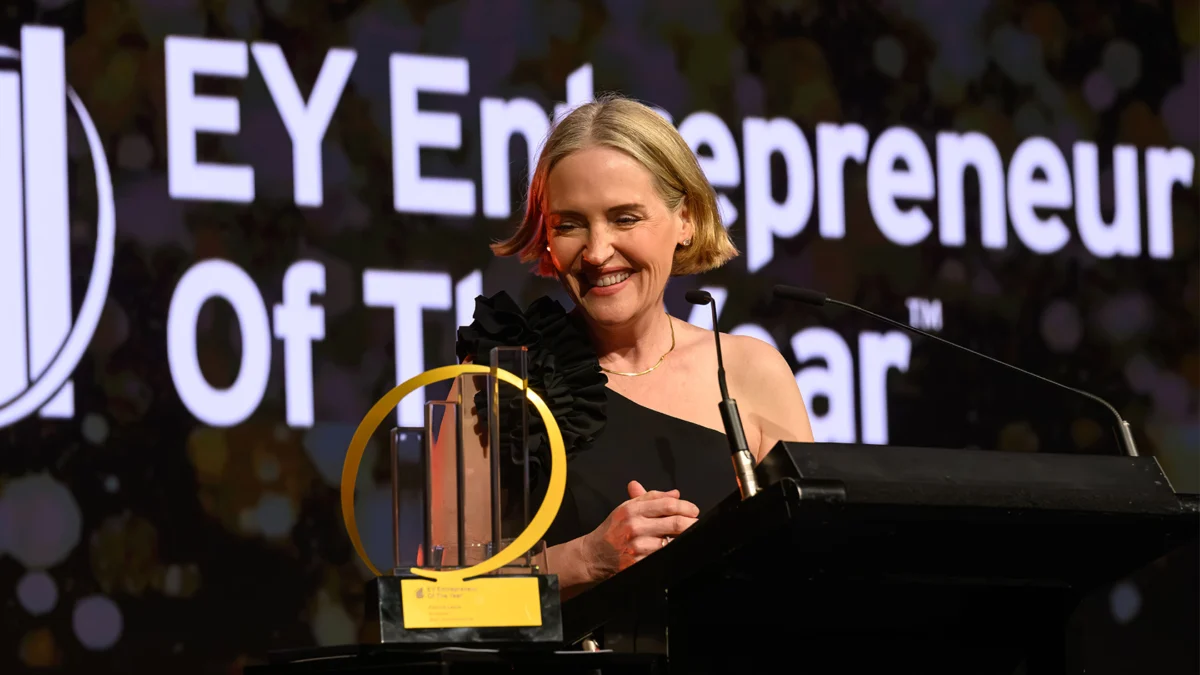




For over a quarter of a century, the EY Entrepreneur Of The Year™ awards have served as the definitive barometer for Australia’s commercial vitality. On October 22, the historic Regent Theatre in Melbourne became the stage for the 26th annual iteration of this prestigious program, celebrating the grit, ingenuity, and transformative vision that define the nation’s business landscape.
Hosted by professional services giant EY Australia, the gala recognized 27 national finalists. These individuals represent a diverse cross-section of the economy, ranging from agile emerging innovators challenging the status quo to established titans of industry whose influence spans global markets. The event underscored a fundamental truth: Australian entrepreneurship is not merely surviving; it is setting a global benchmark for excellence.
The Pinnacle of Achievement: Katrina Leslie and the Swipejobs Revolution
The evening’s highest honor, the EY Entrepreneur Of The Year, was bestowed upon Katrina Leslie, the founder and chair of Swipejobs. Since its inception in 2013, the hiring platform has fundamentally disrupted the recruitment sector by leveraging advanced artificial intelligence to bridge the gap between jobseekers and employers.
By prioritizing skill-matching over traditional resume-filtering, Swipejobs has created a high-velocity ecosystem that minimizes friction in the hiring process. The firm’s reach is now truly international, with operations spanning the United States and the United Kingdom. In a testament to its explosive growth, the company generated $1.3 billion in revenue in 2025.
Naomi Simson OAM, chair of the independent judging panel, highlighted Leslie’s unique position in the entrepreneurial ecosystem. "As founder and chair of Swipejobs, Katrina stood out for her forward-thinking approach and her rare ability to translate bold, abstract ideas into a globally scalable, operational business," Simson noted. "She has fundamentally challenged traditional thinking regarding what recruitment can look like in the modern age. We need more role models like Katrina to inspire the next generation of founders."
A Career Defined by Disruption: The Journey of Katrina Leslie
To understand Leslie’s success, one must look at her trajectory—a path that began far from the boardroom. Growing up as a Queensland cattle farmer’s daughter, Leslie developed the resilience and pragmatism that would eventually define her career.
Her professional journey spans over three decades, during which she has served as a front-row witness to the evolution of human resources. She entered the workforce when "help-wanted" signs and newspaper classifieds were the primary tools of the trade. Her early career saw her holding pivotal roles at corporate giants such as Westpac, Microsoft, and BHP.
However, the itch to innovate led her to entrepreneurship in 1997, when she launched IPS, an assessment and career services company. This was merely the beginning. In 2005, she founded ePredix, a pioneer in applicant screening and ranking, and the applicant tracking platform HRX.
When asked about her storied past, Leslie remains characteristically forward-looking. "If you want to get out of bed and drive a car at 100 kilometers an hour, you cannot be looking in the rearview mirror at the same time," she said during her acceptance speech. This relentless focus on the horizon is now set on the global stage. As the Australian winner, Leslie will travel to Monaco in 2027 to compete against founders from over 60 countries for the title of EY World Entrepreneur Of The Year™.
Supporting Data: The Macro-Economic Impact of Entrepreneurship
The success of Swipejobs is not an isolated phenomenon but rather a reflection of the robust health of the Australian entrepreneurial spirit. Historically, the EY Entrepreneur Of The Year program has acted as a catalyst for economic growth.
Data compiled by the program indicates that previous winners have collectively supported approximately 135,000 jobs. More significantly, these enterprises have contributed a combined $21.4 billion to Australia’s GDP. This statistic highlights that the awards are not just about personal accolades; they are about recognizing individuals who serve as engines for national economic health and social stability.
Excellence Across the Board: The 2025 Category Winners
While Leslie secured the top honor, the 2025 program highlighted excellence across six distinct categories, each reflecting a different facet of Australian ingenuity.
Consumer: Lou Tandy, The APT Travel Group
Lou Tandy, co-owner of The APT Travel Group, secured the Consumer award. Representing a legacy business with nearly a century of history, Tandy has successfully modernized a brand that serves 60,000 guests annually across six continents. Her leadership has been defined by the delicate art of balancing heritage with the high-tech, high-touch expectations of the modern traveler.
Emerging: Omar Sabré and Zane Sabré, MAISON de SABRÉ
In one of the most competitive categories, the Sabré brothers took home the Emerging award. By applying an "outsider’s perspective" to the luxury goods market, they transformed a simple phone case startup into a global lifestyle brand. Their success highlights the importance of questioning legacy business models. "Rather than asking how luxury products had always been designed or sold, we asked what customers actually valued and where the category had stopped evolving," noted Zane Sabré.
Industry: Dave Riches, GenusPlus Group Ltd
Dave Riches was recognized in the Industry category for his role in transforming GenusPlus from a local Western Australian powerline business into a billion-dollar infrastructure powerhouse. Since 2009, his firm has been instrumental in securing Australia’s energy future, tackling complex projects ranging from renewable energy grids to national telecommunications infrastructure.
Services: Daniel Tucker AM, Carey Group Holdings
The Services category winner, Daniel Tucker AM, represents a milestone in Australian business. Since founding Carey Group Holdings in 1995, Tucker has grown the organization into the largest 100% First Nations-owned commercial enterprise in the country. His focus on safety, quality, and community outcomes has cemented his reputation as a leader in mining, civil works, and professional training.
Social Impact: David Elliott OAM, Australian Age of Dinosaurs Ltd
Perhaps the most unique story of the night, David Elliott’s win in the Social Impact category, honors a man who turned a sheep-mustering discovery into a national treasure. Since finding a fossil on his Queensland property in 1999, Elliott has built the Australian Age of Dinosaurs Museum into a world-class scientific and tourist destination, driving a 10% population increase and significant economic revitalization in the Winton region.
The Implications: What the Future Holds
The 26th annual EY Entrepreneur Of The Year awards offer several key insights into the future of the Australian startup ecosystem:
- AI as a Force Multiplier: As evidenced by Swipejobs, AI is no longer a buzzword; it is a fundamental tool for scaling businesses beyond domestic borders.
- Legacy Modernization: The success of the APT Travel Group proves that established companies can remain "startup-like" in their agility if they are willing to challenge their own foundations.
- Regional Vitality: The story of the Australian Age of Dinosaurs proves that entrepreneurship is a powerful vehicle for regional development, capable of driving tourism and job growth in non-metropolitan areas.
- First Nations Leadership: The continued growth of Carey Group Holdings sets a clear path forward for inclusive economic growth, demonstrating that commercial success and cultural values are not mutually exclusive.
As these winners move forward, they carry the weight of the Australian business reputation. Whether they are operating in the digital sphere of recruitment or the physical realm of infrastructure, their commitment to innovation remains the common thread.
For the broader ecosystem, the message from the 2025 ceremony is clear: the environment for innovation in Australia is fertile, provided that founders are willing to pair their ambition with a disciplined, forward-looking strategy. As the national winners prepare for the global stage, they serve as a reminder that Australia’s role in the global market is defined not by the size of its population, but by the scale of its ideas.
With the 26th year now concluded, the focus shifts to 2026. If the current trajectory of these finalists is any indication, the next chapter of Australian entrepreneurship will be defined by even greater technological integration and a deeper commitment to the social and economic fabric of the nation.
