



While corporate tax rates often dominate political headlines and boardrooms alike, there exists a quieter, yet arguably more consequential, mechanism that dictates the pace of economic growth: capital allowances. These tax provisions, which determine how businesses recover the costs of their investments, act as the structural plumbing of a nation’s tax base. As recent data indicates, the divergence in how European countries treat these investments is not merely a technicality—it is a critical factor influencing business expansion, workforce productivity, and long-term national competitiveness.
The Mechanics of Capital Recovery
To understand the economic weight of capital allowances, one must first understand how corporate profit is defined. In a standard fiscal environment, businesses calculate their tax liability by subtracting operating costs—such as wages, electricity, and raw materials—from their total revenue. However, capital expenditures (CapEx), such as the purchase of heavy machinery, the construction of industrial facilities, or the acquisition of intellectual property, are treated differently.
Most tax jurisdictions do not allow for "full expensing," where the entire cost of an investment is deducted in the year it occurs. Instead, they mandate "depreciation schedules." These schedules assign a theoretical "useful life" to an asset, forcing companies to spread the cost deduction over several years.
The economic problem arises from the time value of money. A euro deducted from taxable income ten years from now is worth significantly less in real terms than a euro deducted today, especially when accounting for inflation. By failing to allow immediate or neutral cost recovery, tax codes essentially inflate a business’s taxable profits. This creates a "tax bias" against investment, effectively raising the cost of capital and discouraging firms from modernizing their facilities or upgrading their technology.
Chronology of Reform: A Shifting Landscape
The approach to capital allowances across Europe has been fluid, defined by a mix of emergency post-pandemic measures and a growing recognition that permanent tax incentives are superior to temporary ones.
The 2020–2022 Pivot
Following the economic disruptions of the pandemic, many European nations turned to accelerated depreciation as a stimulus tool. Germany, for instance, implemented accelerated depreciation schedules for machinery between 2020 and 2022. Similarly, Finland doubled its declining-balance depreciation rate for machinery to incentivize industrial activity during the height of economic uncertainty.
2023–2025: The Trend Toward Permanence
Recognizing that temporary "on-again, off-again" tax policies create uncertainty for investors, several nations have moved toward permanent reforms:
- The United Kingdom (2023): In a landmark move, the UK government introduced "full expensing" for machinery and equipment, alongside a 50 percent first-year deduction for long-life assets. Originally viewed as a temporary measure, the Autumn Statement of 2023 codified these as permanent features of the tax code, providing investors with the predictability required for long-term capital allocation.
- Germany (2024–2027): After the expiration of earlier pandemic-era incentives, Germany renewed its commitment to industrial growth. The government has not only extended accelerated depreciation for machinery through 2027 but has also introduced new incentives for the construction of dwellings, acknowledging that a robust tax environment must support both manufacturing and housing infrastructure.
- Lithuania (2026): Looking ahead, Lithuania has set a significant milestone for January 1, 2026, by implementing permanent full expensing for machinery, equipment, software, and acquired rights, signaling a shift toward a more aggressive, pro-growth tax stance.
Supporting Data: A Continental Comparison
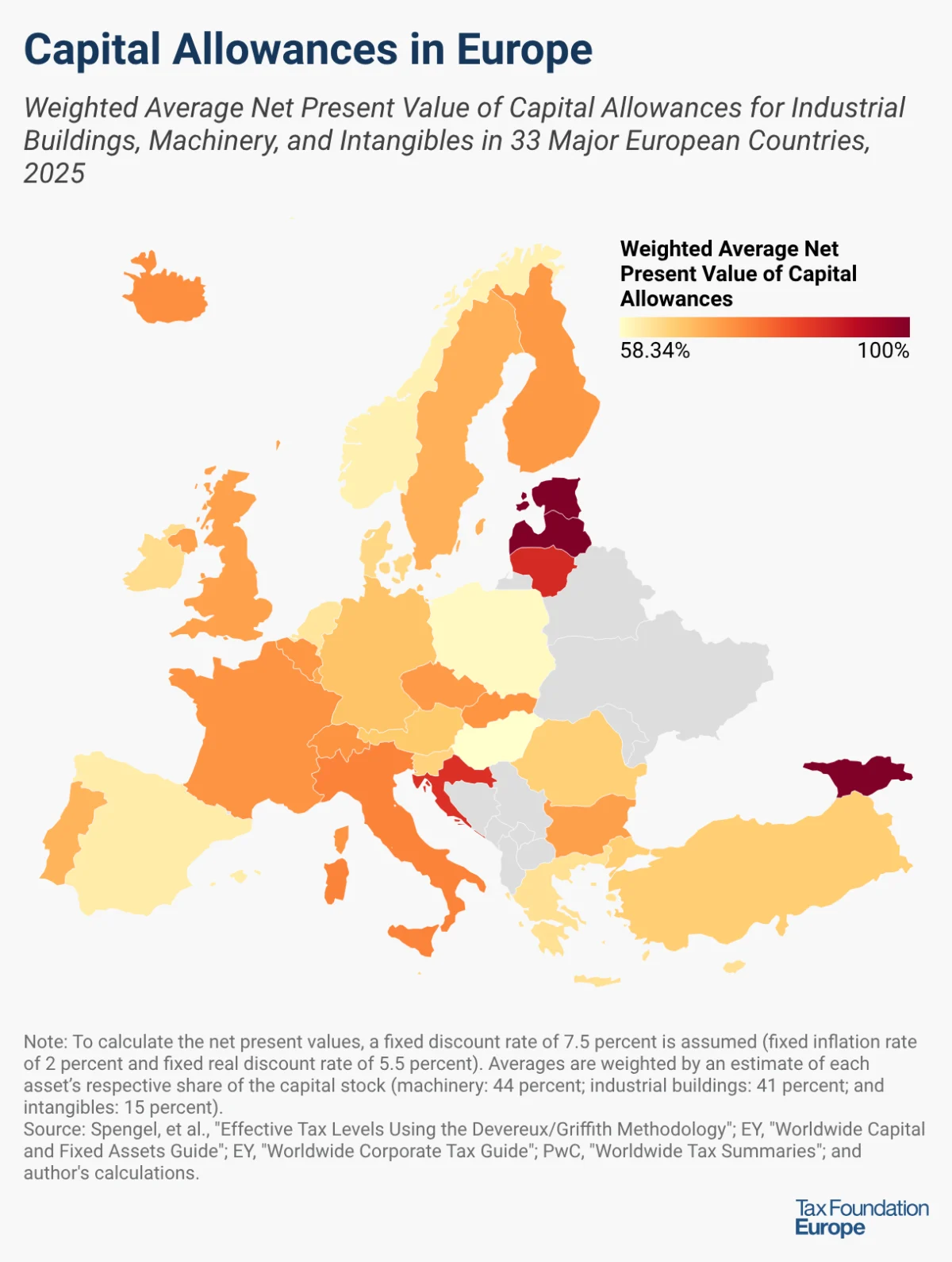
The Tax Foundation’s 2025 analysis provides a stark look at the disparity in capital cost recovery across the continent. On average, European businesses can recover 72.1 percent of the present value of their investment costs. However, this average masks significant variations based on asset type.
Asset Class Performance
- Machinery: Leading the pack, machinery enjoys the most favorable treatment, with an average recovery rate of 87 percent.
- Intangibles: Patents and "know-how" follow closely at 82.6 percent, reflecting the increasing importance of the digital and knowledge-based economy.
- Industrial Buildings: Lagging significantly behind, industrial buildings see only 52.3 percent recovery on average, creating a potential bottleneck for manufacturing expansion.
The Distribution-Based Advantage
The most competitive tax environments in Europe are found in Estonia, Latvia, and Georgia. These nations utilize a distribution-based tax system. Under this model, reinvested earnings remain untaxed, allowing for a 100 percent present value recovery of all capital investments. This structural design removes the tax burden from growth-oriented activities, positioning these nations as magnets for foreign direct investment.
Among countries using traditional corporate tax systems, Lithuania (88.2 percent), Croatia (87.2 percent), and Italy (76.3 percent) lead the rankings. Conversely, Norway (60.7 percent), Poland (59.3 percent), and Hungary (58.3 percent) offer the least favorable recovery, effectively placing a higher tax hurdle on their domestic industries.
The U.S. Context
For global perspective, it is useful to look at the United States, which currently allows for 94.5 percent recovery of capital costs. While the U.S. previously relied on temporary "bonus depreciation" (which began phasing out in 2023), it has transitioned toward a framework of permanent full expensing. Furthermore, the U.S. is currently providing 100 percent expensing for qualifying structures initiated between early 2025 and 2029, a move designed to revitalize domestic industrial capacity.
Official Perspectives and Policy Implications
The consensus among tax policy experts is increasingly clear: the design of capital allowances is a primary lever for labor productivity.
When businesses can deduct the full cost of an investment immediately, the "cost of capital" drops. This leads to a higher capital-to-labor ratio, which in turn boosts the marginal productivity of the average worker. Higher productivity is the only sustainable pathway to higher real wages.
However, many European governments remain trapped in a cycle of "temporary relief." Policy experts argue that this is suboptimal. When an incentive is set to expire, businesses often rush to complete projects before the deadline or pause investment until the next cycle of relief is announced. This "stop-start" investment cycle creates inefficiencies in supply chains and labor markets.
The recommendation from the fiscal policy community is twofold:
- Prioritize Permanent Expensing: Governments should aim to move away from temporary, fluctuating depreciation schedules in favor of permanent, full immediate expensing for machinery and equipment.
- Neutral Cost Recovery: For long-term assets where immediate expensing may be fiscally difficult to implement, tax codes should be adjusted to account for inflation and the time value of money, ensuring that the real value of the deduction is preserved over the life of the asset.
Conclusion: The Path Ahead
As European economies face global competition, the aging of their industrial bases, and the need to transition toward greener, more digital technologies, the tax treatment of investment will remain a focal point. The countries that succeed in the coming decade will likely be those that treat capital investment not as a source of immediate tax revenue, but as the essential seed for future prosperity.
By shifting the focus from short-term tax collection to long-term capital recovery, policymakers have the power to lower the barriers to innovation. Whether through the bold distribution-based models of the Baltics or the permanent full-expensing regimes gaining traction in the UK and Lithuania, the trend is clear: the future belongs to the nations that make it easiest for their businesses to build, upgrade, and grow.
